GEOMYTHAAll stories are the same story
Index Record

Ehyeh Asher Ehyeh — Exodus 3:14 / Burning Bush
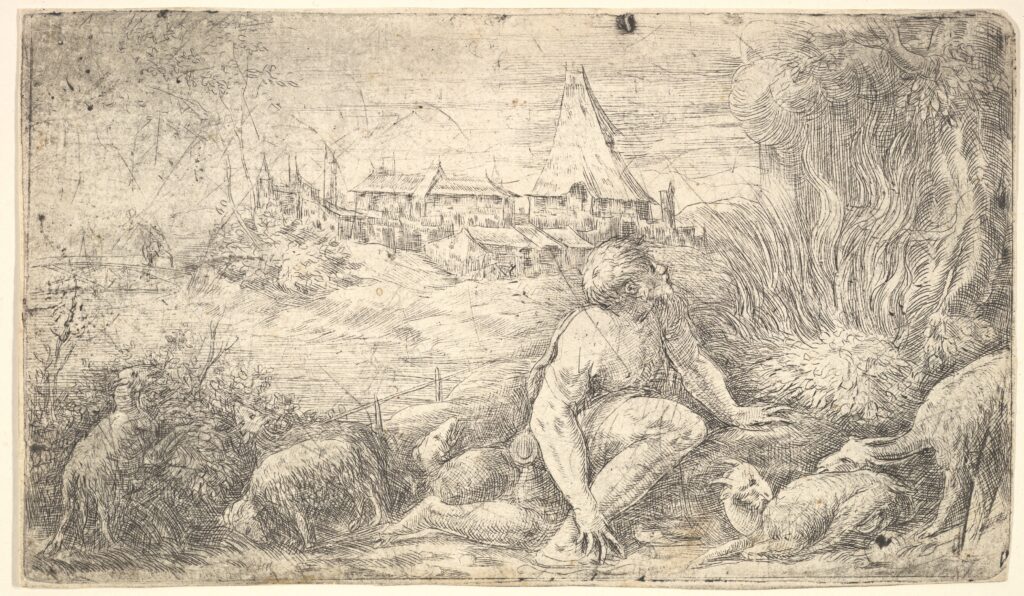
Moses and the burning bush, ca. 1544–47
Moses and the burning bush · Andrea Schiavone (Andrea Meldola) · ca. 1544–47 · The Metropolitan Museum of Art, New York · 27.78.2(26) · Public domain / The Met Open Access ↗
A distinct later image of Moses and the burning bush anchors the Exodus scene. It does not settle the translation of Ehyeh Asher Ehyeh or prove that the artist intended GEOMYTHA's being-and-claim distinction.
Conventional Reading
In Exodus 3, Moses asks what name he should give the Israelites when they ask who sent him. The reply includes the Hebrew formula Ehyeh Asher Ehyeh before Moses is instructed what to say to the Israelites.
Geomytha Reading

Geomytha uses the divine-name scene as a stress test for sacred grammar: being-language can loosen ordinary predicates, but the claimant can also appropriate the phrase as spiritual identity. The interpretive movement therefore asks whether the phrase reduces the claimant or crowns it.

Parent work / tradition / source

Exodus 3:13–15 / Moses at the burning bush

Source location / reference

Exodus 3:13–15 via The Sefaria Library.

Reading Boundary

The biblical text establishes the burning-bush scene and divine-name formula. It does not teach Geomytha’s Is–Am–I–This grammar or the proposed reduction from I Am That toward Is; those are comparative Geomytha interpretations.

Archetype stress test

Ehyeh is Hebrew verbal language within a covenantal encounter, with multiple translation traditions. An English resemblance to I/Am is not historical proof of the GEOMYTHA sentence. The full Exodus context must be allowed to resist the grammatical comparison.

Source trail

Evidence beneath the record

Exodus 3:13–15 — Ehyeh Asher Ehyeh / Divine Name
Supports the Exodus narrative and wording. It does not support Geomytha’s grammatical reduction from I/Am/That toward Is.
United States Conference of Catholic Bishops