GEOMYTHAAll stories are the same story
Index Record

Ankh — Life Sign and Crossing
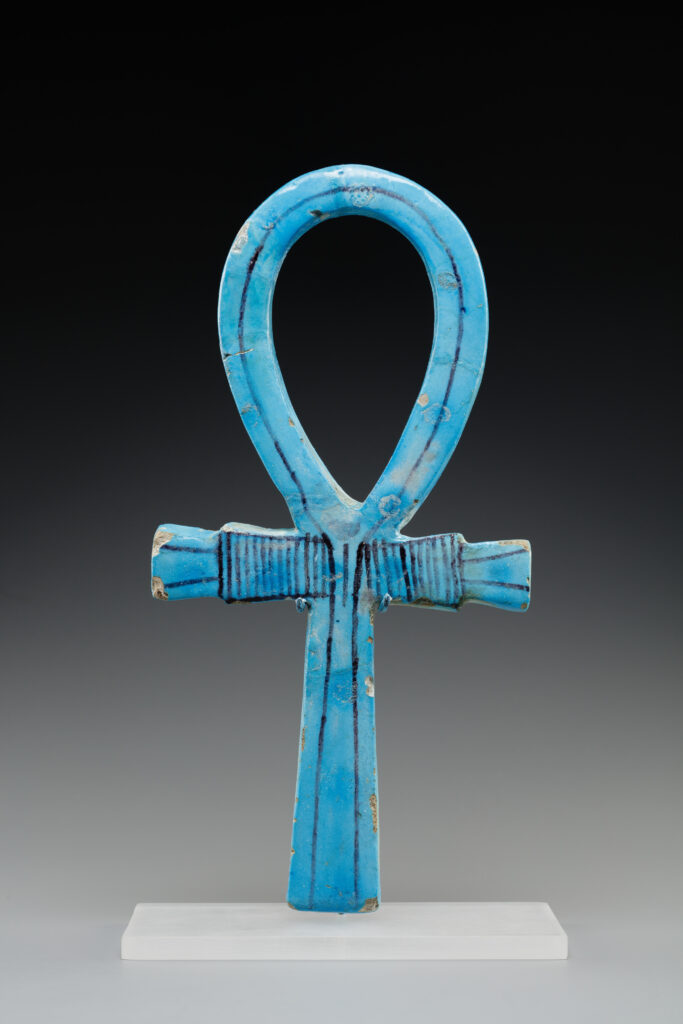
Ceremonial Implement in the Shape of an Ankh, ca. 1396–1386 BCE
Ceremonial Implement in the Shape of an Ankh · Ancient Egyptian · maker not identified · ca. 1396–1386 BCE · The Metropolitan Museum of Art, New York · 30.8.29 · Public domain / The Met Open Access ↗
An actual ankh-shaped implement anchors the discussion in Egyptian material culture. The life-sign identification belongs to its historical context; GEOMYTHA's open-crossing comparison is a separate reading and does not establish that the ankh anticipated Christian crucifixion or a modern geometric doctrine.
Conventional Reading
The Met identifies the ankh as a hieroglyph used to write “live,” “alive,” or “life,” and as a general symbol of life. Its wooden model is dated to Egypt’s Middle Kingdom, long before Christianity.
Geomytha Reading

Geomytha reads the ankh’s loop and cross-form as a comparative image of life moving through an open intersection. The essay sets this beside a reading of the crucifix as a crossing fixed into identity, using its Is–Am / I–Am–This grammar.

Parent work / tradition / source

Ancient Egyptian ankh sign; Met Model ankh, Middle Kingdom, Dynasty 12

Source location / reference

The Metropolitan Museum of Art, object 12.182.66 (Model ankh), ca. 1981–1802 B.C.

Reading Boundary

The artifact establishes the ankh’s antiquity, form, and documented life meaning. It does not demonstrate that its ancient makers intended Geomytha’s psychological grammar, that every cross bears one meaning, or that the Christian cross descends directly from this object. Those connections are comparative interpretation.

Archetype stress test

The ankh's historical meaning is life; its crossing form does not prove it secretly encodes Christian or GEOMYTHA theology. A common geometry can carry unrelated functions. Iconographic context must outweigh a visual resemblance.

Source trail

Evidence beneath the record

Model ankh — The Metropolitan Museum of Art
Primary museum collection record supports ankh chronology and the hieroglyph’s documented meanings live, alive, and life. It does not establish Geomytha’s Is/Am/I reading or direct descent of the Christian cross from this object.
The Metropolitan Museum of Art