Nile Inundation — Osirian Flood Cycle
GEOMYTHA reads the sequence of inundation, recession, sowing and germination as continuity that survives a change of visible form. It can illuminate an Osiris/AM comparison where renewal depends on relation, memory or what is carried through apparent loss. The strongest support is the documented ritual linking Osiris with germinating seed, rather than water alone. The hymn adds dependence and uncertainty: people cannot simply command the conditions that sustain them. This is not a promise that every loss produces renewal or that flooding is always beneficial. The interpretation applies to a specified agricultural and ritual sequence, not to every river or every use of the word return.
The conventional reading distinguishes hydrology, Hapy's personification and Khoiak's Osirian seed ritual. The GEOMYTHA reading compares the documented sequence with continuity through disappearance and return. Keeping those layers distinct prevents a natural cycle from being treated as proof of a universal spiritual law.
Ancient Egyptian geography, Nile agriculture and royal/religious traditions
Hymn to the Nile Flood, sections 1–3, UCL translation and source apparatus; Helck (1972), edition identified via UCL; Met 31.9.8, Satiyet linen; Met 10.130.617, Hapy scarab.
Flood, ritual and myth are related evidence, not interchangeable terms. Hapy the inundation is distinct from the son of Horus. No claim that Osiris is scientifically the river or that every disaster is restorative. Ancient annual flooding is distinguished from the modern regulated river. Frankfort remains historical bibliography, not a newly verified passage-level quotation.
Claim tested: the agricultural/ritual cycle offers an image of continuity through apparent loss. Support: Khoiak germination and burial near the recession of floodwaters. Counterexample: the hymn describes deprivation when the flood delays; renewal is conditional, not automatic. Deity test: Hapy and Osiris must not collapse into one definition. Result: retain a bounded Osirian comparison grounded in seed ritual; reject the comforting but unsupported rule that every destruction guarantees rebirth.
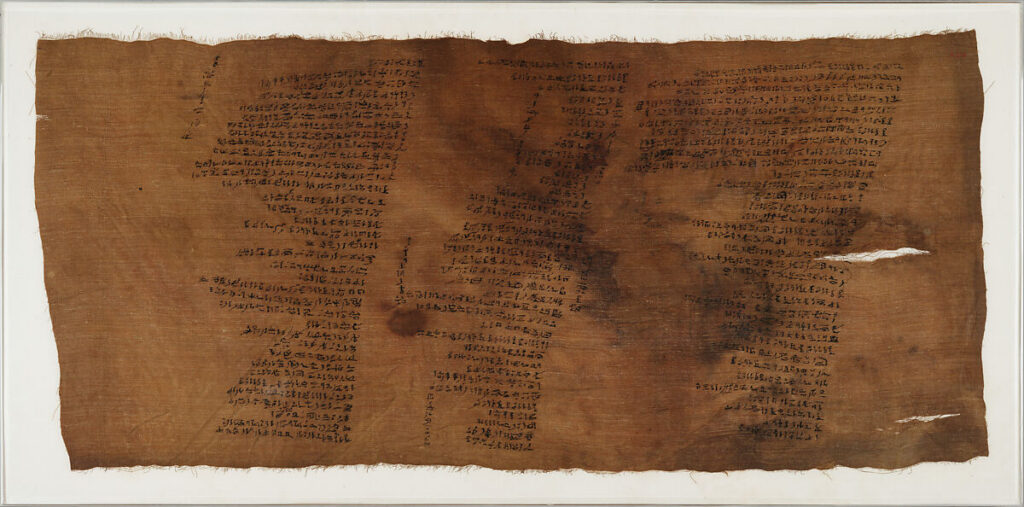
Original story and earliest witnesses: the Hymn to the Nile Flood is an anonymous primary composition transmitted in New Kingdom copies. UCL leaves its composition date uncertain, with a possible Middle Kingdom origin distinguished from surviving manuscripts. Its principal sources include Chester Beatty V, Sallier II, Anastasi VII and Turin; UCL's translation follows Helck's 1972 edition. This is an early literary witness consulted here, not claimed as the first Nile text. The later Satiyet linen, 332–30 BCE, witnesses Khoiak's ritual context; it is not a copy of that hymn. No complete original Osiris narrative is reconstructed from the linen.