Brave New World — Aldous Huxley
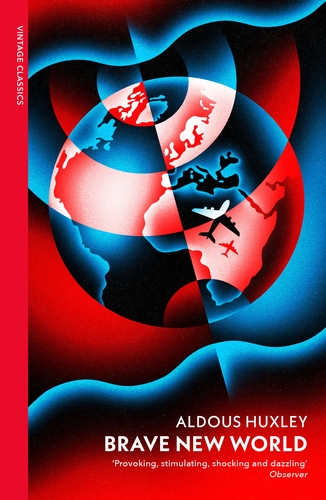
GEOMYTHA reads the promise of a finished, comfortable society as counterfeit completion when a system prevents people from questioning the terms of their satisfaction. The mechanism is not pleasure itself. It is a closed loop in which the authority that shapes desire then treats satisfied desire as proof that its order is right. The comparison applies to those institutional actions, not automatically to every reference to happiness or belonging.
The conventional work is a dystopian novel about the costs of engineered stability. GEOMYTHA names a specific closure: a world declares the human problem solved by restricting what can be wanted or questioned. Atwood’s critical introduction supplies a separately attributed examination of planned happiness, not an endorsement of this framework.
Aldous Huxley, Brave New World (1932)
Brave New World, ch.1 (hatchery/castes), ch.16 (art, science, dissent), ch.17 (comfort and freedom); online chapter transcriptions checked. Atwood’s Penguin introduction extract (2017) checked separately. No complete fresh reread or first-manuscript verification claimed.
GEOMYTHA’s comparison is distinct from source facts, attributed scholarship and creator intent. Mond’s dialogue gives the case for stability real force; rejecting coercion does not require celebrating disease or deprivation. His position is a character’s argument, not automatically Huxley’s. Pleasure, medicine and social cooperation can be beneficial without becoming instruments of closure.
Mond’s dialogue gives the case for stability real force; rejecting coercion does not require celebrating disease or deprivation. His position is a character’s argument, not automatically Huxley’s. Pleasure, medicine and social cooperation can be beneficial without becoming instruments of closure.
Original story: Huxley’s Brave New World (1932), not the graphic or television adaptations. Targeted chapter checks use later digital texts, not an authenticated first-edition facsimile or oldest surviving manuscript. No full fresh reread or exhaustive scholarly survey claimed. Brave New World, ch.1 (hatchery/castes), ch.16 (art, science, dissent), ch.17 (comfort and freedom); online chapter transcriptions checked. Atwood’s Penguin introduction extract (2017) checked separately. No complete fresh reread or first-manuscript verification claimed.