Professor Aronnax — Twenty Thousand Leagues Under the Seas
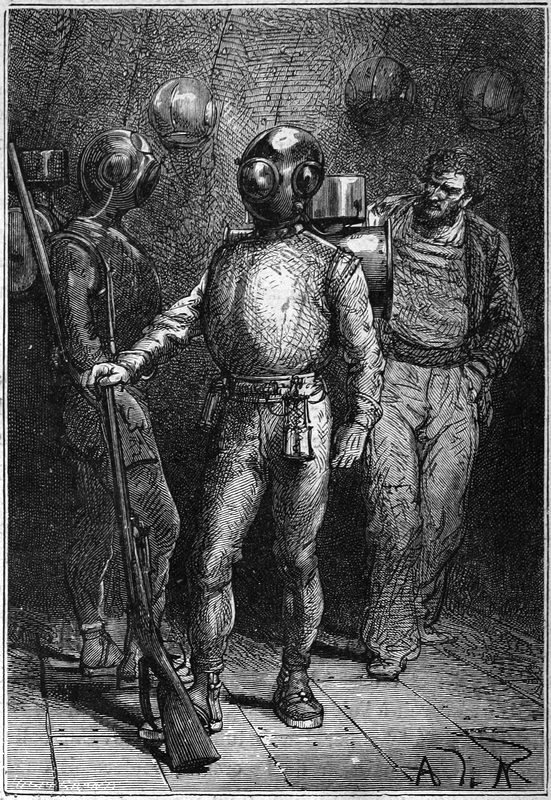
GEOMYTHA reads Aronnax’s absorption in the voyage as reflective intelligence that can describe a world accurately while postponing the question of whether it should remain there. The relevant movement is his reluctance to count the days of captivity, not the mere act of naming organisms. Observation becomes an enclosure only when fascination displaces judgment and consent.
The source narrator’s science yields genuine knowledge and changes when evidence corrects him. GEOMYTHA isolates the moments where intellectual fascination excuses captivity; it does not equate learning or reflection with delusion.
Jules Verne, Twenty Thousand Leagues Under the Seas
Gutenberg 54873, I.2–4 (hypothesis and expedition), I.8–13 (submarine and facilities), I.16 (underwater excursion), II.4 (attachment to voyage), II.22–23 (escape and account).
GEOMYTHA’s conditional literary comparison is distinct from the novel’s documented events and from any claim of Verne’s intention. No character is assigned a universal identity or diagnosis. His recognition of the submarine corrects the monster hypothesis, and his eventual escape disproves an absolute claim that he cannot act. His medical care and observations have practical value. This is a changing narrative tension, not a permanent archetypal diagnosis.
His recognition of the submarine corrects the monster hypothesis, and his eventual escape disproves an absolute claim that he cannot act. His medical care and observations have practical value. This is a changing narrative tension, not a permanent archetypal diagnosis.
Original story: Jules Verne’s Vingt mille lieues sous les mers, not a screen adaptation. The checked French text is Project Gutenberg 54873, with the early Hetzel illustrations; BnF catalogues the illustrated Paris volume as [1871]. This source is an accessible early illustrated witness, not a claim to the oldest surviving manuscript or a verified first-serial transcription. Targeted passages were checked for this record. Gutenberg 54873, I.2–4 (hypothesis and expedition), I.8–13 (submarine and facilities), I.16 (underwater excursion), II.4 (attachment to voyage), II.22–23 (escape and account).