GEOMYTHAAll stories are the same story
Index Record

The Eighth Day — Completion Reopened
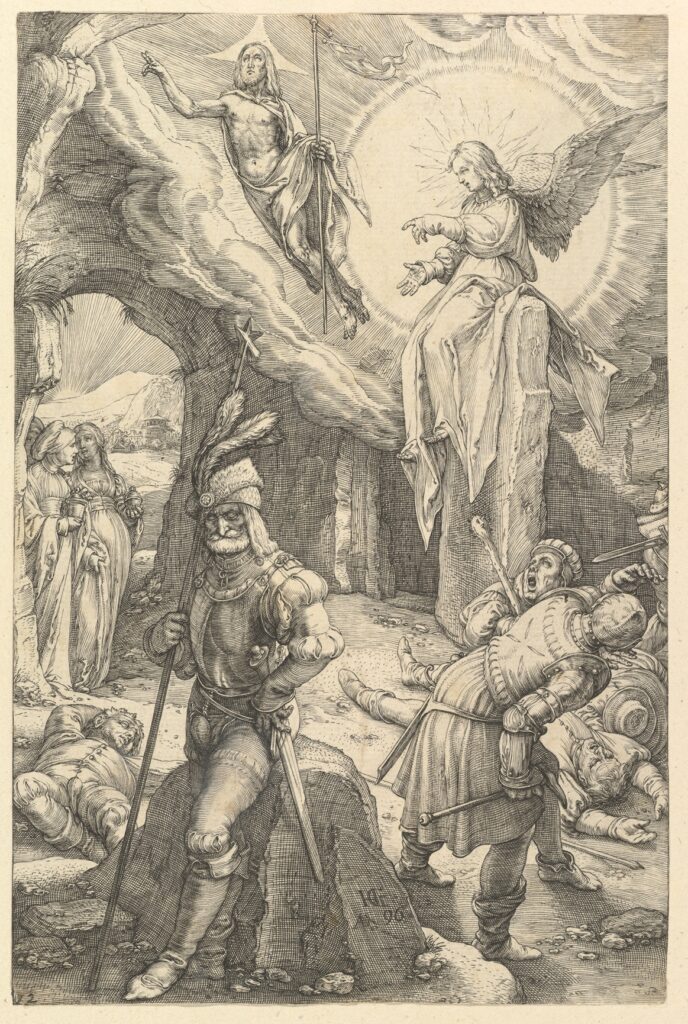
The Resurrection, from "The Passion of Christ", 1596
The Resurrection, from "The Passion of Christ" · Hendrick Goltzius · 1596 · The Metropolitan Museum of Art, New York · 51.501.167(12) · Public domain / The Met Open Access ↗
This later Christian Resurrection image supplies a concrete visual anchor for the eighth-day comparison. GEOMYTHA's completion-and-reopening reading remains distinct from Christian resurrection theology; the print is not evidence for a universal numerological system.
Conventional Reading
Early Christian writers used the eighth day as a resurrection symbol beyond the completed seven-day week. Augustine explicitly calls the eighth day a type of resurrection. The Lateran Baptistery’s official history states that its octagonal form traditionally recalls the eighth day and the risen Christ.
Geomytha Reading

In Geomytha, the Eighth Day is Return after completed seven. Seven closes the visible order; eight reopens it. The eighth day marks consciousness passing beyond completion rather than merely repeating the completed cycle. Resurrection therefore becomes the image of a closed world losing its finality and opening again toward source.

Why the Difference Matters

Historically, early Christian writers use the eighth day as a resurrection symbol beyond the completed seven-day week. Geomytha extends that symbolism into its return grammar: completion is not the end when the completed order can reopen toward source.

Parent work / tradition / source

Christian liturgical and resurrection symbolism

Source location / reference

Augustine, Letter 55; Lateran Baptistery institutional history.

Reading Boundary

The historical Christian eighth-day symbolism is documented. Geomytha’s use of it as a general mechanism of closed-cycle reopening is interpretive.

Archetype stress test

Christian eighth-day symbolism is explicitly theological and tied to resurrection. It need not mean GEOMYTHA's release from a claimant. An eight-sided building alone is insufficient evidence without the relevant tradition or interpretation.

Source trail

Evidence beneath the record

The Eighth Day and Resurrection — Augustine, Letter 55
Primary patristic evidence for historical Christian eighth-day symbolism. Geomytha’s closed-cycle/reopening mechanism is interpretive.
New Advent / public-domain patristic translation
Lateran Baptistery — Octagon and the Eighth Day
Authoritative institutional source for the architecture/symbol relationship.
Vatican basilicas