Minos — King of Crete
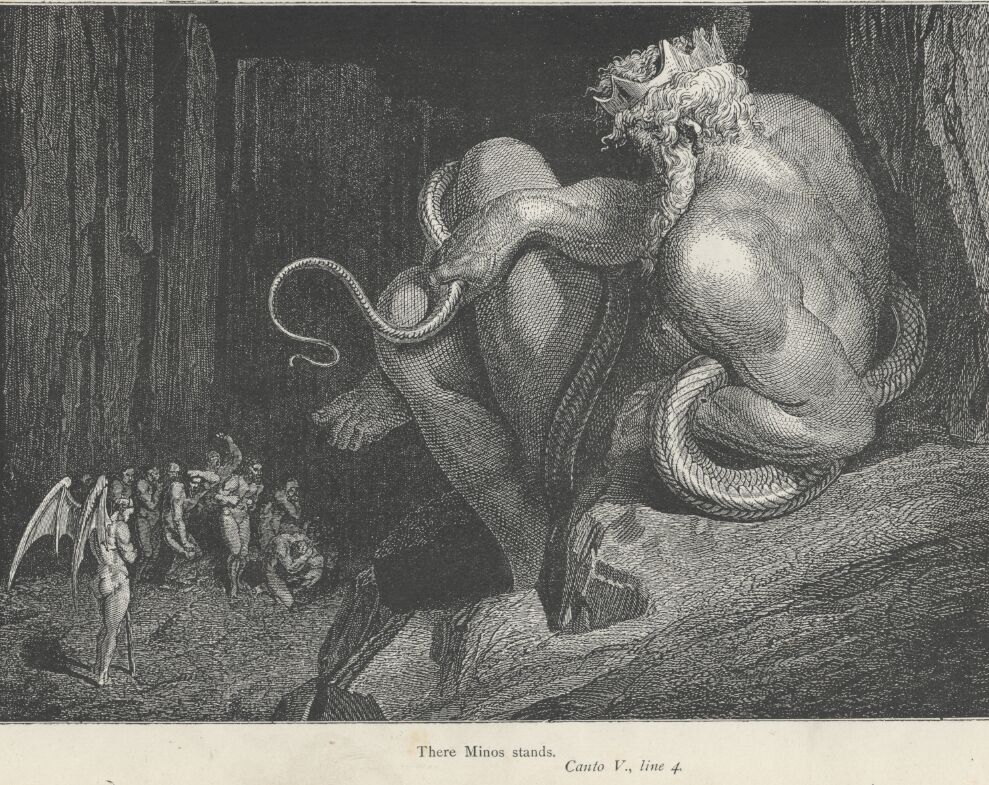
GEOMYTHA reads the substituted sacrifice as a separation of public claim from accepted obligation. Minos receives the sign he requested and obtains authority, yet retains what he promised to relinquish. The esoteric application lies in that sequence: a received sign becomes something the claimant treats as his to keep while preserving the benefit it brought.
In GEOMYTHA's grammar, the pressure of I is the act of claiming authority; THIS describes the stabilized identity that presents that authority as settled. These functions are applied to Minos's conduct, not to whichever pronoun a translation happens to use. The reading is strongest at the substitution itself. It cannot make every royal office, divine sign or act of ownership inherently false, and it must leave room for the just ruler and judge preserved elsewhere in the tradition.
The classical source narrates a breached sacrificial promise and its consequences. GEOMYTHA adds a distinction between receiving a sign and treating its authority as private possession. Homer's judge and Plutarch's conflicting reputations limit a single tyrant archetype.
Greek traditions of Minos; Pseudo-Apollodorus, Library 3.1.3–4; compare Diodorus 4.77 and Homer, Odyssey 11.
Library 3.1.3–4: kingship sign, vow and substituted bull. Diodorus 4.77.2: a different herd-bull premise. Odyssey 11.568–571: Minos judging the dead. Plutarch, Theseus 16: rival reputations.
GEOMYTHA's vocabulary of claim, identity, relation and return is a comparative reading, not an ancient author's stated doctrine or a proven Egyptian origin. Ordinary occurrences of “this,” “these,” “all” or “I” do not establish the esoteric layer. Identify a narrated action before applying a function. Greek and Roman authors preserve incompatible variants; the records do not combine them into one original account. Mythic punishment is a feature of the story, not evidence of inherited moral guilt, disability as evil, or the justice of harming another person. Ancient narrative, modern scholarship, artwork and GEOMYTHA interpretation remain distinct. No proof of a historical Minos, literal maze or human-sacrifice practice is claimed. Targeted passages and selected scholarship were checked, not all manuscripts or every scholarly reference.
Proposed mechanism: benefiting from a received sign while evading the obligation attached to it. Positive test: Pseudo-Apollodorus 3.1.3 expressly links the requested bull, kingship, promise and substitution. Counterexamples: Odyssey 11.568–571 depicts Minos judging the dead; Plutarch Theseus 16 contrasts hostile theatrical portrayals with royal and legislative traditions. Diodorus 4.77 describes a bull born in the herd, so the sea-sign premise is version-specific. Kingship itself does not prove illegitimate claim. Poseidon's retaliation through Pasiphae and the child's fate cannot be endorsed as a just punishment or evidence that the child inherits guilt.
There is no recoverable single original Minos biography. Early surviving literary witnesses include Homeric poetry: Odyssey 11.568–571 shows the judge of the dead, while 11.321–325 names Minos through Ariadne. These are earlier than the later continuous bull/Labyrinth accounts and do not recount that entire plot. Diodorus 4.77 and Pseudo-Apollodorus 3.1.3–4 provide different sacrificial premises. Plutarch preserves additional earlier authors through later testimony. Oral composition, later manuscripts and modern translations are different dates; the oldest physical witness of each passage was not inspected.