Ariadne’s Thread
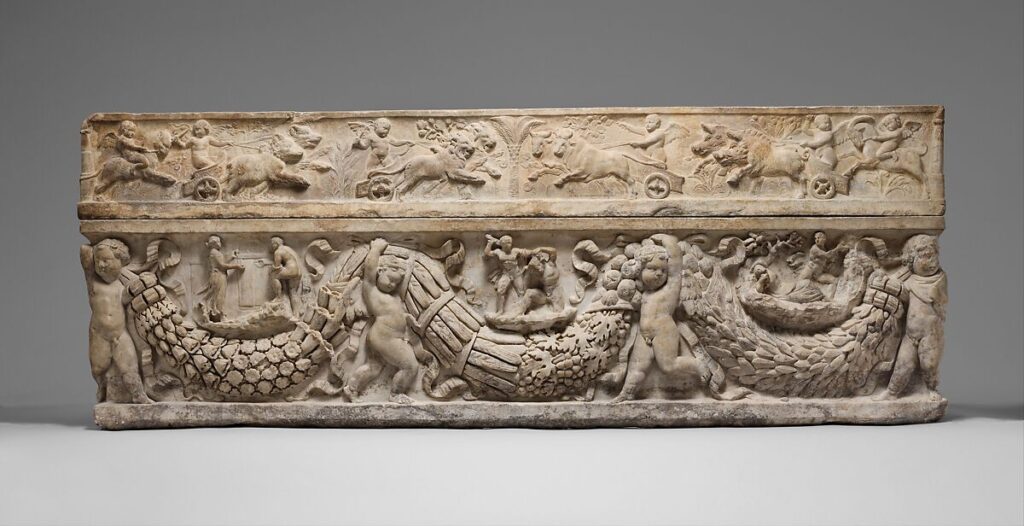
GEOMYTHA reads the thread as a maintained connection between entering a difficult structure and finding a way out. The mechanism is concrete: Theseus preserves a trace of the route rather than trusting victory alone to supply his return. Ariadne's intervention and Daedalus's knowledge also prevent the hero from appearing self-sufficient.
The thread's practical success is not the same as fulfilled relation. Ariadne's own future differs sharply across sources, and the abandonment tradition makes the limit especially clear: a man can follow the route back while failing the person who made that route possible. GEOMYTHA therefore distinguishes navigation, memory and fidelity. A preserved line can enable return without guaranteeing care, liberation or moral completion.
The source gives a navigational device and a negotiated act of help. GEOMYTHA reads it as continuity that resists disorientation, while Ariadne's divergent fates test the stronger claim that successful escape necessarily restores relationship.
Ariadne and Theseus traditions; Pseudo-Apollodorus, Epitome 1.8–10; Plutarch, Theseus 19–20; compare Homer, Iliad 18 and Odyssey 11.
Epitome 1.8–9: Ariadne seeks Daedalus's advice and gives the thread; 1.10: further consequences. Plutarch Theseus 19–20: thread and divergent fates. Iliad 18.590–606: dance; Odyssey 11.321–325: Ariadne's different fate. Met 90.12a,b.
GEOMYTHA's vocabulary of claim, identity, relation and return is a comparative reading, not an ancient author's stated doctrine or a proven Egyptian origin. Ordinary occurrences of “this,” “these,” “all” or “I” do not establish the esoteric layer. Identify a narrated action before applying a function. Greek and Roman authors preserve incompatible variants; the records do not combine them into one original account. Mythic punishment is a feature of the story, not evidence of inherited moral guilt, disability as evil, or the justice of harming another person. Ancient narrative, modern scholarship, artwork and GEOMYTHA interpretation remain distinct. No proof of a historical Minos, literal maze or human-sacrifice practice is claimed. Targeted passages and selected scholarship were checked, not all manuscripts or every scholarly reference.
Claim tested: a maintained trace enables a return. Strongest evidence: the thread fixed at the entrance and recovered in Epitome 1.8–9. Counterexample: practical escape need not fulfill Ariadne's hopes or the marriage bargain; abandonment variants expose this distinction. Pseudo-Apollodorus instead has Dionysus take her away, and Homer gives her death on Dia, so no ending may be silently substituted for another. Ariadne is an agent who secures advice and negotiates help, not just an accessory to a male hero. The reading does not prove a universal feminine guide, an Egyptian identity, or a mystical meaning of every thread.
Early Homeric references are included for chronological honesty: Iliad 18.590–606 associates Ariadne and Daedalus with a dance; Odyssey 11.321–325 reports her death. Neither passage supplies the complete familiar thread rescue. Later continuous narratives and Plutarch's testimony to earlier authors preserve the guiding thread and competing outcomes. The ca.130–150 CE sarcophagus depicts a Roman narrative sequence. The earliest physical manuscript or absolute first occurrence of the thread motif was not established; these accessible witnesses are not labeled the lost original.