Anubis — Egyptian Funerary Deity
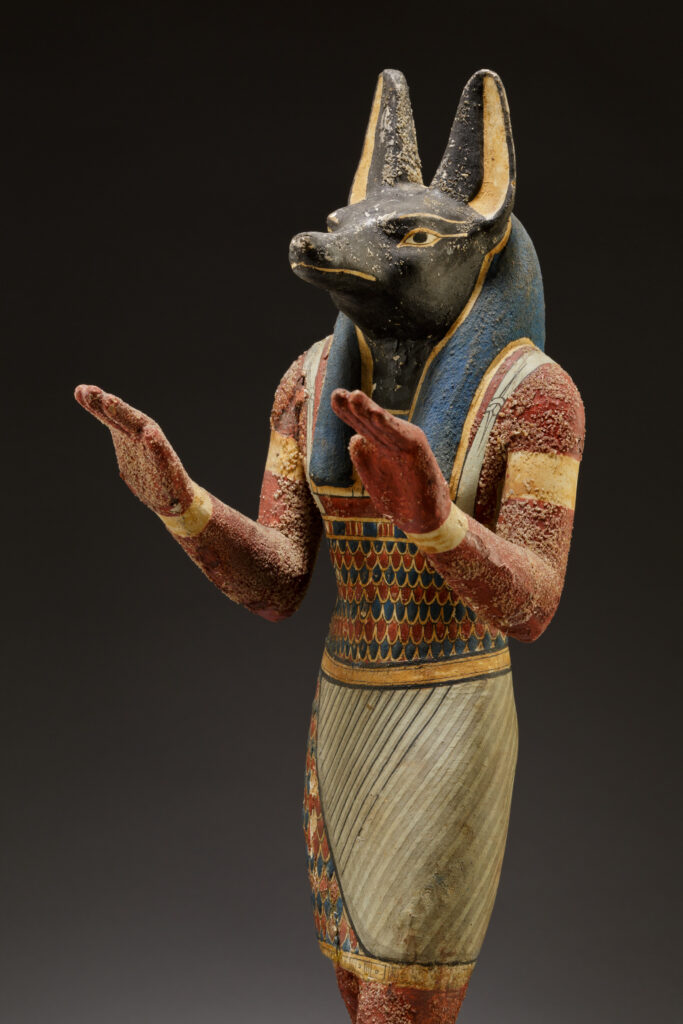
In Geomytha, Anubis functions at the threshold of reckoning. He does not stand for the claimant's story about itself; he accompanies the heart to the place where the story must submit to measure. The symbolic motion is therefore from defended identity toward exposure: This is brought into relation with a standard it cannot manipulate merely by narration.
Anubis is historically an Egyptian funerary deity associated with embalming, guidance of the dead, and judgment imagery. Geomytha reads his role in the weighing scene as a threshold function within its return grammar; that mapping is interpretive and does not replace Egyptological meaning.
Ancient Egyptian funerary and mortuary traditions
Ancient Egyptian funerary traditions concerning Anubis, including embalming, protection of the dead, and participation in judgment imagery such as the weighing of the heart.
Mythic figure; historical meaning separate from Geomytha mapping.
Anubis's embalming, protective and judgment functions exceed one modern witnessing role. A canine form does not make all guide dogs Anubis. The comparison requires the actual funerary or weighing action.
The surviving Egyptian record begins with ritual and fragmentary witnesses, not one recoverable original story. The late Fifth-Dynasty Pyramid Texts provide the early inscribed corpus; Middle Kingdom Lahun fragments preserve an early extensive Horus–Seth struggle. Plutarch's On Isis and Osiris, written much later in the Roman period, supplies a connected narrative. Compare versions rather than attributing Plutarch's complete sequence to the earliest inscriptions. GEOMYTHA's grammatical assignments are modern comparisons.