Nautilus — Twenty Thousand Leagues Under the Seas
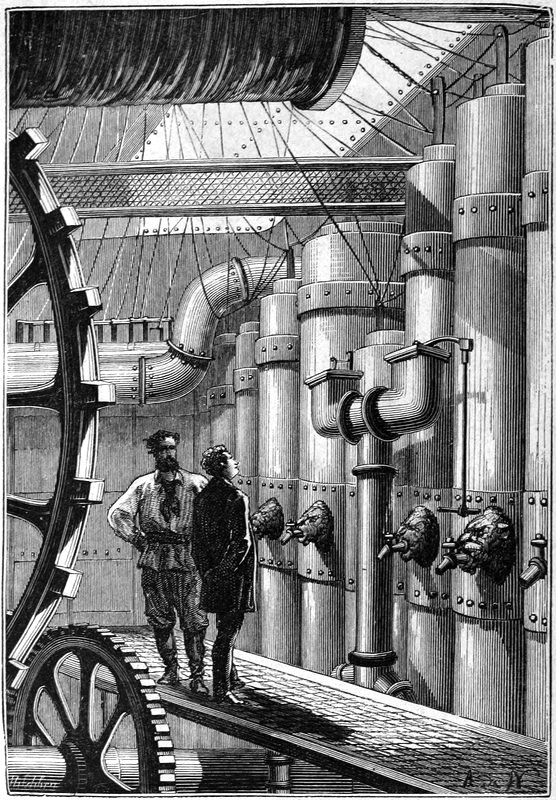
GEOMYTHA reads the Nautilus as a constructed identity-world where technical mastery can make dependence and captivity appear like complete independence. Its interpretive force lies in the contrast between Nemo’s freedom of movement and his passengers’ inability to choose departure. The vessel is a substitute kingdom when its order protects one ruler’s unresolved grievance from challenge.
Conventionally the source vessel embodies technological imagination with both beneficial and destructive uses. GEOMYTHA adds a distinction between an enabling structure and a closed identity: engineering alone does not make a prison; denied consent does.
Jules Verne, Vingt mille lieues sous les mers (original French novel; early illustrated Hetzel edition)
Gutenberg 54873, I.8–13 (captivity, ventilation, rooms and machinery); II.3 (rescue), II.16 (air crisis), II.21–23 (attack, escape and unresolved fate).
GEOMYTHA’s conditional literary comparison is distinct from the novel’s documented events and from any claim of Verne’s intention. No character is assigned a universal identity or diagnosis. The Nautilus saves lives, houses knowledge and requires outside air. These details challenge both ‘all technology is imprisonment’ and literal self-sufficiency. Its weaponization and compulsory residence support only a conditional enclosure reading.
The Nautilus saves lives, houses knowledge and requires outside air. These details challenge both ‘all technology is imprisonment’ and literal self-sufficiency. Its weaponization and compulsory residence support only a conditional enclosure reading.
Original story: Jules Verne’s Vingt mille lieues sous les mers, not a screen adaptation. The checked French text is Project Gutenberg 54873, with the early Hetzel illustrations; BnF catalogues the illustrated Paris volume as [1871]. This source is an accessible early illustrated witness, not a claim to the oldest surviving manuscript or a verified first-serial transcription. Targeted passages were checked for this record. Gutenberg 54873, I.8–13 (captivity, ventilation, rooms and machinery); II.3 (rescue), II.16 (air crisis), II.21–23 (attack, escape and unresolved fate).