GEOMYTHAAll stories are the same story
Index Record

Revelation — Book of Revelation
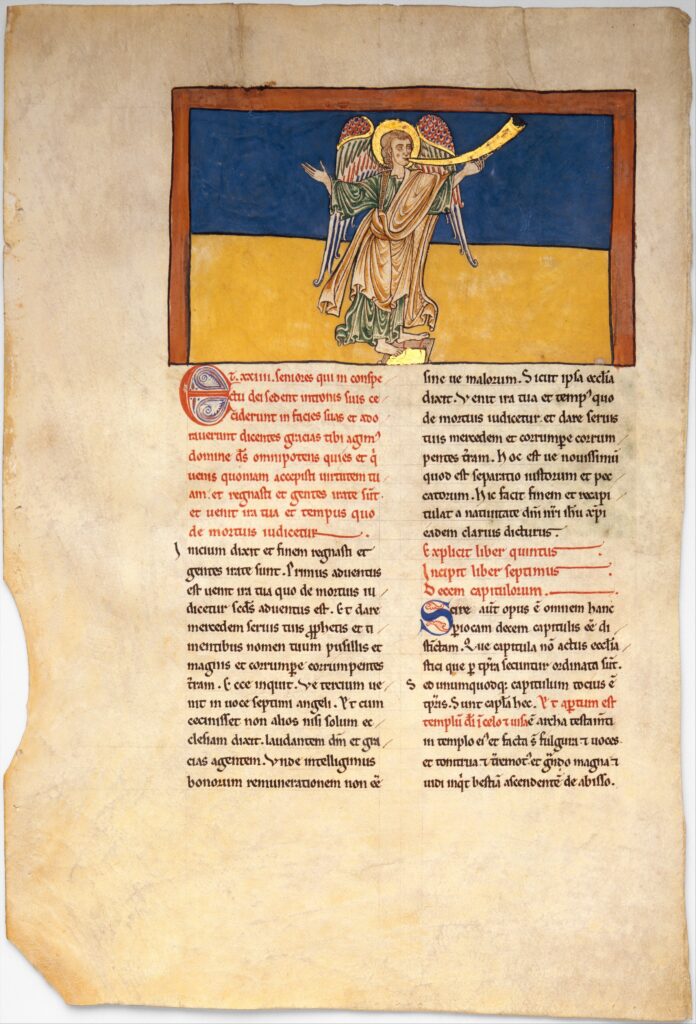
Spanish Beatus manuscript illumination of the Seventh Angel proclaiming the reign of the Lord from the Book of Revelation
Leaf from a Beatus Manuscript: the Seventh Angel Proclaims the Reign of the Lord · Anonymous / Spanish Beatus manuscript tradition · ca. 1180 · The Metropolitan Museum of Art, The Cloisters · CC0 / Public Domain Dedication ↗
Work-level Revelation image from the Beatus manuscript tradition, chosen to represent the Apocalypse broadly without duplicating the specific Revelation 13 fire-from-heaven scene.
Conventional Reading
The final book of the Christian New Testament, also called the Apocalypse of John.
Geomytha Reading

In Geomytha, Revelation supplies the terminal fire-image for the attention cycle. The lake of fire and second death are read not as the fire that creates the vessel, and not as the claimed fire that expands identity, but as exposure after All This has reached its limit. Second Death Fire burns the false claim to permanence: the beast-system, enemy-field, and hardened identity can no longer continue merely because they have learned to perpetuate themselves.

Why the Difference Matters

The Book of Revelation is a Christian apocalyptic text with its own historical, theological, and literary contexts. Geomytha's First Fire / claimed fire / Second Death Fire sequence is an interpretive framework applied to specific Revelation imagery; it is not presented as the book's sole or explicit doctrinal meaning.

Parent work / tradition / source

Book of Revelation / Apocalypse of John

Source location / reference

Book of Revelation, especially chapters 13 and 19–21 for beast, fire, second death, judgment, and final-order imagery.

Reading Boundary

Specific claims must be tied to passages; Geomytha’s fire grammar is interpretive.

Archetype stress test

Revelation addresses ancient churches through imperial, theological and apocalyptic imagery. An interior reading does not exhaust that setting. Repeated cycles need not form one linear private awakening, and early fragments do not preserve all chapters.

Original story and earliest witnesses

Revelation is an ancient Greek apocalypse addressed to seven churches. No authorial autograph survives. Papyrus 98 is catalogued as a possible second-century fragment and does not preserve every chapter; the fourth-century Codex Sinaiticus provides the earliest complete surviving New Testament witness. Consult the chapter's full biblical text alongside these witnesses and historical-critical scholarship. The GEOMYTHA interior reading does not replace the book's ancient social, imperial and theological setting.

Source trail

Evidence beneath the record

Hesiod, Theogony — Prometheus, fire and Zeus’s thunderbolt
Primary ancient literary anchor in a public-domain English translation. Geomytha’s distinction between gift, theft, claim, First Fire, and returned fire is interpretive.
Perseus Digital Library
Prometheus Making Man and Animating Him with Fire from Heaven — National Gallery of Art
Authoritative museum source for Prometheus/fire iconography. Geomytha’s First Fire / claimed fire distinction is interpretive.
National Gallery of Art
Revelation 13:13 — Fire from Heaven
Textual reference for the passage. Geomytha’s distinction between true fire and counterfeit spectacle is interpretive.
Bible Gateway
Codex Sinaiticus — earliest complete surviving New Testament
Primary text, manuscript catalogue or academic institutional reference. The historical evidence and GEOMYTHA comparative reading must remain distinct.
Codex Sinaiticus Project / British Library and partner institutions
Revelation 1 — Papyrus 98 manuscript witness
Primary text, manuscript catalogue or academic institutional reference. The historical evidence and GEOMYTHA comparative reading must remain distinct.
Center for the Study of New Testament Manuscripts
Revelation — Apocalyptic and Resistance
Primary text, manuscript catalogue or academic institutional reference. The historical evidence and GEOMYTHA comparative reading must remain distinct.
Dale B. Martin / Yale University