Poseidon — Greek Sea God
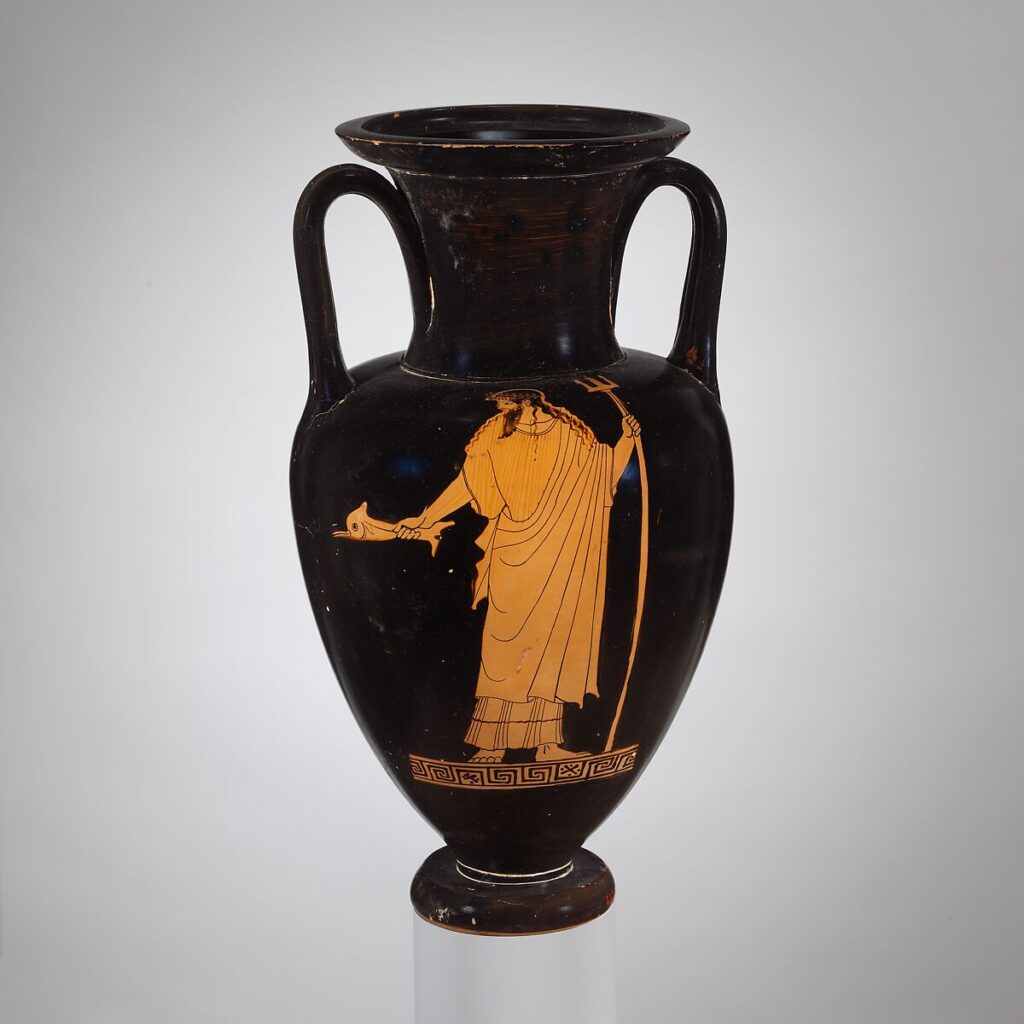
GEOMYTHA reads the bull episode as a test of whether a ruler acknowledges the conditions attached to his authority. Minos treats a promised offering as his own possession; Poseidon's response exposes that claim as dependent rather than self-created. The relevant movement is from received authority to the assertion of ownership and then to the consequences of that assertion. Poseidon remains an acting divine character, not an empty source-field. Within this limited comparison, the royal claim resembles AM becoming fixed as THIS; the episode does not establish Poseidon as an Egyptian god, an English pronoun, or a universally benevolent source.
The conventional account identifies a broken vow and divine retaliation. The comparative reading asks how a ruler turns borrowed legitimacy into possession. Keeping those levels separate permits a useful account of authority without pretending the Greek narrator taught GEOMYTHA grammar.
Ancient Greek religion and the Cretan/Theseus myth cycle; distinct ancient accounts and later reception
Homeric Hymn 22.1–7; Pseudo-Apollodorus, Library 3.1.3–4; Met 41.162.17.
Editorial comparison confined to the specified bull narrative. Divine retaliation is not endorsed as justice, especially where Pasiphaë suffers for Minos's decision. No Greek–Egyptian identity, etymology, scientific cosmology or universal water symbolism is established.
Claim tested: Poseidon marks a limit on Minos's self-authorizing claim. Supporting scene: requested bull, promised sacrifice and substitution. Counterexample: Hymn 22 presents a god petitioned for safe passage, not merely a punisher. Ethical limit: suffering imposed on Pasiphaë cannot be excused as necessary spiritual instruction. Result: retain the vow/possession comparison locally; reject the claim that Poseidon always means an impersonal source or that retaliation proves moral perfection.
Original story and earliest witnesses: Homeric poetry and the Homeric Hymns preserve early Greek representations of Poseidon, but the hymn collection is composite and this review does not identify Hymn 22's absolute date. For the connected Minos–bull sequence, consult the later surviving synthesis in Pseudo-Apollodorus, Library 3.1.3–4, rather than calling it an eyewitness Bronze Age account. The hymn is translated by Evelyn-White (1914); Library by Frazer (1921). Ancient composition, surviving manuscript and modern translation dates are different matters.