GEOMYTHAAll stories are the same story
Index Record

Theseus — Hero of the Labyrinth
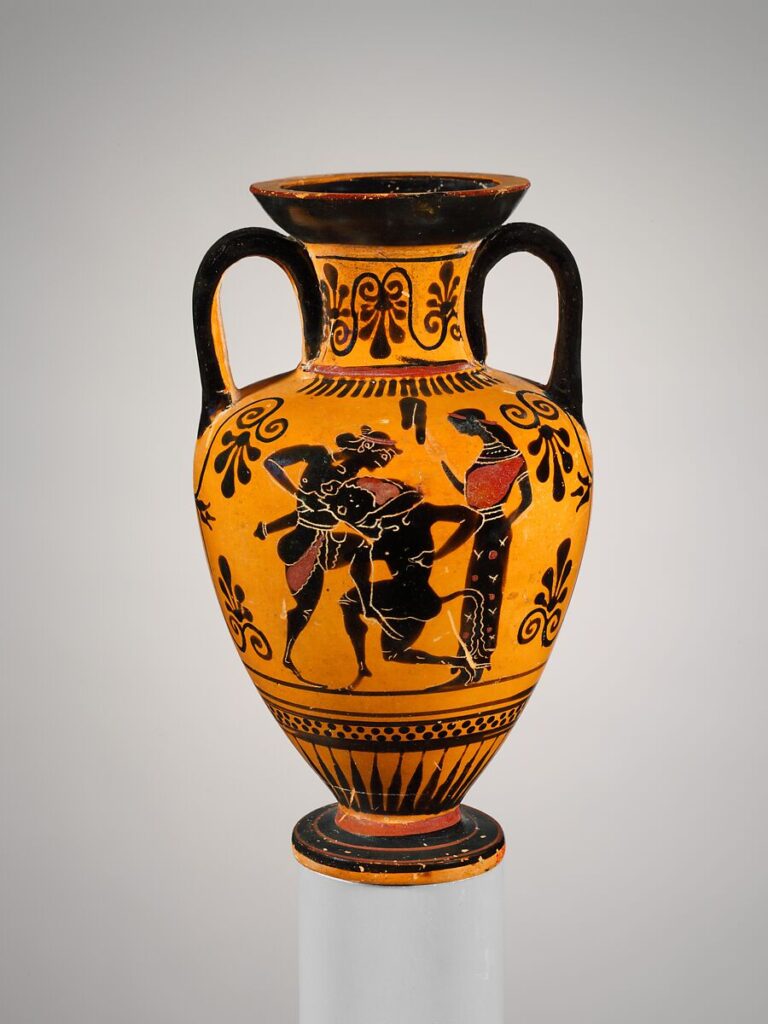
Theseus fighting the Minotaur beside a woman identified by the museum as Ariadne, with uncertainty.
Terracotta neck-amphora, Theseus and the Minotaur; Met 21.88.92 · Attributed to the Edinburgh Painter; Greek, Attic · ca. 500 BCE · The Metropolitan Museum of Art · Public Domain — The Met Open Access ↗
Ancient image of the fight. The accompanying woman is identified by the museum as Ariadne (?), with uncertainty retained.
Conventional Reading
Theseus is the Athenian hero who kills the Minotaur and escapes the Labyrinth with Ariadne's assistance in familiar ancient accounts. The surviving traditions disagree about details, including Ariadne's fate. Plutarch preserves competing tellings rather than one uniform biography; later Athenian art and politics develop Theseus as a civic hero.
Geomytha Reading

GEOMYTHA reads the Labyrinth episode as effective action that depends on relationship and remembered guidance. Courage confronts the immediate threat, while Ariadne's aid and the route of return make escape possible. The monster's defeat is a real rescue; acknowledging that benefit does not make the hero infallible. The thread prevents achievement from being mistaken for self-sufficiency. Later troubles and conflicting Ariadne traditions ask whether a victorious identity can sustain obligations after the crisis. The useful contrast is between a deed that frees people and the larger claim that its performer is therefore complete. Theseus is not automatically Horus or THIS merely because a reader can call him a hero.

Why the Difference Matters

The conventional reading describes the ancient narrative and its surviving variants. The GEOMYTHA reading offers a separate symbolic comparison: The plot celebrates a successful intervention. The comparative reading examines the dependence and limits inside that success. It preserves the rescue while questioning the conversion of one achievement into a total identity.

Parent work / tradition / source

Ancient Greek myth and its reception

Source location / reference

Odyssey 11.321–325; Pseudo-Apollodorus, Epitome 1.7–15; Plutarch, Theseus 15–20; Greene (2009); Street (2015), selected pp. 70–73; Met 21.88.92.

Reading Boundary

No single Ariadne ending is imposed on all sources. Heroism does not excuse abandonment, abduction or violence in other episodes. Mythic biography is distinct from the historical political use of Theseus; comparisons do not prove Egyptian derivation.

Archetype stress test

Claim tested: heroic action needs guidance and does not guarantee complete ethical transformation. Supporting scene: Ariadne's aid and escape. Counterexample: Theseus genuinely ends the immediate danger; calling every victory another trap would erase the story's stakes. Variant test: Ariadne's fate differs, so abandonment cannot be the only proof. Scholarly check: Greene on civic imagery and Street on Plutarch's competing systems of meaning complicate a timeless fixed archetype. Result: retain a bounded reading of dependent action, not a verdict that all heroes fail.

Original story and earliest witnesses

Original story and earliest witnesses: Homeric passages preserve early references to Theseus and Ariadne, notably Odyssey 11.321–325; they do not supply the entire later Labyrinth plot. Pseudo-Apollodorus, Epitome 1.7–15, and Plutarch, Theseus 15–20, give fuller surviving accounts with disagreements. The ca. 500 BCE amphora is an early visual witness to the fight, not a literal illustration commissioned for either later text. Greene's museum essay and selected pages of Street's 2015 dissertation supply modern interpretive context; no exhaustive bibliography is claimed.

Source trail

Evidence beneath the record

Pasiphaë — Greek Mythology — Theoi
Reference page compiling ancient literary attestations; use ancient citations listed on the page for claim-level verification.
Theoi Project
Pseudo-Apollodorus — Minos, the bull and the Labyrinth
Supports the specified text, textual variant or attributed scholarship. Does not establish GEOMYTHA's comparative reading as ancient doctrine or prove the events happened historically.
The Library 3.1.3–4 and Epitome 1.7–15; Theoi Classical Texts Library
Homer — early witnesses for Ariadne, Daedalus and Minos
Supports the specified text, textual variant or attributed scholarship. Does not establish GEOMYTHA's comparative reading as ancient doctrine or prove the events happened historically.
Iliad 18.590–606; Odyssey 11.321–325 and 11.568–571; Theoi text editions
Plutarch — Theseus, Ariadne and competing Cretan traditions
Supports the specified text, textual variant or attributed scholarship. Does not establish GEOMYTHA's comparative reading as ancient doctrine or prove the events happened historically.
Life of Theseus 15–20; Loeb edition via LacusCurtius, University of Chicago
Joel Martin Street — Atypical Lives: Systems of Meaning in Plutarch's Theseus-Romulus
Supports the specified text, textual variant or attributed scholarship. Does not establish GEOMYTHA's comparative reading as ancient doctrine or prove the events happened historically.
PhD dissertation in Classics, University of California, Berkeley, 2015
Andrew Greene — Theseus, Hero of Athens
Supports the cited passage, argument or object. GEOMYTHA's symbolic reading is a separate editorial interpretation, not established ancient doctrine.
Metropolitan Museum of Art, Heilbrunn Timeline of Art History; August 2009
Met 21.88.92 — Theseus and the Minotaur amphora
Supports the cited passage, argument or object. GEOMYTHA's symbolic reading is a separate editorial interpretation, not established ancient doctrine.
Metropolitan Museum of Art, collection catalogue