Athens — Ancient Greek City-State
GEOMYTHA reads Athens in the tribute episode as the community that bears the recurring cost of another ruler's settlement. A political demand converts living people into counted offerings; the city must reproduce that arrangement until an intervention interrupts it. The mechanism is an imposed collective identity: a community becomes legible to power as what it owes. This reading applies to Athens in that narrative situation, not to every Athenian across time. A further test asks how a community remembers liberation once it gains power itself. Civic images of Theseus can preserve a rescue while also legitimating new authority. A city can occupy different positions in different relationships; it is not a permanent victim archetype.
The conventional reading describes the ancient narrative and its surviving variants. The GEOMYTHA reading offers a separate symbolic comparison: The myth supplies a tribute-paying community; historical study supplies a polis that also exercised imperial power. Reading the two carefully exposes changing positions within systems of obligation without turning the myth into a factual political chronicle.
Ancient Greek myth and its reception
Pseudo-Apollodorus, Epitome 1.7–15; Plutarch, Theseus 15–20; Greene (2009); Fornara and Samons (1991), Foreword pp. xv–xvi; Met 2016.92.
No archaeological proof of actual Minotaur tribute is asserted. Plutarch's interval and rationalizations are attributed to their versions. Ancient democracy is not equated with modern universal participation. No collective moral essence is assigned to Athenians, ancient or modern.
Claim tested: mythic Athens represents people made to sustain a coercive center. Supporting scene: the tribute arrangement in the Cretan cycle. Counterexample: fifth-century historical Athens possessed an empire; it cannot be fixed as perpetually powerless. Greene's account of civic Theseus imagery and Fornara–Samons's Foreword constrain that simplification. Result: retain a relational reading of imposed obligation, reject a single timeless identity for a real city.
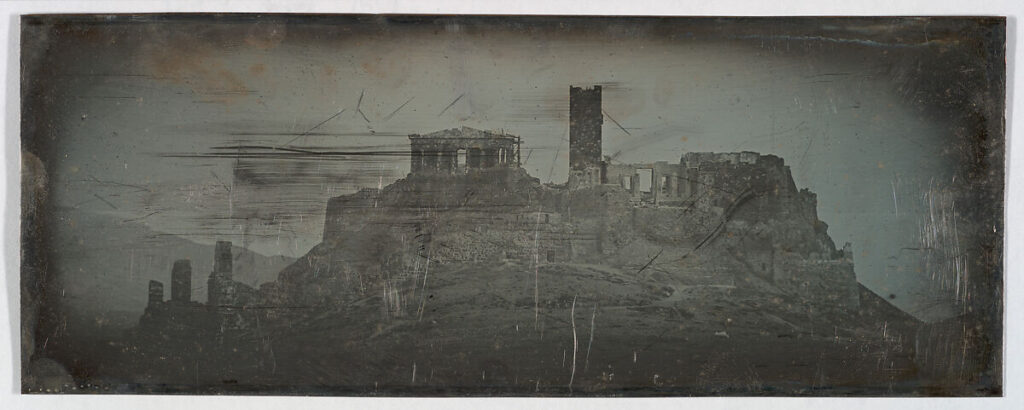
Original story and earliest witnesses: Homeric poetry contains early Theseus/Ariadne references but no complete continuous account of Athens's Labyrinth tribute. Later surviving accounts include Pseudo-Apollodorus's Epitome and Plutarch's Theseus 15–20; these are sources for the myth and its disputed transmission, not contemporaneous civic records of a monster. For historical Athens, this review consults Greene's curatorial essay and the Foreword of Fornara and Samons (1991), not the entire modern literature. The 1842 photograph is explicitly later documentation of the Acropolis.