Victor Frankenstein — Frankenstein
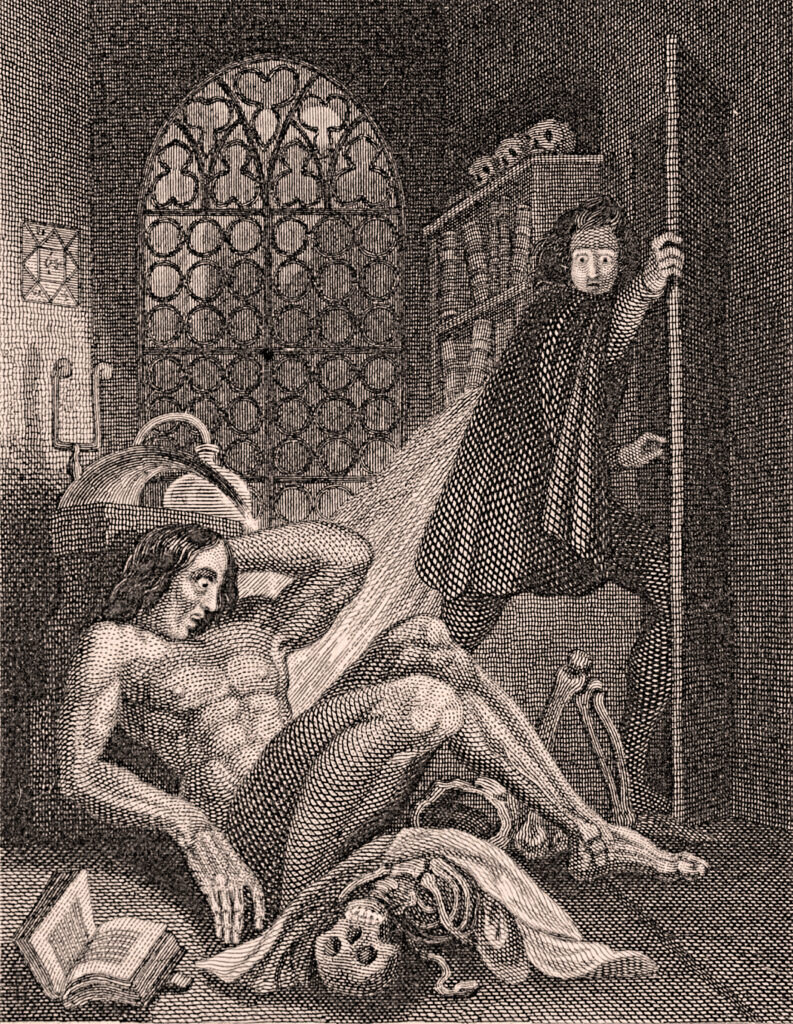
For GEOMYTHA, Victor tests the difference between identifying oneself as a source of life and accepting responsibility toward the life that answers back. In the 1818 narrative, his expectation that a new species will bless him precedes his inability to remain with his creation. The esoteric layer belongs to this relationship between claim and action: a creator identity seeking confirmation while rejecting the dependent being who makes the obligation concrete.
The hearth reading concerns sustained welcome, education and accountability, rather than a literal household prop or an automatic meaning of “I,” “this” or “being.” Victor's guilt and suffering complicate an image of pure domination; they do not by themselves repair abandonment. His later concern about the second being's autonomy and possible harm must be considered on its own merits. Eileen Hunt Botting's published rights-of-the-child reading supplies a scholarly interlocutor for the question of care, while remaining distinct from GEOMYTHA's terminology.
The source presents Victor as a conflicted creator and retrospective narrator. GEOMYTHA focuses on the gap between his desired creator identity and the care he actually supplies. This reading evaluates decisions rather than assigning an immutable villain archetype or confusing Victor with his creature.
Mary Wollstonecraft Shelley, Frankenstein; or, The Modern Prometheus (1818); distinguish the revised 1831 edition.
1818: vol. I, chs. III–IV; vol. II, chs. VIII–IX; vol. III, ch. III; Walton's continuation. Text: https://www.gutenberg.org/ebooks/41445. Earlier surviving draft/fair-copy witnesses: https://shelleygodwinarchive.org/contents/frankenstein/.
GEOMYTHA's fire, hearth and identity vocabulary is a comparative reading, not Shelley's terminology or a demonstrated secret code. Neither ordinary demonstratives nor every mention of life, light or fire carries an esoteric definition. Shelley is the author; Victor is the creator character, distinct from his unnamed creature. Physical difference does not establish moral evil. The novel's narrated scientific achievement is fictional, not an experimental method. Hesiod is comparative background for the explicit Prometheus subtitle, not evidence of an exact Egyptian or grammatical correspondence. Botting's rights argument is attributed scholarship; Mellor is further reading with catalogue metadata only. No full fresh rereading, complete manuscript collation or exhaustive bibliography is claimed.
Proposed pattern: creator identity without continuing care. Anchor the claim in the contrast between anticipated gratitude (1818 I.III) and flight after animation (I.IV). Do not infer that Victor has no affection: he loves family and friends and experiences grief. His responsibility also changes after the creature's deliberate murders. His destruction of the unfinished companion includes fear for others and recognition that she might refuse the male bargain (III.III); the record cannot assume completing her was the only ethical outcome. Near the end, Victor urges Walton's crew toward glory even after warning of ambition, exposing tension rather than a neatly completed redemption. Victor's self-report and the creature's counter-narrative must both remain contestable.
Victor first appears in Shelley's Frankenstein, published 1818. Earlier surviving composition witnesses are the 1816–17 draft and partial fair copy identified by the Shelley-Godwin Archive; the initial 1816 story is lost. Character claims here follow the 1818 text, particularly I.III–IV, II.VIII–IX, III.III and Walton's continuation. The 1831 frontispiece is identified as later reception. No claim is made that film laboratory apparatus, assistants or a particular cinematic body design describe Shelley's original scene.