Alice’s Adventures in Wonderland — Lewis Carroll
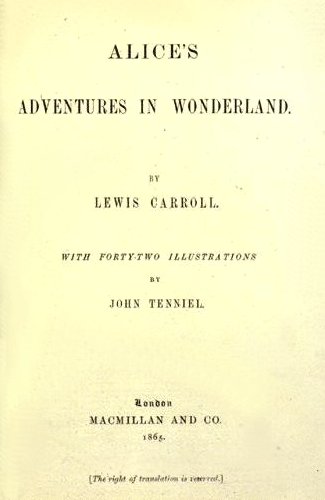
In Geomytha, Alice’s Adventures in Wonderland is a demonstrative world under stress. Body, language, time, law, rank, judgment, and personality all become unstable until the named world exposes itself as constructed rather than ultimate. Alice moves through This, These, Those, and All This without becoming their sovereign; Return begins when recognition withdraws authority from the card-world and the dream can no longer govern attention.
Conventionally, Alice’s Adventures in Wonderland is Carroll’s 1865 literary work. Geomytha reads its unstable body, language, time, law, rank, and waking as a demonstrative-world stress test, without claiming Carroll encoded the later Geomytha grammar.
Lewis Carroll, Alice’s Adventures in Wonderland (1865)
Project Gutenberg ebook #11; 1865 title page via Wikimedia Commons.
Plot and publication facts should be grounded in the text and bibliography; the Geomytha grammar is interpretive.
Alice discovers and improvises as well as resisting imposed identity. Growth and confusion do not automatically mean possessive capture, and the Caterpillar is not a uniformly benevolent witness. Test who sets the terms of judgment, how language constrains action, and where Alice withdraws that authority; preserve the story's play, satire and contradictions.
Carroll's Alice's Adventures in Wonderland was published in 1865. The linked Gutenberg text is an accessible digitized reading edition rather than an original manuscript. Distinguish it from Through the Looking-Glass (1871), film adaptations and the earlier manuscript Alice's Adventures Under Ground, which has a separate textual history.