Cheshire Cat — Alice’s Adventures in Wonderland
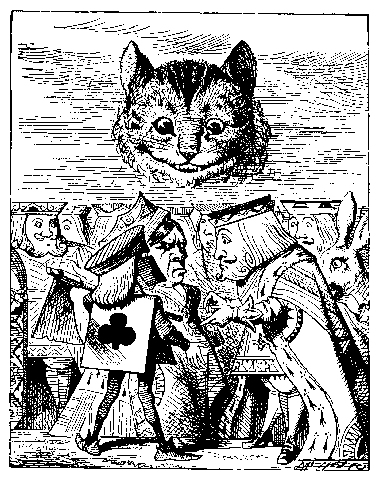
GEOMYTHA uses the continuing grin or head as an image of a recognizable persona apparently detached from its bodily support: a possible disembodied I. The comparison asks whether the performance of knowingness continues while relation and grounding have been set aside.
The image is a question, not a verdict on the Cat. Disappearance alone does not establish possessive claim, and the Cat's challenge to arbitrary royal power can instead loosen a fixed identity. The reading applies only where the scene actually supports a self-position being maintained independently of its grounding.
The source offers a comic, disappearing guide and a logical puzzle about a head without a body. GEOMYTHA compares that separation with a persona maintaining its position without embodied relation, while preserving the alternative reading of the Cat as a destabilizer of false authority.
Lewis Carroll, Alice’s Adventures in Wonderland (1865)
Carroll, Alice's Adventures in Wonderland (1865), Chapters VI and VIII; Gutenberg ebook 11. Tenniel illustration 31 in Gutenberg ebook 114.
A disappearing fictional body is not evidence of psychological dissociation or spiritual failure. Carroll does not define the Cat as ego. Advice, wit, a smile and resistance to the Queen may be helpful rather than identity fixation.
The Cat asks where Alice wants to go before advising her, which is responsive guidance rather than direction without relation. Its refusal to submit to royal ceremony also challenges the disembodied-I interpretation. If no defended self-claim is present, retain only the visual analogy, not the diagnosis.
Primary narrative witness used here: Lewis Carroll, Alice's Adventures in Wonderland (1865), Chapters VI and VIII. The linked Gutenberg text is a modern digital transcription of the published work, not an original manuscript or first-edition facsimile. Tenniel's historical illustrations are separately credited. This review does not claim to establish the earliest surviving manuscript witness or comprehensive scholarly coverage.