Index Record
The Velveteen Rabbit
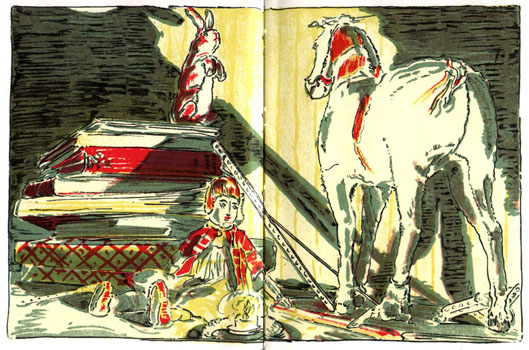
Nicholson's story illustration shows the Skin Horse and Rabbit; the text distinguishes being real to the Boy from the later literal transformation.
Conventional Reading
Margery Williams’s story follows a toy rabbit that becomes Real through love, wear, and lived relationship rather than through pristine appearance.
Geomytha Reading
The article uses the Velveteen Rabbit as a model of the surface-image softening into embodied reality: the worn object becomes more real as image-value matters less.
Why the Difference Matters
The literary transformation from toy to Real is the documented layer; Geomytha extends it into a body-versus-image reading.
Parent work / tradition / source
Margery Williams, The Velveteen Rabbit
Source location / reference
Project Gutenberg eBook 11757.
Reading Boundary
The story’s plot is documented in the literary source; the contrast between image-value and embodied realness is Geomytha interpretation.
Archetype stress test
Becoming Real in the story is tied to love and worn relationship, not merely destruction of appearance. A treasured object can deepen care instead of hardening identity. Do not turn all attachment into a false-self diagnosis.
Source trail
Evidence beneath the record
The Velveteen Rabbit — Project Gutenberg
Primary literary source. The article's distinction between surface-image and embodied realness is Geomytha's interpretation.
Project Gutenberg
The Velveteen Rabbit — 1922 Illustration — Wikimedia Commons

Rights/provenance source for the artwork; the article's embodiment reading is interpretive.
Wikimedia Commons / Internet Archive source scan