Quetzalcoatl, Tezcatlipoca, and the claim to be the center of the world.
You can leave one system and still carry its throne with you.
A belief stops making sense. A group loses your loyalty. A role you once defended falls apart. At first, the change feels like freedom.
Then the replacement becomes just as important.
Now you have to be the person who escaped. The person who finally sees clearly. The person who would never become what you used to be.
The ruler changed.
The need for a ruler did not.
That distinction is useful when we look at an old Mesoamerican story about competing suns.
In the early colonial Historia de los mexicanos por sus pinturas, Tezcatlipoca becomes the first sun. Quetzalcoatl strikes him with a large staff and knocks him into water. Tezcatlipoca becomes a jaguar, and the giants of that age are destroyed. Quetzalcoatl becomes the next sun. Later, Tezcatlipoca knocks Quetzalcoatl down, and a great wind devastates that world. [1]
One center falls.
Another takes its place.
The story does not need GEOMYTHA in order to mean something. It belongs to a Mesoamerican religious and historical field that has to be respected on its own terms.
GEOMYTHA adds a comparison.
What happens when we destroy an identity but preserve the demand that something occupy the center?
When a role becomes the sun
A sun does more than occupy one place in the world. It determines how the whole field is illuminated.
That makes it a useful image for a reigning identity.
Someone who must always be competent does not experience a mistake as one mistake. The mistake threatens the light by which the whole person has been organized.
Someone who must always be right does not hear disagreement as information. Disagreement threatens the position from which the world is being interpreted.
Someone who must always be the rescuer may have trouble receiving help, because receiving help contradicts the role that makes the world feel ordered.
The role begins to organize the light.
GEOMYTHA describes the movement into defended identity with four terms:
Is → Am → I → This.
Is names awareness before possession. Am names reflected presence. I names the claimant. This names the identity hardened around the claim.
The problem is not that a role exists. Roles are useful.
The problem begins when reflection becomes possession:
I am this role. I am this belief. I am this authority.
Now the role does not simply help us move through the world.
The world has to keep proving the role.
The smoking mirror
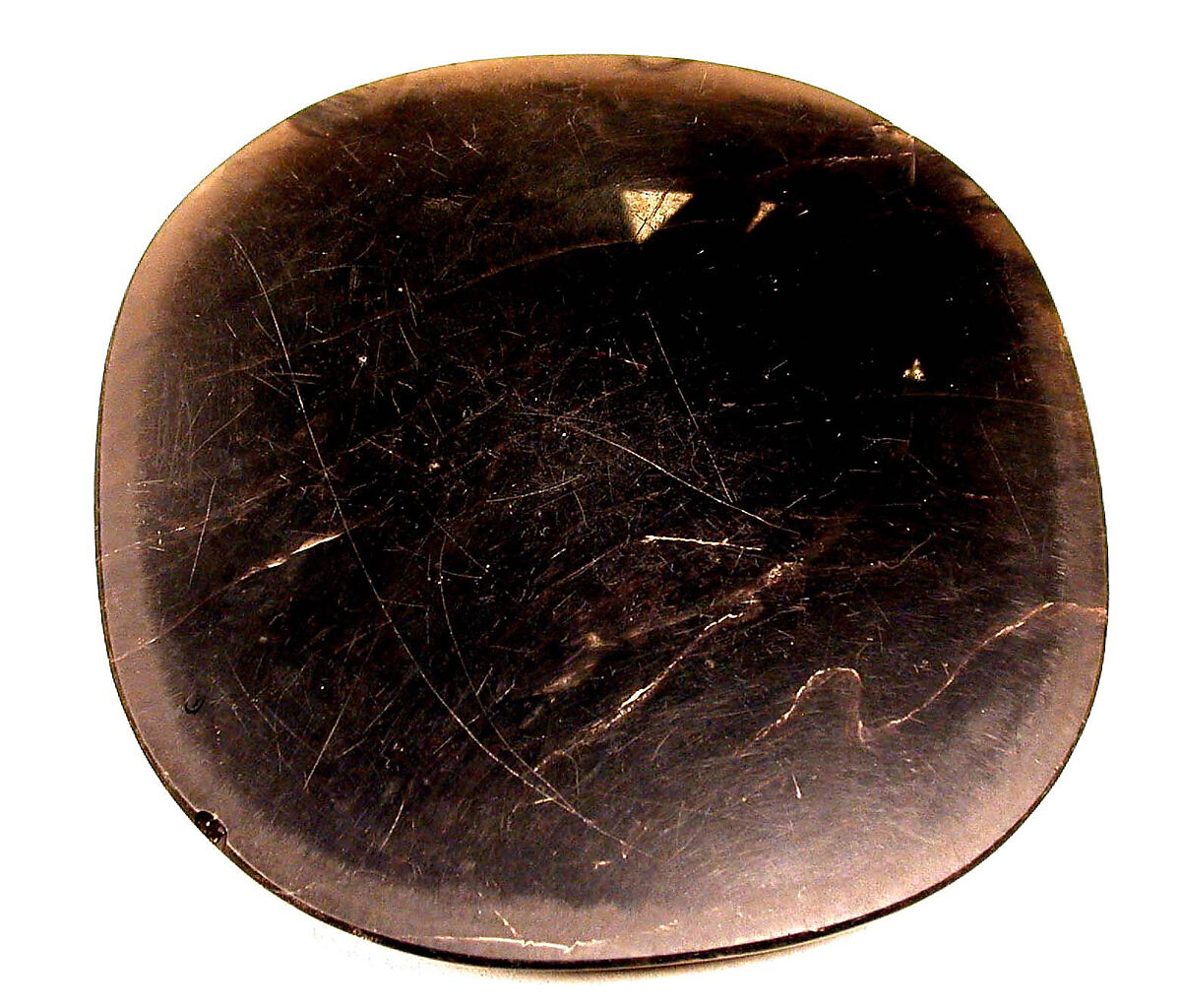
Tezcatlipoca's name is commonly translated as Smoking Mirror. Obsidian mirrors in ancient Mexico were used in divinatory and sacred contexts, and the obsidian mirror was especially associated with Tezcatlipoca. [2]
A mirror is not automatically false.
It reflects.
The problem begins when the reflection claims to be the source of what it reflects.
That is the GEOMYTHA question inside the image.
Does the reflection help us see?
Or does the image begin telling everything else what it must mean?
An identity can work like that.
A person has one painful experience and builds an explanation around it. The explanation may begin with something true. But soon every new event has to pass through the same mirror.
People become allies or threats.
Success becomes confirmation.
Failure becomes humiliation.
The mirror stops serving attention.
Attention starts serving the mirror.
Knocking down the center
Quetzalcoatl's blow interrupts Tezcatlipoca's reign.
Something that occupied the center is revealed to be removable.
That can happen in ordinary life.
A fact defeats a belief. A job disappears. A relationship ends. A teacher loses authority. A political order falls. A spiritual explanation no longer works.
Something that looked permanent turns out to depend on conditions.
That matters.
Sometimes a harmful authority really should be removed. Sometimes leaving a system is necessary. Sometimes one explanation is simply better than another.
The argument here is not that replacement is meaningless.
The question comes after the replacement:
What happened to the need for centrality?
We can reject one doctrine and become defined by rejecting it.
We can escape one hierarchy and build another hierarchy around being the people who escaped.
We can see through one illusion and become attached to being the person who sees through illusions.
The new insight can inherit the old crown.
The jaguar after the fall
Tezcatlipoca does not disappear when he loses the solar position.
He becomes a jaguar.
That image has to be handled carefully. The jaguar carried complex meanings in Mexica thought. It should not be reduced to a simple symbol of evil, rage, or ego. [3]
The narrower GEOMYTHA comparison concerns the action in this episode.
The displaced power remains active after deposition.
Deposition is not dissolution.
A possessive demand can survive the loss of the identity that once expressed it.
A person who can no longer control a relationship may try to spoil it.
An institution that loses authority may attack the conditions under which its authority can be examined.
A person who stops being admired may decide that admiration itself is corrupt.
The form changes.
The demand survives.
It is tempting to romanticize catastrophe here and call the destroyed world an illusion finally collapsing.
That goes too far.
A destroyed order can leave injury, grief, confusion, and another order built around the same demand.
The deaths in the story are not automatically awakening.
Collapse can expose a false center.
Collapse is not the same thing as return.
The second sun
Quetzalcoatl becomes the next sun.
This is where the reading has to resist an easy moral chart.
If Tezcatlipoca were simply the bad claimant and Quetzalcoatl simply the good return, the story would already be finished.
It is not.
Tezcatlipoca later knocks Quetzalcoatl down too.
The pattern continues.
That is why GEOMYTHA should not assign either figure one permanent function.
A name does not guarantee a mechanism.
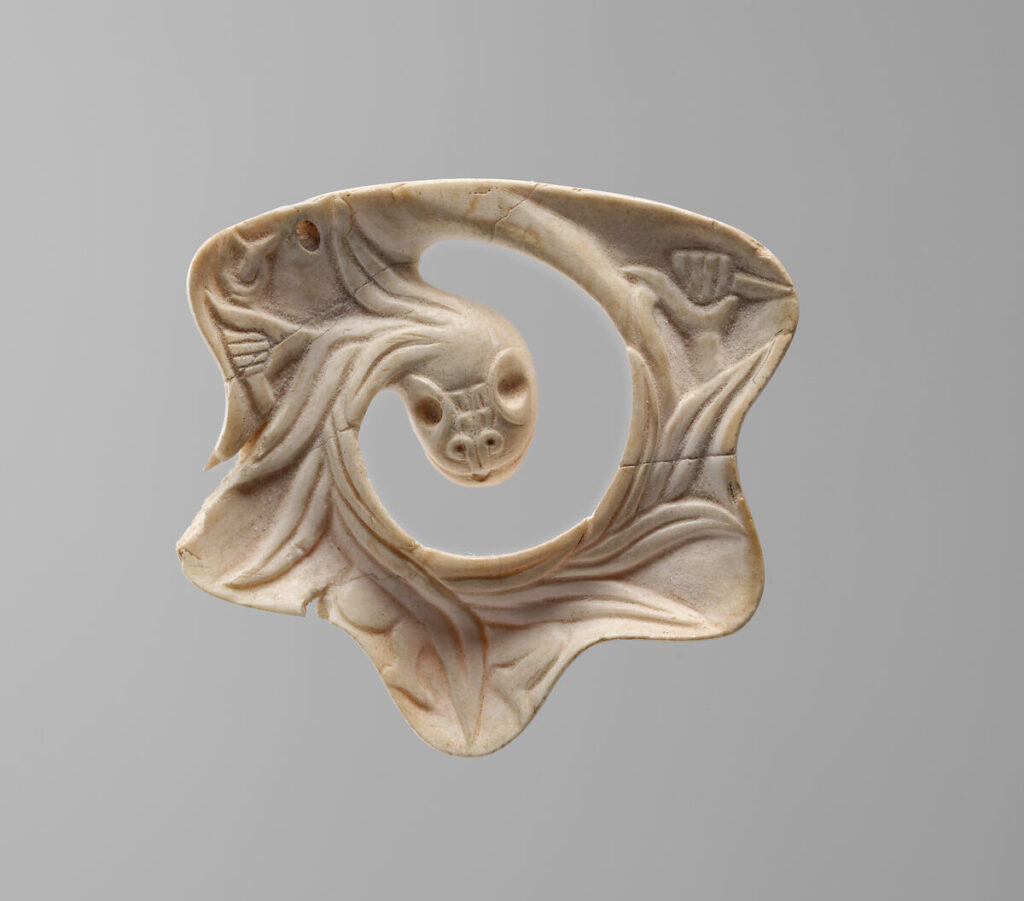
Even a symbol associated with wind, fertility, creation, or life can be used badly if we turn the association into a fixed identity. A Mexica feathered-serpent pendant in the Metropolitan Museum is identified as an ehecacozcatl, or wind jewel, often associated with Quetzalcoatl-Ehecatl. [4]
That history gives the comparison texture.
It does not give Quetzalcoatl a permanent GEOMYTHA job.
The question remains functional:
What is happening now?
Is reflection serving the field?
Or is a reflected form demanding the throne?
A real stress test
There is an obvious objection.
Human life requires centers.
A body coordinates itself. A household makes decisions. A team may need a captain. A government needs offices. A person may have to commit to one course of action rather than remain endlessly open.
So why treat centrality as a problem?
We should not.
Coordination is not the same as sovereignty of identity.
A leader can lead without requiring every event to prove the leader's worth.
A belief can guide action while remaining open to evidence.
A role can organize responsibility without becoming the whole person.
Replacing a destructive ruler with a better one can matter enormously.
The GEOMYTHA claim is narrower: change has not reached the root when the replacement must become unquestionable because the self now depends on it.
The problem is not that something has a function.
The problem is that the function becomes a crown.
Raising the sky together
A later scene in the same source gives us a different arrangement.
After a flood and the fall of the heavens, Tezcatlipoca and Quetzalcoatl become great trees and participate with four men in raising the sky. [5]
The text does not tell us that they have completed a GEOMYTHA return.
That is our comparison.
But the change in relationship is striking.
They are no longer competing in that moment to be the sun.
Difference remains.
Power remains.
Action remains.
What changes is the relation of those powers to the whole.
They support a field larger than either one.
That is closer to what GEOMYTHA means by return.
Return does not require every distinction to disappear.
Direction can serve. Judgment can serve. Interruption can serve. Leadership can serve. A mirror can serve.
The problem begins when any of them claims final authority over the field it only helps reveal or organize.
Before the insight becomes a title
The practical test is simple.
When an old conviction falls, notice what wants to replace it.
Maybe the new belief is better. Maybe the new role is healthier. Maybe the new community is safer.
Keep the improvement.
Then ask one more question:
Can this remain useful without becoming what I have to be?
Can the belief survive examination?
Can the role survive failure?
Can the group survive disagreement?
Can the insight remain an insight rather than a title?
A new sun may be necessary.
But a new sun is not yet a return.
Let the new understanding illuminate something before it becomes another crown.
Receive the reflection.
Then let it return to what is.
Sources
1. Historia de los mexicanos por sus pinturas, chapters III–V, transcription based on Ángel María Garibay's edition.
2. Getty Research Institute, “Through the Obsidian Mirror.”
3. Guilhem Olivier, “El jaguar en la cosmovisión mexica,” Arqueología Mexicana 72.
4. The Metropolitan Museum of Art, Feathered serpent pendant, Mexica, 1325–1521 CE, object 2020.386.1.
5. Rafael Tena, “Del diluvio y caída del cielo,” Arqueología Mexicana.