Isis nursing Horus
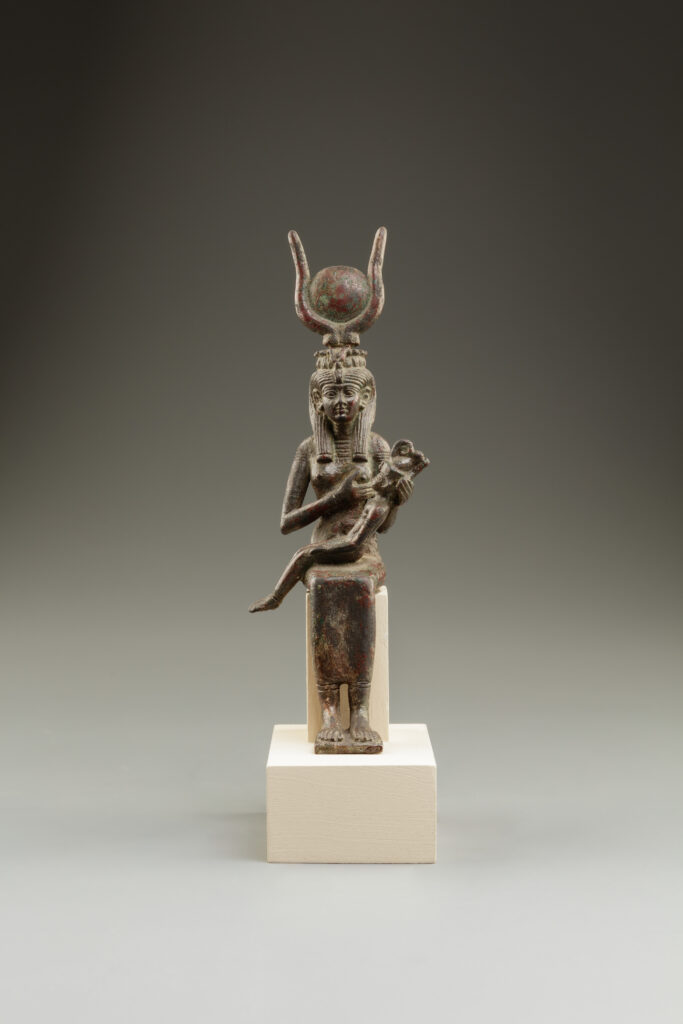
Geomytha uses the nursing/holding image as the primary visual analogue for the Isis Plexus: awareness as container, receiver, protector, and ground before reflected presence is pulled upward into projection and identity.
Conventionally, the image belongs to Egyptian religious iconography of Isis as mother, nurturer, protector, and life-giver. Geomytha does not alter that documented meaning; it uses those qualities comparatively as the visual language for a symbolic body-center of containment.
Ancient Egyptian Isis-Horus iconography
The Metropolitan Museum of Art, Statuette of Isis nursing Horus, Late Period, 664–332 BCE, object 553002; related Ptolemaic Isis with Horus object 552064.
The Met does not identify an 'Isis Plexus,' teach a hidden anatomical doctrine, or connect this statuette to the celiac plexus or pineal gland. Those body mappings are Geomytha interpretations layered onto documented iconography.
The mother-and-child image documents care, divine maternity and royal protection. It does not anatomically depict an 'Isis plexus.' Historical devotional function must remain intelligible even where the embodied GEOMYTHA analogy is set aside.
The surviving Egyptian record begins with ritual and fragmentary witnesses, not one recoverable original story. The late Fifth-Dynasty Pyramid Texts provide the early inscribed corpus; Middle Kingdom Lahun fragments preserve an early extensive Horus–Seth struggle. Plutarch's On Isis and Osiris, written much later in the Roman period, supplies a connected narrative. Compare versions rather than attributing Plutarch's complete sequence to the earliest inscriptions. GEOMYTHA's grammatical assignments are modern comparisons.