GEOMYTHAAll stories are the same story
Index Record

Halo / Nimbus — Christian Iconography
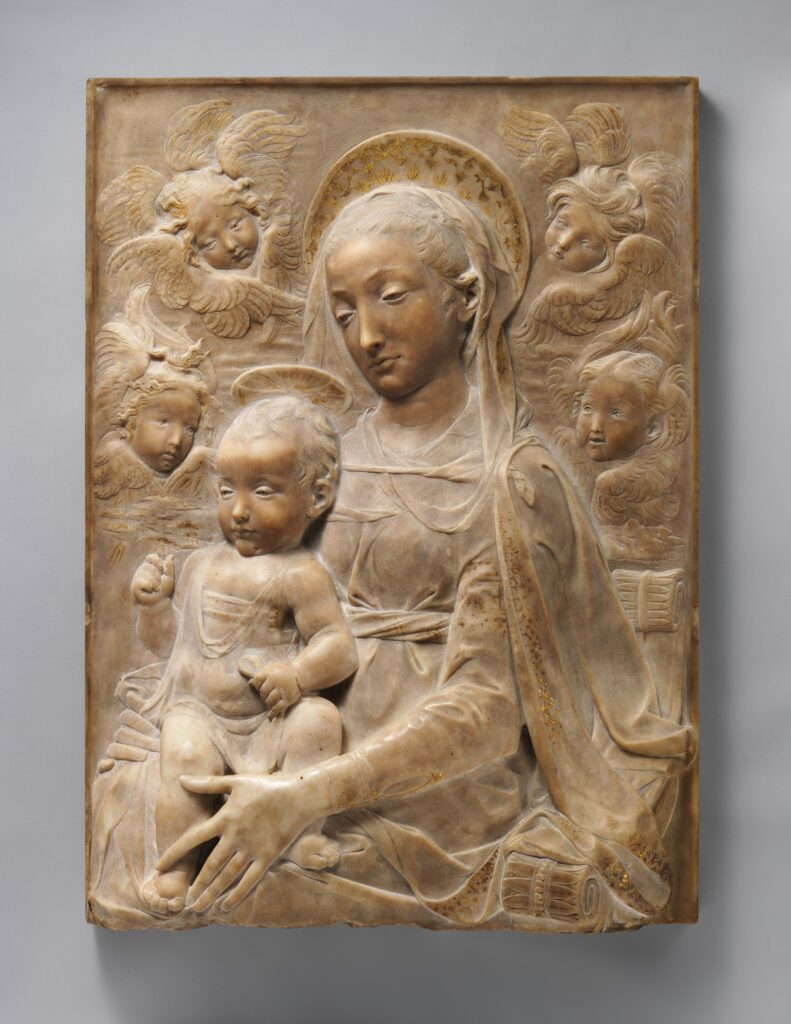
Madonna and Child with Angels, ca. 1455–60
Madonna and Child with Angels · Antonio Rossellino · ca. 1455–60 · The Metropolitan Museum of Art, New York · 14.40.675 · Public domain / The Met Open Access ↗
The gilt halo details in this Christian relief provide a concrete nimbus example. GEOMYTHA's radiance-and-identity comparison is not a claim that Christian holiness is inherently egoic or that the artist intended an Egyptian transmission argument.
Conventional Reading
In Christian art, the halo or nimbus functions as a visual marker associated with holiness and sacred status. The Met's Byzantine Halo from an Icon Cover is a physical gold-and-enamel halo made to be attached to an icon, demonstrating that the halo could exist not only as painted radiance but as a literal applied object within devotional imagery.
Geomytha Reading

Geomytha reads the circular halo comparatively as a crown-image of visible spiritual identity: radiance can become an outline around the self, and therefore a place where illumination hardens into enthronement. The article contrasts this 'crown' function with the Grail as vessel and with the torus as a modern geometric analogy for a circulating field.

Why the Difference Matters

The conventional record explains the halo as an iconographic sign of holiness or sacred status. Geomytha does not replace that meaning; it asks what happens structurally when visible radiance itself becomes an identity-object. The torus and Grail comparisons are analogies used to distinguish self-crowning from receptivity, not historical derivations.

Parent work / tradition / source

Late antique and medieval Christian iconography

Source location / reference

The Metropolitan Museum of Art, Halo from an Icon Cover, Byzantine, 10th–early 11th century, object 17.190.683; broader Christian use of the nimbus/halo to identify holy figures is documented in Met scholarship.

Reading Boundary

This record does not claim that Byzantine or medieval Christian artists understood halos as tori, that the Holy Grail was historically a toroidal diagram, or that halo and Grail iconography encoded Geomytha's Is/Am/I/This grammar. Historically, the halo/nimbus marks sacred or holy figures in Christian visual culture; the torus/crown/vessel comparison is a modern Geomytha interpretation.

Archetype stress test

A halo conventionally signifies holiness and may direct devotion beyond the pictured person. That is a counterexample to halo = ego crown. Require evidence of self-enthronement in the selected use, not the circular shape alone.

Source trail

Evidence beneath the record

Halo from an Icon Cover — The Met 17.190.683
Primary institutional object record for a historical halo. It does not connect halos to toroidal geometry or Geomytha’s crown/vessel interpretation.
The Metropolitan Museum of Art
Estoire del Saint Graal — British Library Royal MS 19 C XII
Institutional manuscript record. It supports the historical existence and literary context of the Grail tradition, not Geomytha’s torus/vessel equivalence.
British Library
Torus — Wolfram MathWorld
Technical mathematical reference. It provides geometry only; it does not support historical claims that halos or grails were intended as tori.
Wolfram MathWorld
Mental Rehearsal and Identification — Kirby & Greenwald 2017
Peer-reviewed experimental research. It does not validate manifestation metaphysics or claims that visualization causes external events; it is used only to contextualize how rehearsal can strengthen identification.
Journal of Experimental Social Psychology / Elsevier