GEOMYTHAAll stories are the same story
Index Record

Christianity — Religious Tradition
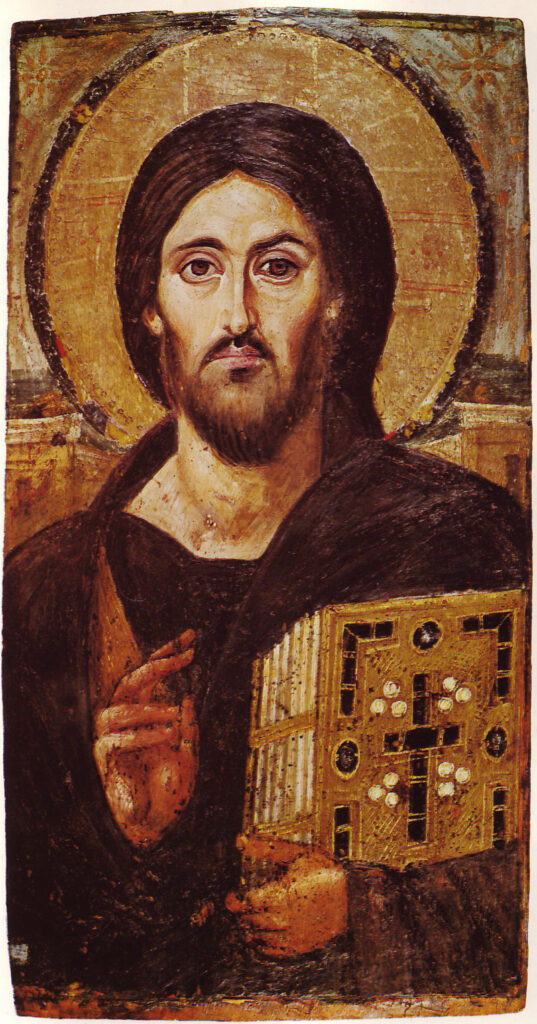
Sixth-century Byzantine icon of Christ Pantocrator from Saint Catherine's Monastery at Mount Sinai
Christ Pantocrator · Byzantine / Early Christian icon tradition · 6th century · Saint Catherine's Monastery, Mount Sinai · Public Domain ↗
Tradition-level Christian image chosen to represent the broader religious field without duplicating the Lateran Baptistery, resurrection, or Eighth Day imagery used elsewhere.
Conventional Reading
The Christian religious tradition referenced through resurrection, baptism, and the symbolic Eighth Day.
Geomytha Reading

Geomytha makes no single standalone symbolic claim about Christianity as a whole. This record functions as the parent religious-tradition field for particular Christian symbols examined elsewhere, including resurrection, baptism, the Eighth Day, the cross, and apocalyptic fire. Each mechanism must be read at the level of the specific text, rite, image, or tradition rather than projected onto Christianity as one undifferentiated symbolic object.

Why the Difference Matters

Conventionally, Christianity is a diverse religious tradition with many historical, theological, liturgical, and denominational forms. Geomytha uses selected Christian symbols comparatively, but the parent tradition record exists to preserve provenance and prevent those local interpretations from being mistaken for a total definition of Christianity.

Parent work / tradition / source

Christian religious and theological traditions

Source location / reference

Christian traditions of resurrection, baptism, the Lord's Day, and the symbolic Eighth Day; Augustine, Letter 55, and the Lateran Baptistery provide specific historical anchors for the Eighth Day material used here.

Reading Boundary

Represent Christian traditions accurately and distinguish historical theology from Geomytha interpretation.

Archetype stress test

Christianity contains different scriptures, communities and interpretations. A resurrection or baptism comparison cannot stand for the entire tradition. No claim of one hidden doctrine follows from a recurring image.

Source trail

Evidence beneath the record

The Eighth Day and Resurrection — Augustine, Letter 55
Primary patristic evidence for historical Christian eighth-day symbolism. Geomytha’s closed-cycle/reopening mechanism is interpretive.
New Advent / public-domain patristic translation
Lateran Baptistery — Octagon and the Eighth Day
Authoritative institutional source for the architecture/symbol relationship.
Vatican basilicas
The Beatles — “Eight Days a Week”
Primary artist/catalog source for song identity and release. Geomytha’s Eighth Day/overflow reading is interpretive.
Apple Corps / The Beatles
Leap Years and the Tropical Year — U.S. Naval Observatory
Authoritative astronomical reference for the approximate tropical-year length and calendar drift calculation. The article's symbolic use of the fractional remainder is Geomytha interpretation.
U.S. Naval Observatory
Moon Phases 2026 — U.S. Naval Observatory
Authoritative astronomical timing for historical calendar verification; Geomytha phase labels and symbolic directives are editorial interpretation.
U.S. Naval Observatory
Plutarch on Caesar’s Calendar Reform — Livius
Historical source for Caesar’s calendar reform. Geomytha’s Caesar/seizure mnemonic is explicitly symbolic and not an etymological claim.
Livius.org