GEOMYTHAAll stories are the same story
Index Record

DNA Base Pairing — A–T / C–G
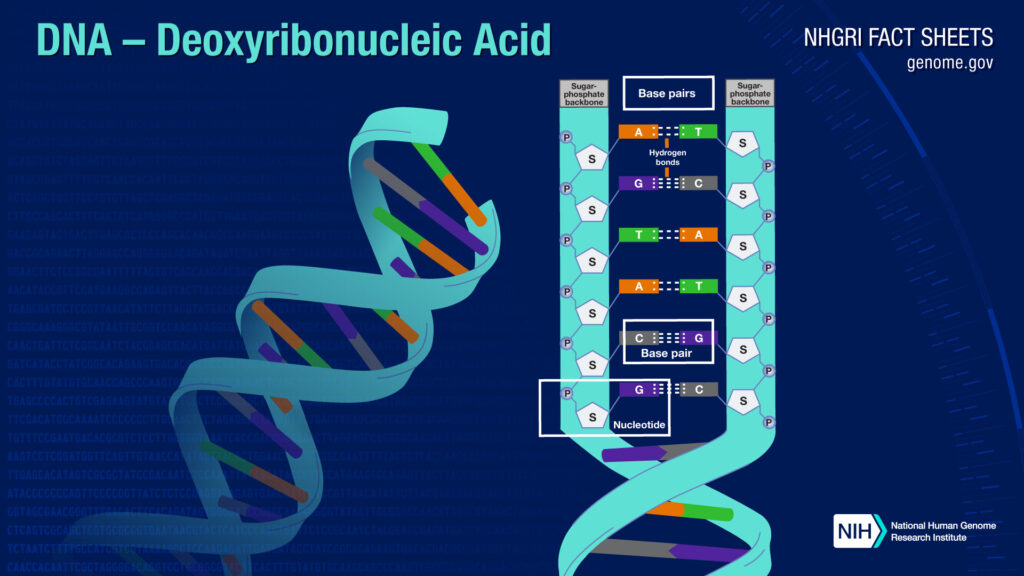
NHGRI illustration of the DNA double helix, nucleotides, and complementary A–T and C–G base pairs.
Deoxyribonucleic Acid (DNA) · National Human Genome Research Institute · 2020 fact-sheet illustration · NHGRI / National Institutes of Health · U.S. government educational illustration; NHGRI ↗
Scientific diagram of DNA and complementary base pairing. Illustrates the documented biological mechanism, not evidence for the symbolic analogy.
Conventional Reading
In DNA, adenine pairs with thymine and cytosine pairs with guanine across the two strands of the double helix.
Geomytha Reading

The article uses complementary base pairing as a biological analogy for paired systems becoming legible as one explanatory body.

Why the Difference Matters

The scientific pairing mechanism is documented; the symbolic fusion analogy is Geomytha interpretation.

Parent work / tradition / source

Molecular genetics

Source location / reference

National Human Genome Research Institute DNA Fact Sheet.

Reading Boundary

DNA base pairing is scientific fact; any analogy to Geomytha’s fusion grammar is interpretive.

Archetype stress test

A–T and C–G pairing has a biochemical explanation. Four bases do not prove a consciousness cross, and symbolic false-wholeness language must not imply that DNA is defective or unreal. Keep molecular facts and interpretation separate.

Original story and earliest witnesses

The paired double-helix proposal appears in Watson and Crick's 1953 Nature paper, alongside the Wilkins–Stokes–Wilson and Franklin–Gosling papers in the same issue. Earlier chemical and diffraction research also matters; this is not the beginning of all DNA knowledge. The modern NHGRI fact sheet is a readable explanation rather than the original research report.

Source trail

Evidence beneath the record

DNA Base Pairing — NHGRI
Authoritative scientific source for DNA base-pair structure. It does not support Geomytha’s symbolic comparison of paired systems becoming one explanatory body.
National Institutes of Health
Watson and Crick — DNA double-helix proposal (1953)
Source-derived facts and GEOMYTHA comparisons remain distinct. The linked bibliographic record identifies the work; availability of full text varies.
Nature