Emperor Palpatine — Star Wars
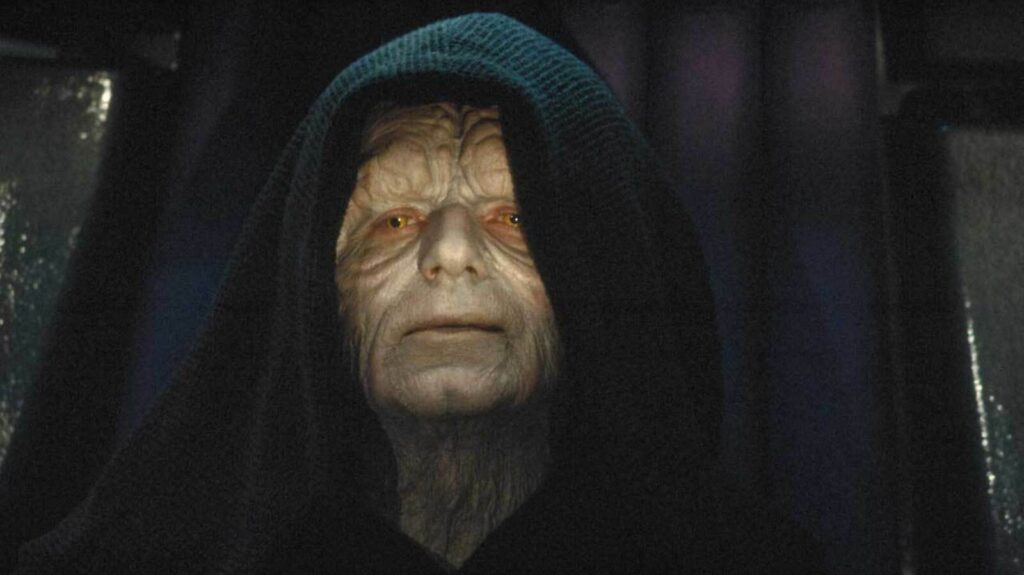
GEOMYTHA calls Palpatine's concentration of authority throne-motion: the claiming I attempts to make every relation answer to its own continuance. Manipulated institutions and apprentices become means to a defended center rather than partners whose independent reality can be acknowledged.
This is more specific than saying a villain is ego. The comparison is supported where he converts emergency, fear or another person's vulnerability into a demand for control. A throne or political office alone does not establish the reading; the action of appropriating other fields does.
The source narrative gives a manipulator who gains and enforces imperial power. GEOMYTHA extracts the mechanism of treating independent people and institutions as extensions of claim; it does not replace the political plot with a universal metaphysical explanation.
Lucasfilm / Star Wars franchise; Emperor Palpatine / Darth Sidious Databank
Episodes V and VI: Emperor and apprentice; Return of the Jedi: refusal and lightning confrontation; Revenge of the Sith: political consolidation. Official Palpatine / Darth Sidious Databank.
The interpretation does not identify all government, strategic planning or leadership with domination. Palpatine remains a fictional antagonist, not a template for diagnosing real people. The Endor reading is not a claim that the entire franchise ends there.
His failure to control Luke and Vader at Endor contradicts the fantasy that complete control is achievable. Legitimate authority that accepts limits, evidence and succession is a counterexample. Calling a disliked leader Palpatine without demonstrating the mechanism is not analysis.
Film scope: the Emperor's role in The Empire Strikes Back (1980), the Endor confrontation in Return of the Jedi (1983), and the later-published rise-to-Emperor narrative in Revenge of the Sith (2005). In-universe chronology and publication order differ. Earlier mentions, novels and scripts are not claimed as fully collated.