GEOMYTHAAll stories are the same story
Index Record

English Alphabet — 26-Letter Sequence
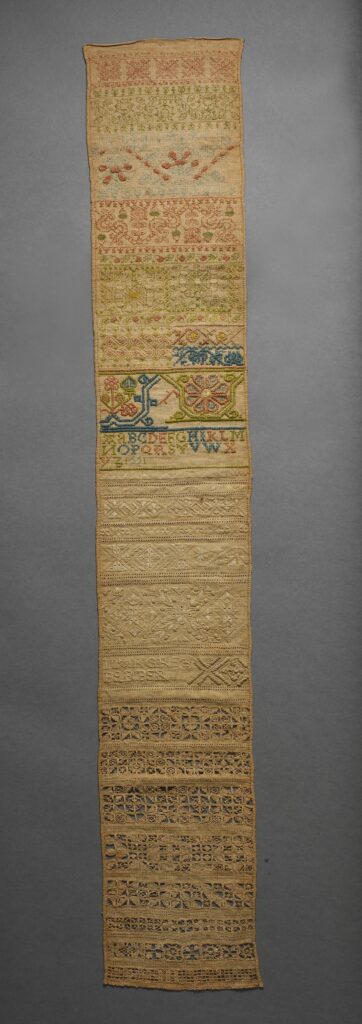
Sampler, 1661–63
Sampler · Margret Barber · 1661–63 · The Metropolitan Museum of Art, New York · 57.122.368 · Public domain / The Met Open Access ↗
This seventeenth-century English sampler provides a real example of alphabetic sequence in material culture. It is not a modern 26-letter teaching chart and does not establish intentional A-M/N-Z encoding; GEOMYTHA's division is a later symbolic reading.
Conventional Reading
Modern English uses a 26-letter alphabet from A through Z. CAD is a standard abbreviation for computer-aided design/drafting. Pi is the ratio of a circle's circumference to its diameter and begins 3.14159. The United States originated from thirteen British colonies commonly called the original 13 colonies. Astronomically, the Sun's apparent path crosses Ophiuchus as one of the constellations along the zodiac/ecliptic.
Geomytha Reading

Geomytha splits the 26 letters into A–M and N–Z and treats the two 13-letter halves as a symbolic reflective/projective structure. The alphabet trilogy further reads letter shapes, mirrored positions, septenary arcs, CAD as C-A-D = 3-1-4, Ophiuchus as a thirteenth pressure, and the original thirteen colonies as repeating symbolic pressure rather than as evidence of intentional historical coding.

Why the Difference Matters

The conventional record describes an alphabet, a mathematical constant, an engineering acronym, an astronomical constellation, and thirteen colonies as separate facts. Geomytha deliberately overlays them to test symbolic recurrence; the overlay is the interpretation, not the documentary evidence.

Parent work / tradition / source

Modern English alphabet; comparative Geomytha symbolic reading

Source location / reference

Modern English A–Z sequence; supporting factual anchors include CAD terminology, pi, the original 13 colonies, Ophiuchus on the astronomical zodiac/ecliptic, and public-domain historical alphabet engravings.

Reading Boundary

None of the A–M / N–Z, septenary, G-versus-T Sabbath, CAD=314, lightning-Z, zodiac, colonial, Set/Osiris, or counterclockwise correspondences are presented as established linguistics, typography history, mathematics, astronomy, or U.S. history. Ophiuchus is an astronomical constellation crossed by the Sun's apparent path; that fact does not establish a 13-sign Western astrological system. CAD's acronym and pi's value are factual; their juxtaposition is Geomytha wordplay. The original 13 colonies are historical fact; their lunar or consciousness meaning is interpretive.

Archetype stress test

Splitting the modern English alphabet into two groups of thirteen is a chosen operation, not evidence of an ancient design shared with calendars or colonies. Other alphabets have different lengths. Preserve actual letter history and do not infer intent from a count.

Source trail

Evidence beneath the record

Ophiuchus and the Astronomical Zodiac — IAU FAQ
Authoritative astronomy source. It does not validate Geomytha's 13-fold symbolic zodiac, astrological directives, or alphabet correspondences.
International Astronomical Union
Original Thirteen Colonies — National Archives
Authoritative U.S. archival source. It does not support a symbolic claim that the 13 colonies encode a lunar or consciousness structure.
National Archives
What Is CAD? — Autodesk
Primary industry source for the acronym and function of CAD. It does not support the numerological reading C-A-D = 3-1-4; that is Geomytha word/number play.
Autodesk
Pi — Wolfram MathWorld
Technical mathematical reference. It supports the conventional definition and value of pi, not Geomytha's symbolic reading of CAD as C-A-D = 3-1-4.
Wolfram MathWorld
Decorated Roman Alphabet — Nessenthaler — The Met 63.513.9
Institutional artwork record; visual support only, not evidence for Geomytha's numerical or zodiacal alphabet correspondences.
The Metropolitan Museum of Art
Decorated Roman Alphabet — Engelbrecht — The Met 63.513.6
Institutional artwork record; visual support only, not evidence for Geomytha's mirrored/inversion alphabet reading.
The Metropolitan Museum of Art
Decorated Roman Alphabet — Wachsmuth — The Met 63.513.2
Institutional artwork record; visual support only, not evidence for the article's septenary or Sabbath correspondences.
The Metropolitan Museum of Art