Frankenstein — Mary Shelley Novel
GEOMYTHA reads the distance between making a living being and sustaining a relationship as the novel's central pressure. The laboratory represents the achievement Victor can claim; the hearth names the continuing obligation he fails to meet when confronted by an independent life. This application begins with the sequence of aspiration, animation and abandonment, rather than with an isolated word such as “this.” The imagined gratitude of a new species is especially revealing: Victor anticipates recognition before providing care.
The story also tests this reading. The creature's demand for companionship cannot license murder, and a prospective female being cannot fairly be reduced to a remedy promised between two males. Walton's return offers a partial alternative: accepting limits in response to living companions. GEOMYTHA therefore treats the Promethean pattern as power requiring answerability, rather than proof that knowledge, technology or creation is inherently wrong.
Conventional accounts identify a Gothic novel about creation, ambition and responsibility. GEOMYTHA adds a distinction between bringing life into being and receiving it through continuing care. The source supports testing that distinction at concrete decisions; it does not establish a universal anti-science doctrine.
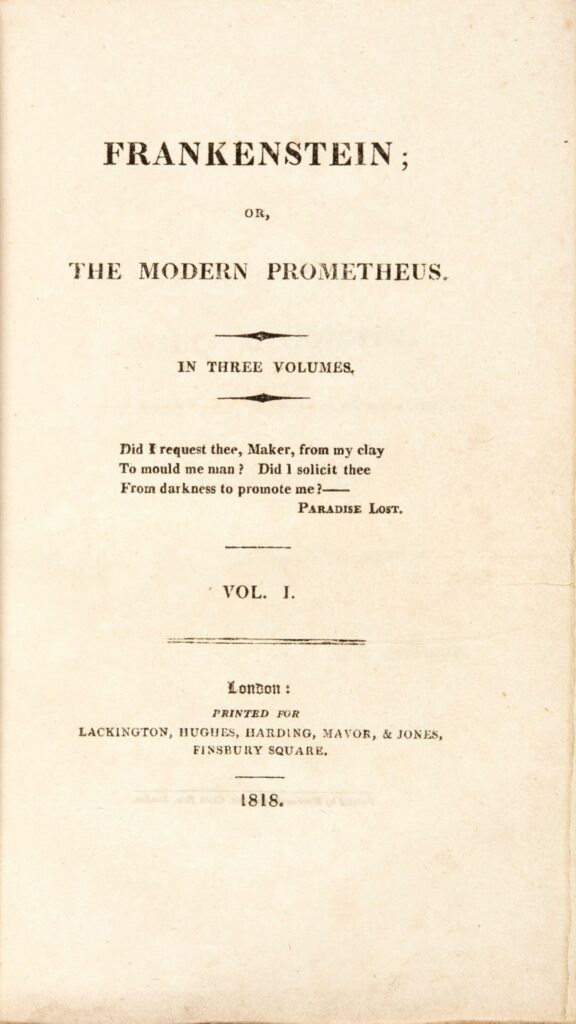
Mary Wollstonecraft Shelley, Frankenstein; or, The Modern Prometheus (1818); distinguish the revised 1831 edition.
1818: vol. I, chs. III–IV; vol. II, chs. VIII–IX; vol. III, ch. III; Walton's continuation. Text: https://www.gutenberg.org/ebooks/41445. Earlier surviving draft/fair-copy witnesses: https://shelleygodwinarchive.org/contents/frankenstein/.
GEOMYTHA's fire, hearth and identity vocabulary is a comparative reading, not Shelley's terminology or a demonstrated secret code. Neither ordinary demonstratives nor every mention of life, light or fire carries an esoteric definition. Shelley is the author; Victor is the creator character, distinct from his unnamed creature. Physical difference does not establish moral evil. The novel's narrated scientific achievement is fictional, not an experimental method. Hesiod is comparative background for the explicit Prometheus subtitle, not evidence of an exact Egyptian or grammatical correspondence. Botting's rights argument is attributed scholarship; Mellor is further reading with catalogue metadata only. No full fresh rereading, complete manuscript collation or exhaustive bibliography is claimed.
Proposed pattern: creation without sustaining relation. Strong evidence: Victor anticipates a new species' gratitude (1818 I.III) and recoils after animation (I.IV). Counterexamples: the creature has agency and deliberately kills William and frames Justine (II.VIII); rejection explains suffering without excusing retaliation. Victor's refusal of the companion also raises future harm and her possible independence (III.III), not merely fear of intimacy. Walton turns back at his crew's request but still feels defeated; this is a practical limit, not total enlightenment. Nested narration makes certainty about motives difficult. Retain the reading only where a specific choice separates power or reputation from care.
Oldest story: Shelley's 1816 initial tale is lost. The Shelley-Godwin Archive identifies surviving 1816–17 draft material (Bodleian MS Abinger c.56–57) and partial fair copy (c.58), predating the three-volume first publication in 1818. This record's passage references use Gutenberg #41445, a transcription from an 1818 photo-reprint. The revised 1831 edition (#42324) must not be silently substituted. Archive introduction and targeted published passages checked; all manuscript leaves and edition variants were not collated.