Hatter — Alice’s Adventures in Wonderland
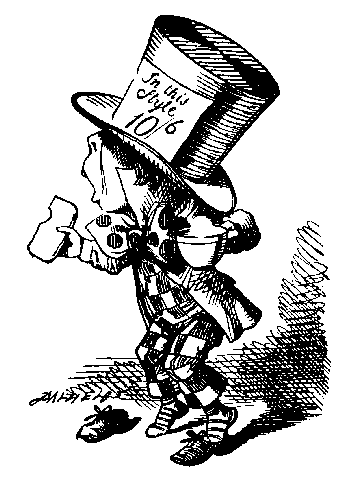
GEOMYTHA reads the Hatter as the participant adapting to an unfinished pattern: he talks, changes places and seeks another cup while the condition of perpetual tea-time remains. This differs from the episode-level record, which describes the whole enclosure. The character-level question is how a person keeps functioning inside it.
His unfinished tea follows him into court, supplying an image of a pattern carried from one setting to another. That does not prove he has chosen the pattern as his final identity. The stronger formed-identity reading applies only if repetition or role is defended as what the self must remain, not merely because a person is caught in a situation.
The source gives a comic tea-party host and an intimidated court witness. GEOMYTHA compares the persistence of unfinished tea across settings with adaptation to a loop, while distinguishing externally imposed conditions from a defended identity.
Lewis Carroll, Alice’s Adventures in Wonderland (1865), especially Chapter VII
Carroll, Alice's Adventures in Wonderland (1865), Chapters VII and XI; Gutenberg ebook 11. Tenniel illustration 38 in Gutenberg ebook 114.
Carroll's Hatter is a fictional character, not a psychological diagnosis. Work as a hatter, nervousness under threat and an unfinished cup of tea do not by themselves establish ego fixation. Do not equate being constrained with choosing or possessing the constraint.
The court threatens the Hatter, so his fear has an external cause; it is not proof of a false self. He also leaves the court. Ordinary repeated work or a role held provisionally is a counterexample. Keep the failed-completion analogy without making the whole character a fixed esoteric category.
Primary narrative witness used here: Lewis Carroll, Alice's Adventures in Wonderland (1865), Chapters VII and XI. The linked Gutenberg text is a modern digital transcription of the published work, not an original manuscript or first-edition facsimile. Tenniel's historical illustrations are separately credited. This review does not claim to establish the earliest surviving manuscript witness or comprehensive scholarly coverage.