Hoggle — Labyrinth
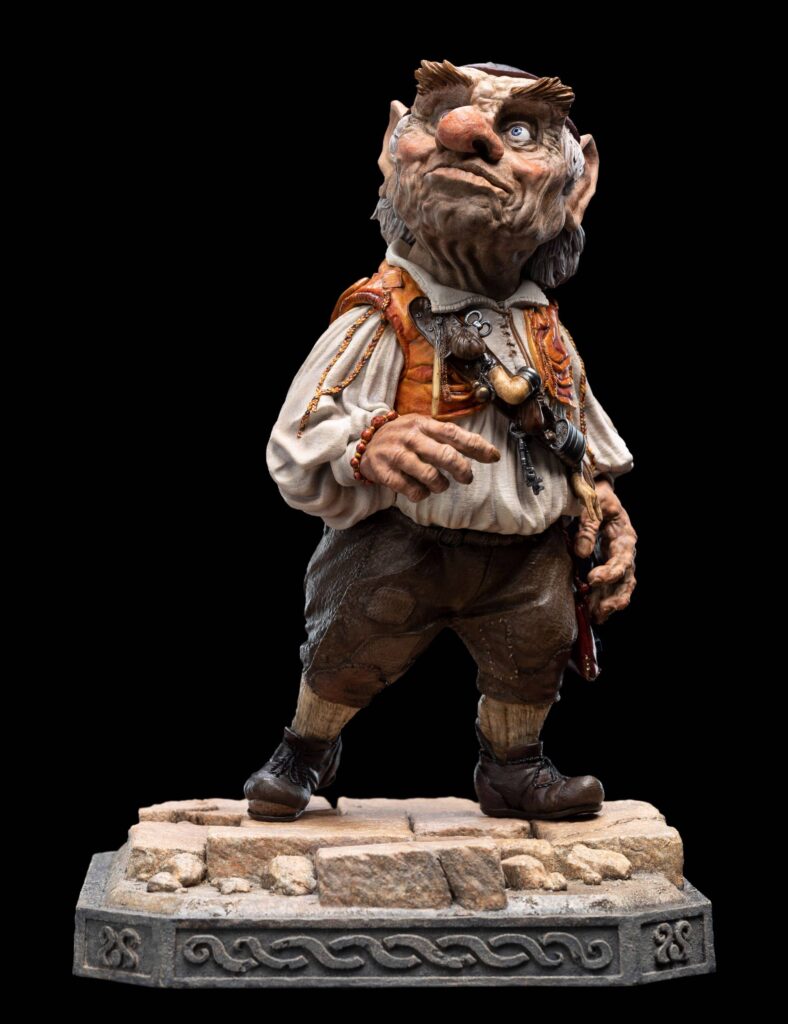
GEOMYTHA reads Hoggle as help that becomes trustworthy through correction. His initial transactions and submission to Jareth contrast with his later return to assist Sarah despite fear and shame. The relevant mechanism is the movement from protecting possessions and avoiding punishment toward answering a particular friend's need.
This is a changing role, not an immutable coward archetype. Fear explains the pressure under which he gives Sarah the peach; it does not erase the harm. Repair requires renewed action. Sarah's own use of his possessions to secure help also complicates an innocent-hero versus selfish-guide division. Friendship is learned within an imperfect exchange, rather than delivered by a flawless mentor.
The conventional film account describes a reluctant guide who betrays and then helps Sarah. GEOMYTHA reads the sequence as a test of whether assistance remains a bargain or becomes accountable friendship. The source supports that change of conduct; it does not make every bargain or fear spiritually false.
Labyrinth (1986), directed by Jim Henson; screenplay credited to Terry Jones; story by Dennis Lee and Jim Henson.
1986 film: initial encounter and bargaining; Jareth's threats; enchanted peach; Humongous rescue and reconciliation. AFI detailed synopsis; Henson Company archive entry on Hoggle's performance.
GEOMYTHA's language of relation, identity and return is an editorial comparison, not an established secret code, Egyptian derivation or statement of the filmmakers' complete intentions. Ordinary words such as “this,” “these” and “all” do not acquire an esoteric meaning merely by appearing in dialogue. Character function must be tested through actions and consequences. The film is the primary work; this pass checked official production accounts, catalogue scene descriptions and selected scholarly passages, not a fresh complete screening. No invented timestamps or claim of exhaustive scholarship. Pazdziora's paternal reading is attributed and contestable; Goodrum is abstract-only here. Later sculptures and adaptations do not independently prove the original story's meaning.
Claim tested: loyalty can replace fear-driven and transactional help. Positive case: Hoggle returns and disables the threatening gate machine. Countercase: delivering the enchanted peach harms Sarah; fear is context, not an acquittal. His earlier assistance also means he is never simply a pure betrayer. Sarah uses leverage over his possessions, so reciprocity must include her conduct too. Reject a fixed coward/traitor label, and reject the inference that forgiveness makes all prior choices harmless. This is a comparison of successive choices, not an esoteric definition of a pronoun.
Original character belongs to the released Labyrinth (1986). Henson Company's curated archive traces the project to 1983 development, an early Dennis Lee narrative and subsequent script work. Its 1984 scale-test account identifies Hoggle among early mockups. Its December 1985 entry explains the multi-performer puppet and reshoot. These accounts provide an earlier production trail, not access to a complete earliest treatment. Later Wētā sculpture is reception imagery only. No complete script comparison or fresh complete film screening claimed.