GEOMYTHAAll stories are the same story
Index Record

Horus the Elder — The Watcher
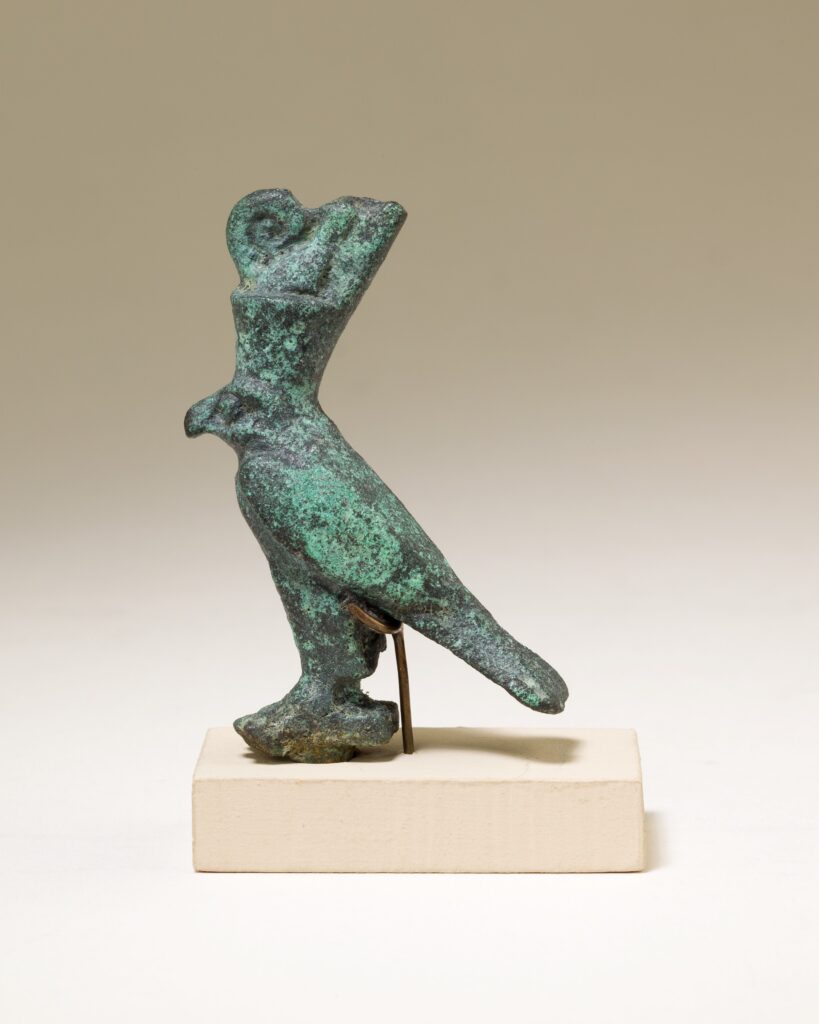
Horus falcon in double crown, 664–30 BCE
Horus falcon in double crown · Ancient Egyptian · maker not identified · 664–30 BCE · The Metropolitan Museum of Art, New York · 86.1.72 · Public domain / The Met Open Access ↗
Comparative falcon illustration for GEOMYTHA's Horus the Elder / watcher reading. The Met calls this object Horus falcon in double crown and explains its kingship associations; it does not specifically identify it as Haroeris. Named Haroeris evidence comes from British Museum EA20654, a different object.
Conventional Reading
Haroeris is a named manifestation of Horus, known as Horus the Elder. British Museum EA20654 is a lapis-lazuli amuletic figure identified as Haroeris, represented as a hawk-headed standing god in the double crown. The separate Met object 86.1.72 is catalogued as Horus falcon in double crown, 664–30 BCE, with kingship associations; its catalogue does not specifically identify it as Haroeris.
Geomytha Reading

GEOMYTHA distinguishes Horus the Elder / Haroeris as the watcher: pre-possessive vision, orientation and witnessing before awareness hardens into claim, role or throne. Horus the Son of Isis and Osiris instead carries This / formed identity. Seeing a form is not the same movement as claiming that form as the whole self.

The distinction is functional, not a division of every Egyptian falcon into a fixed two-part code. The watcher reading applies where the scene sustains observation without possession. Enthronement, conquest or defensive self-assertion is a counterexample, not automatic evidence for the watcher. The watcher can itself become an identity if someone claims to be a uniquely enlightened observer.

Why the Difference Matters

Historical museum records identify particular manifestations and objects: the British Museum names Haroeris; the Met names a Horus falcon associated with kingship. GEOMYTHA separately assigns the Elder to witnessing and the Son to formed identity (This). The falcon illustrates that contrast without proving either psychological correspondence.

Parent work / tradition / source

Ancient Egyptian Horus traditions

Source location / reference

British Museum EA20654 (named Haroeris); The Met 86.1.72 / object 570710 (generic Horus falcon illustration).

Reading Boundary

The watcher / Stellar Field is GEOMYTHA's interpretation, not the museum's definition of Haroeris. Falcon form and the double crown occur across Horus traditions. The featured Met falcon is a comparative illustration, not an object-specific identification of Horus the Elder; British Museum EA20654 provides explicit Haroeris evidence. Do not transfer This to the Elder solely because both figures are called Horus.

Source trail

Evidence beneath the record

Haroeris (Horus the Elder) — British Museum EA20654
Authoritative museum identification for Haroeris/Horus the Elder. This source is used to keep Haroeris distinct from generic Horus or Horus-the-child imagery; Geomytha’s 'vision before possession' reading is interpretive.
British Museum
Horus falcon in double crown — The Met 86.1.72
Museum authority for the object and generic Horus/kingship identification, not an explicit Haroeris attribution. Elder/watcher is GEOMYTHA's interpretation; British Museum EA20654 supplies named Haroeris evidence.
The Metropolitan Museum of Art