Ludo — Labyrinth
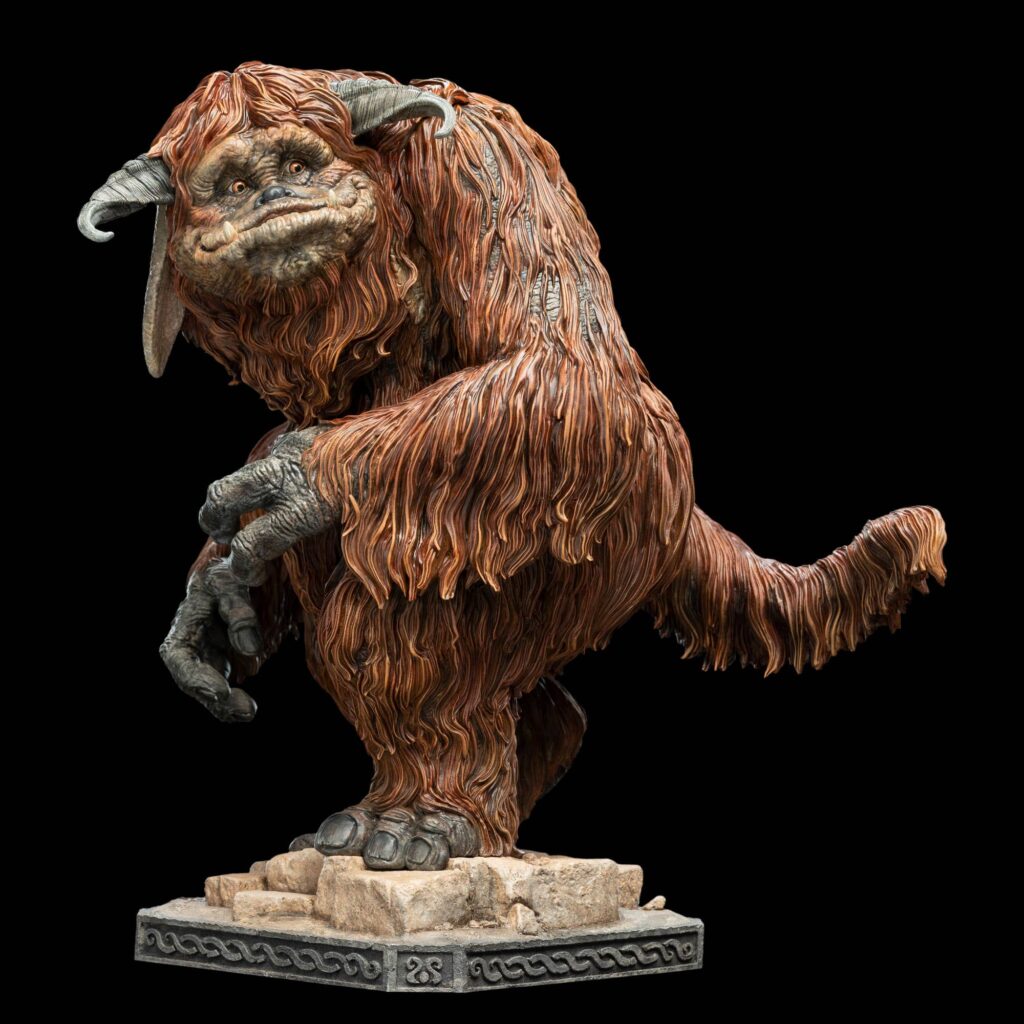
GEOMYTHA reads Ludo as strength directed toward companionship. His frightening appearance first invites a mistaken judgment; Sarah's response to his distress opens a relationship that later supplies practical help. The bog crossing gives the reading a specific action: an unusual bodily power makes passage possible for others.
The earlier draft's phrase “without domination” needs qualification. Ludo also uses rocks in combat. His contribution is protective and effective, not an absence of force. The useful distinction is between power exercised to help companions and power exercised to make others submit. Size and limited speech establish neither spiritual purity nor limited personhood.
The source presents a gentle companion with extraordinary strength and a useful power. GEOMYTHA reads the rescue and reciprocal assistance as power placed within relationship. Combat prevents this interpretation from becoming a claim of absolute nonviolence.
Labyrinth (1986), directed by Jim Henson; screenplay credited to Terry Jones; story by Dennis Lee and Jim Henson.
1986 film: Sarah frees Ludo; bog crossing; summoning rocks during the Goblin City battle; final companionship. AFI synopsis and Wētā's licensed character/product account.
GEOMYTHA's language of relation, identity and return is an editorial comparison, not an established secret code, Egyptian derivation or statement of the filmmakers' complete intentions. Ordinary words such as “this,” “these” and “all” do not acquire an esoteric meaning merely by appearing in dialogue. Character function must be tested through actions and consequences. The film is the primary work; this pass checked official production accounts, catalogue scene descriptions and selected scholarly passages, not a fresh complete screening. No invented timestamps or claim of exhaustive scholarship. Pazdziora's paternal reading is attributed and contestable; Goodrum is abstract-only here. Later sculptures and adaptations do not independently prove the original story's meaning.
Claim tested: strength becomes helpful through relationship. Evidence: Sarah responds to Ludo's vulnerability and his power later helps the group. Counterexample: rocks are also weapons in the Goblin City; the character cannot support an absolute no-force or no-harm doctrine. Dependence and strength coexist; being rescued does not make him passive thereafter. His large body and limited vocabulary do not prove moral innocence, spiritual attainment or a universal giant archetype. Retain a local protective-strength reading and abandon the draft's unqualified “without domination” formulation.
The released 1986 film is the narrative authority. The Henson archive identifies early 1983 development and 1984 character-size tests involving Ludo, Hoggle and Didymus. Those earlier materials are production witnesses, not evidence that a later comic or game supplies the original story. Wētā's later sculpture and its gallery description corroborate character identification but are not independent witnesses to every film scene. Earliest treatment and all draft scripts not examined.