Mad Tea Party — Alice’s Adventures in Wonderland
GEOMYTHA reads the table's continuing activity without a completed interval as captured time or failed Return. Changing seats provides fresh motion without resolving the condition that makes the participants keep moving. All This names the enclosing pattern only in that structural comparison, not every literal use of those words.
The issue is not repetition itself. A living ritual can nourish people and finish; the mechanism appears when activity sustains the enclosure instead of meeting its need. The Hatter's report of stalled time supplies a specific narrative anchor, while Alice's departure shows an available limit to the enclosure.
The conventional scene uses impossible time, riddles and rude manners for comic effect. GEOMYTHA compares its failure to clear and complete the meal with a self-maintaining loop; that comparison is narrower than a theory that all circular motion or social custom is false.
Lewis Carroll, Alice’s Adventures in Wonderland (1865), Chapter VII
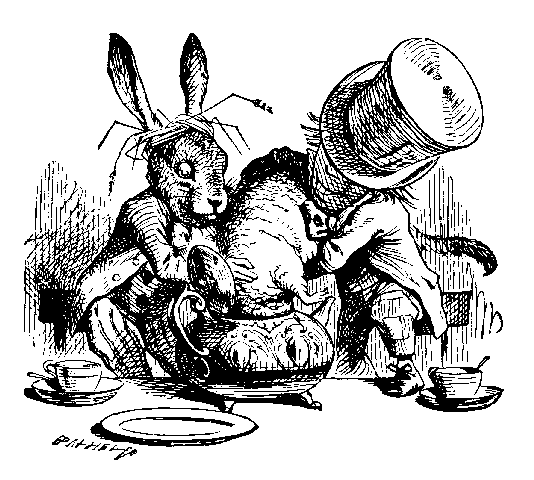
Carroll, Alice's Adventures in Wonderland (1865), Chapter VII; Gutenberg ebook 11. Tenniel illustration 27 in Gutenberg ebook 114.
Do not describe every ritual, meal or cycle as entrapment. The perpetual tea-time condition is reported by the Hatter; it does not establish that all Wonderland time has literally stopped. GEOMYTHA's failed-Return vocabulary is an editorial layer.
Alice can leave the table and reach the garden: she is not permanently imprisoned by the pattern. Repeated meals that restore attention and finish are counterexamples. The new illustration depicts the scene's absurd ending, not proof of an esoteric meaning for the Dormouse.
Primary narrative witness used here: Lewis Carroll, Alice's Adventures in Wonderland (1865), Chapter VII. The linked Gutenberg text is a modern digital transcription of the published work, not an original manuscript or first-edition facsimile. Tenniel's historical illustrations are separately credited. This review does not claim to establish the earliest surviving manuscript witness or comprehensive scholarly coverage.