Index Record

Manifest Destiny / American Progress
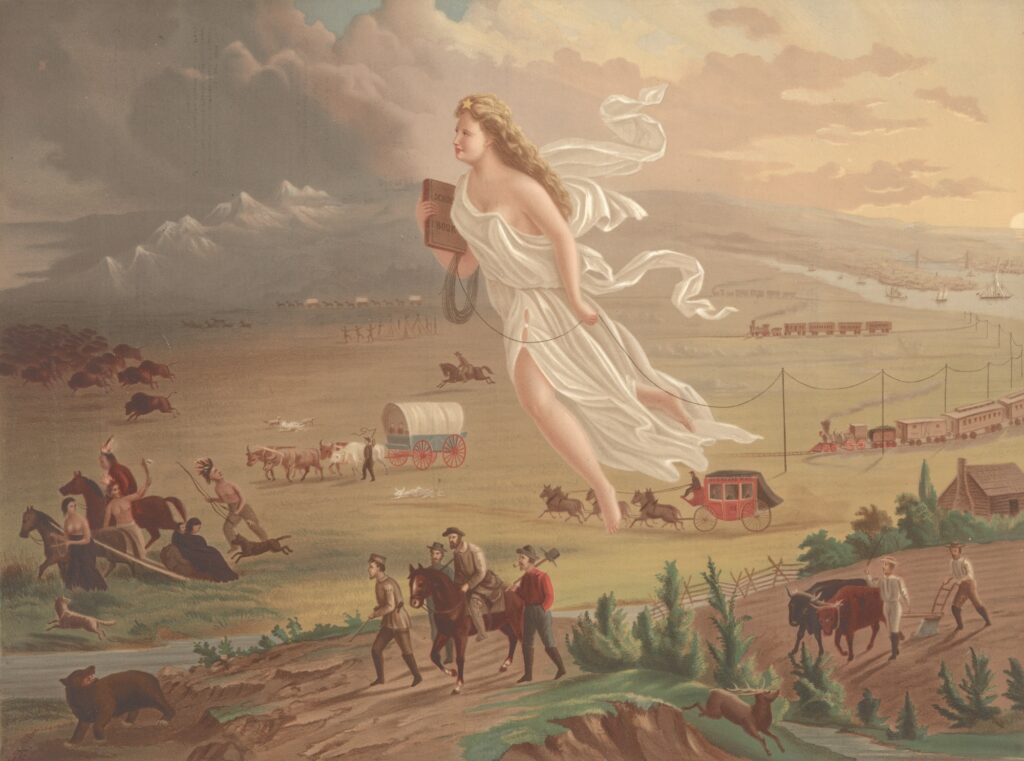
John Gast's 1872 painting American Progress, an allegory of westward expansion and Manifest Destiny
Gast’s allegory is the concrete historical image for the record’s documented Manifest Destiny field; Geomytha’s false-kingdom reading remains a separate interpretive layer.
Conventional Reading
Manifest Destiny was a nineteenth-century U.S. ideology used to justify and promote territorial expansion. John Gast’s American Progress visually allegorizes westward movement through a radiant female figure carrying signs of communication, settlement, and technological expansion.

Geomytha Reading

Geomytha reads Manifest Destiny as a false-kingdom distortion: the horizon becomes mandate, desired territory becomes proof of righteousness, and expansion is recast as sacred calling. The kingdom is dragged from symbolic orientation into land, possession, and collective identity.

Parent work / tradition / source

Nineteenth-century U.S. Manifest Destiny ideology and John Gast’s American Progress (1872)

Source location / reference

Library of Congress materials on westward expansion and Manifest Destiny; John Gast, American Progress (1872), public-domain historical artwork.

Reading Boundary

The Library of Congress materials establish the historical ideology and westward-expansion context; they do not describe Manifest Destiny in Geomytha terms. The false-kingdom reading is an interpretive argument and should not be attributed to the historical source.

Source trail

Evidence beneath the record

Manifest Destiny and westward expansion — Library of Congress

Institutional historical source for westward expansion and Manifest Destiny. Geomytha’s characterization of Manifest Destiny as a false kingdom is an interpretive argument, not a Library of Congress conclusion.

Library of Congress