Ned Land — Twenty Thousand Leagues Under the Seas
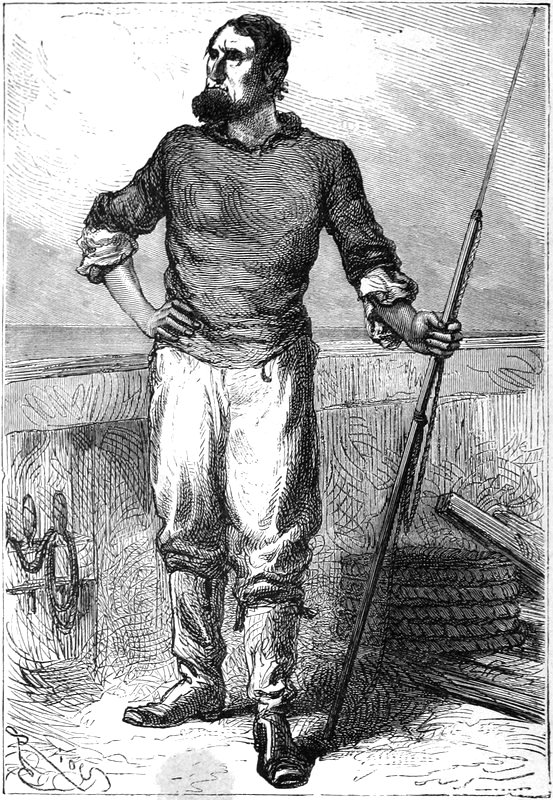
GEOMYTHA reads Ned’s recurring demand to leave as a return-function that interrupts the attraction of Nemo’s enclosed world. He asks whether the companions are free while Aronnax is absorbed in what they can learn. The reading applies to that concrete insistence on an exit, not to every desire to flee discomfort or every literal use of ‘return’.
The source character is a resourceful, impatient harpooner seeking actual liberty. GEOMYTHA treats his pressure toward departure as a counterweight to identity-enclosure, without claiming that physical escape guarantees inner transformation.
Jules Verne, Vingt mille lieues sous les mers (original French novel; early illustrated Hetzel edition)
Gutenberg 54873, I.4 (Ned and skepticism), I.7–9 (survival and confinement), II.4 (argument about captivity), II.22–23 (escape).
GEOMYTHA’s conditional literary comparison is distinct from the novel’s documented events and from any claim of Verne’s intention. No character is assigned a universal identity or diagnosis. Ned’s violence, impatience and hunting complicate an idealized liberator role. His skepticism and practical care sometimes outperform theoretical certainty. Escape is justified by captivity here; no universal instruction to abandon commitments follows.
Ned’s violence, impatience and hunting complicate an idealized liberator role. His skepticism and practical care sometimes outperform theoretical certainty. Escape is justified by captivity here; no universal instruction to abandon commitments follows.
Original story: Jules Verne’s Vingt mille lieues sous les mers, not a screen adaptation. The checked French text is Project Gutenberg 54873, with the early Hetzel illustrations; BnF catalogues the illustrated Paris volume as [1871]. This source is an accessible early illustrated witness, not a claim to the oldest surviving manuscript or a verified first-serial transcription. Targeted passages were checked for this record. Gutenberg 54873, I.4 (Ned and skepticism), I.7–9 (survival and confinement), II.4 (argument about captivity), II.22–23 (escape).