Index Record
Perseus and Medusa — Reflected Shield
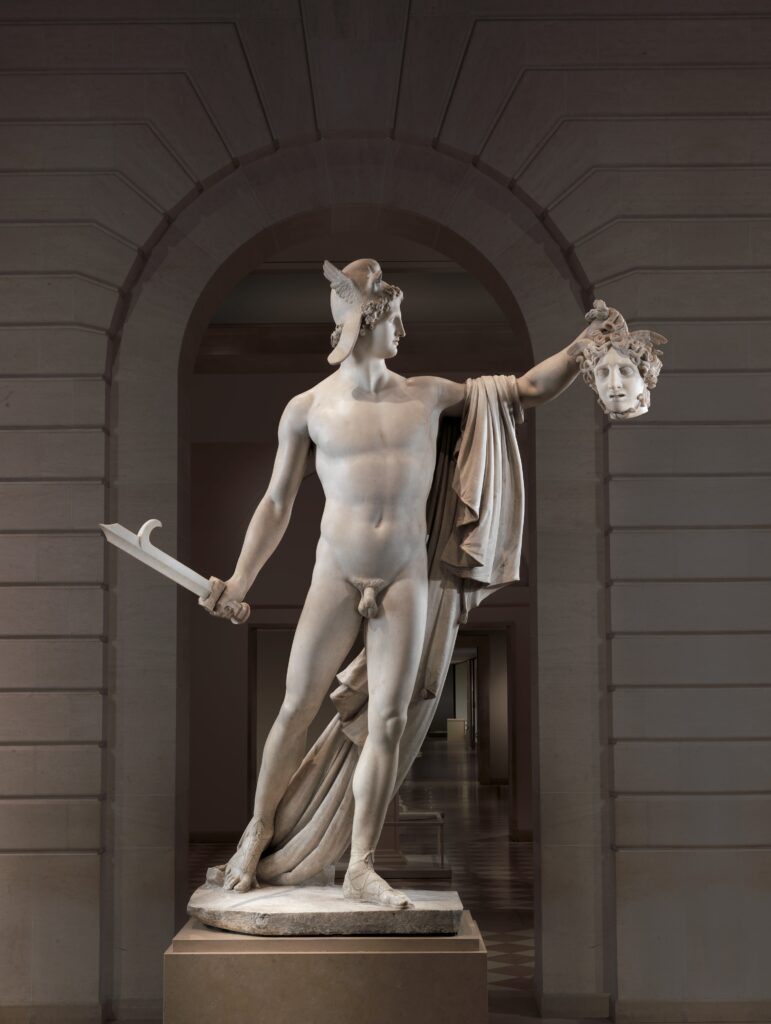
Canova's later depiction of Perseus and Medusa; Ovid's text supplies the reflected-shield episode.
Conventional Reading
Perseus avoids Medusa’s petrifying direct gaze by viewing her reflected form in a polished bronze shield before striking.
Geomytha Reading
The article uses Perseus as the counterexample: reflection remains a tool of orientation rather than becoming an object of worship or identity.
Why the Difference Matters
Ovid supplies the reflected-shield episode; Geomytha reads it as reflection used without identification.
Parent work / tradition / source
Ovid, Metamorphoses, Book IV
Source location / reference
University of Virginia Ovid Collection, Metamorphoses Book IV.
Reading Boundary
The reflected-shield episode is documented in Ovid; the restored-Am interpretation is Geomytha’s.
Archetype stress test
Ancient Perseus accounts and later visual retellings vary in the reflected-shield detail. A mirror can enable action rather than capture identity. This is a counterexample to treating reflected knowledge as inherently pathological.
Source trail
Evidence beneath the record
Ovid, Metamorphoses Book IV — Perseus and Medusa — University of Virginia
Primary literary source in an academic digital collection. Geomytha’s use of the shield as restored reflection rather than identification is interpretive.
Theoi Classical Texts Library