Red Crown of Lower Egypt — Deshret
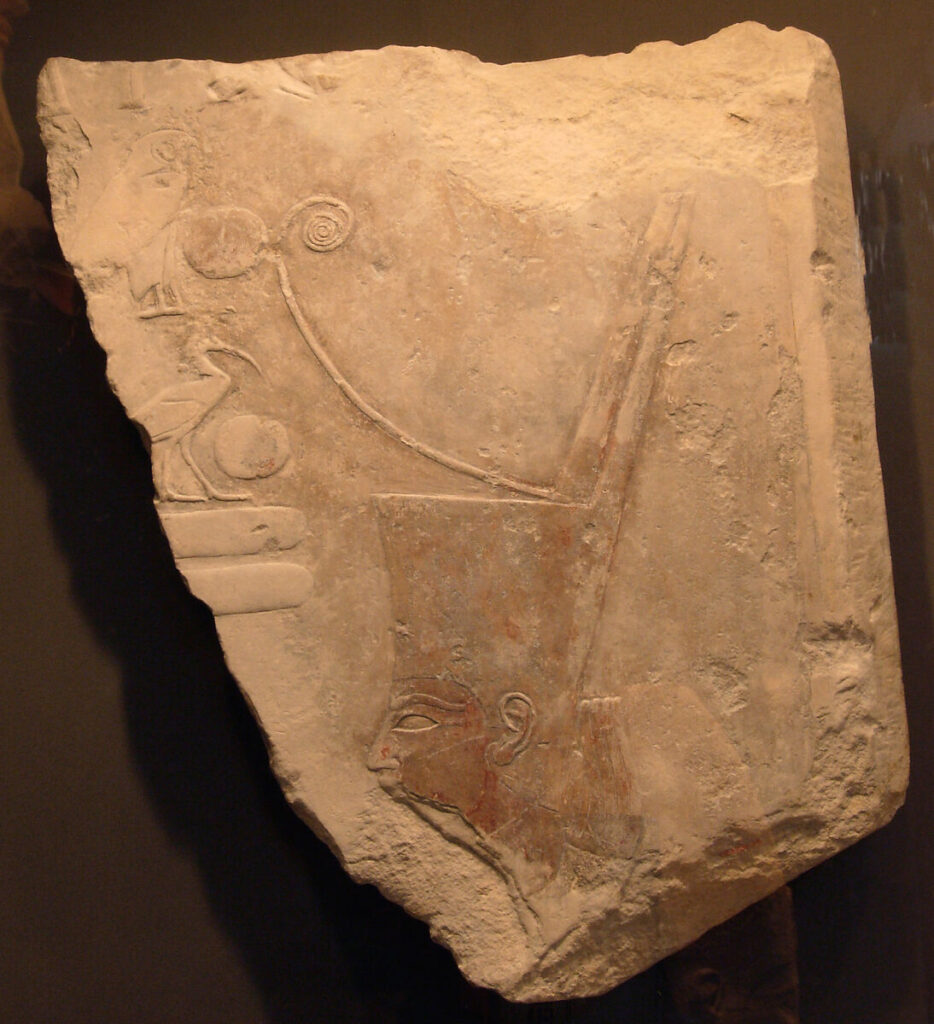
GEOMYTHA reads the Red Crown as a distinct designation capable of becoming part of a composite identity. Its significance lies in a relation, not in redness alone. Alongside the White Crown it allows one authority to present differentiated territories as a united domain. The reader can ask whether that unity keeps the differences answerable or merely makes them available for possession. Ahmose's relief adds a useful constraint: a sign associated with one region can operate elsewhere within a larger royal and ritual framework. Identity is not simply the place where an object happens to stand. This comparison concerns the making and circulation of a defined claim, not a claim that every red object signifies the same esoteric function.
The conventional reading identifies Lower Egyptian regalia within royal and ritual history. The GEOMYTHA reading asks how a regional designation contributes to a whole's identity. Keeping those levels distinct prevents color or findspot from becoming a substitute for evidence.
Ancient Egyptian kingship, royal regalia and the Two Lands
UCL Digital Egypt, Red Crown attestation and royal regalia; Narmer Palette, procession face; Met 06.1231.34, Ahmose I relief.
Lower Egypt is the northern, downstream region. Deshret the crown must not be conflated with every use of related Egyptian color/desert vocabulary. Red is not automatically evil, Set, blood or corruption. A worn crown's meaning is not exhausted by its material color or the artifact's archaeological location.
Claim tested: the Red Crown is a distinct sign within a larger claim of rule. Support: its combination with the White Crown and its royal use. Counterexample: Ahmose's relief comes from Abydos in Upper Egypt, so a strict location-equals-identity reading fails. Origin test: UCL reports an early Red Crown motif from southern Naqada, preventing a simplistic assertion that its earliest attestation proves invention in the Delta. Result: retain historically situated designation; reject universal color codes and geographic determinism.
Original story and earliest witnesses: material imagery, rather than a single origin tale, anchors this entry. UCL notes a Red Crown motif on a Naqada potsherd predating the royal pairing on Narmer's palette. The precise earliest origin is not reconstructed here. Narmer's ca. 3100 BCE procession and Ahmose's ca. 1550–1525 BCE relief are separate later witnesses with distinct contexts. The relief's crown, ruler and provenance are identified by the Met. Its date is not the date when the Red Crown was invented.