GEOMYTHAAll stories are the same story
Index Record

The Arnolfini Portrait — Jan van Eyck
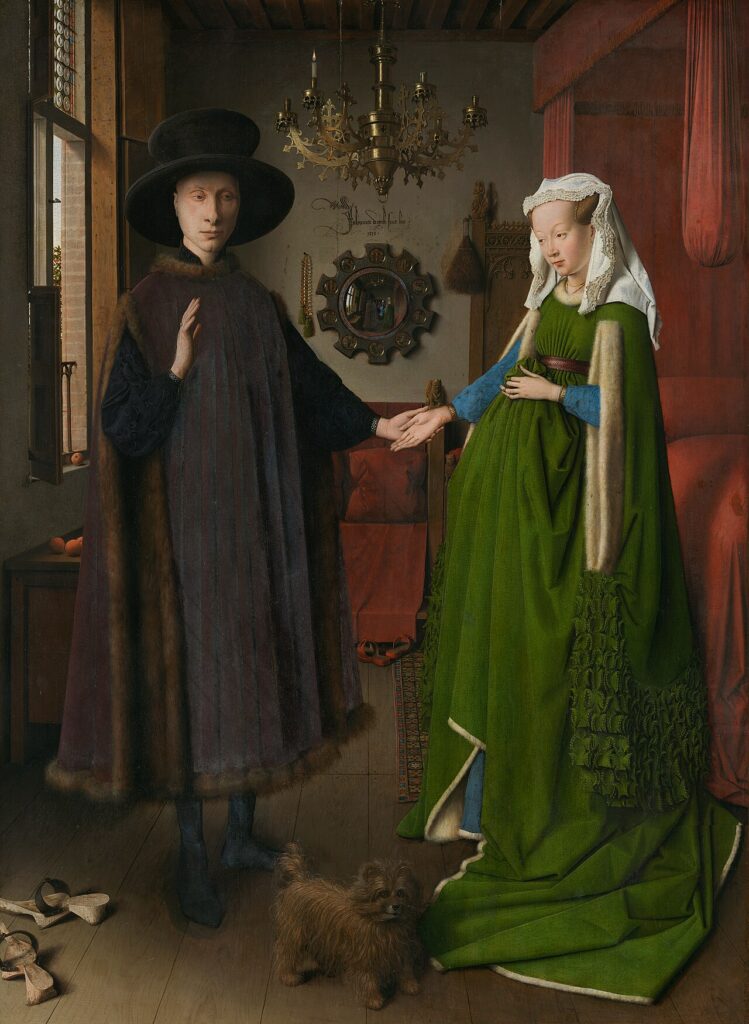
Jan van Eyck's 1434 Arnolfini Portrait with the convex mirror visible behind the couple
The Arnolfini Portrait · Jan van Eyck, Netherlandish · 1434 · National Gallery, London · Public Domain reproduction ↗
Lead visual for the article's union/fusion problem; museum scholarship is used specifically to prevent the old marriage theory from being overstated.
Conventional Reading
Jan van Eyck's 1434 double portrait shows a wealthy man and woman in a domestic reception room, with joined hands, a convex mirror, furnishings, and the artist's signature. The painting has a long history of marriage and betrothal interpretations, but National Gallery scholarship rejects treating it as a definitively documented marriage ceremony and returns to its early description as a double portrait of a husband and wife.
Geomytha Reading

Geomytha uses the portrait comparatively as an image of two persons, joined hands, witness-like reflection, room, social identity, and public unity. In The Ritual of the False One, it becomes a visual pressure point for asking when union preserves relation and when a projected public identity begins to dominate the bodies it joins.

Why the Difference Matters

The institutional record treats the work as a double portrait with a contested interpretive history. Geomytha uses its visual structure—two figures, joined hands, mirror, domestic room—as an analogy for social fusion without asserting a specific ritual event.

Parent work / tradition / source

Jan van Eyck, Netherlandish painting, 1434

Source location / reference

National Gallery, London, NG186.

Reading Boundary

The article does not claim that the painting documents a wedding, private marriage contract, betrothal ritual, pregnancy, or a historical Geomytha fusion rite. Those older theories are disputed or rejected in current National Gallery scholarship. The fusion reading is explicitly modern and comparative.

Archetype stress test

The Arnolfini Portrait's marriage-ceremony interpretation is disputed by the owning museum's scholarship. Joined hands and a mirror do not prove a ritual of self-erasure or fusion. Keep the GEOMYTHA question comparative rather than a claim about the sitters' inner lives.

Source trail

Evidence beneath the record

The Arnolfini Portrait — National Gallery
Authoritative museum source. The catalogue rejects treating the work as a definitively established marriage scene; Geomytha uses it comparatively rather than as documentary proof of a wedding ritual.
The National Gallery, London
The Arnolfini Portrait — Wikimedia Commons Image
Image-rights/provenance source. The painting should not be presented as a definitively documented wedding ceremony.
Wikimedia Commons / National Gallery work