Toby — Labyrinth
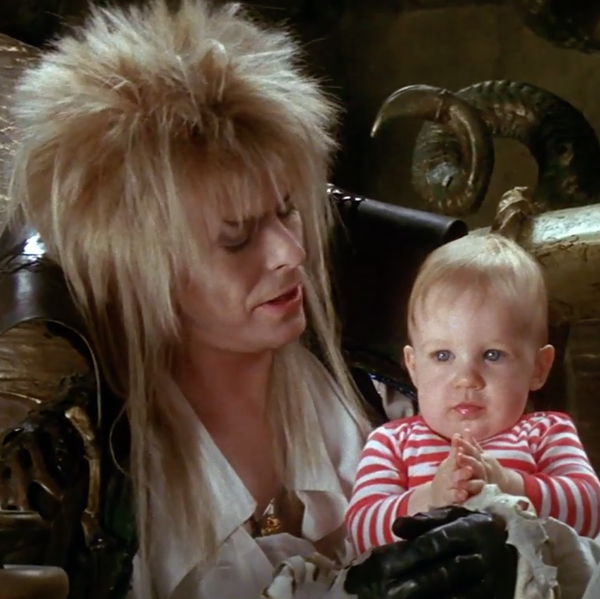
GEOMYTHA reads Toby as a living relationship that Sarah cannot responsibly replace with an imagined resolution of her frustration. His dependence gives the quest concrete stakes: a person must be brought back, rather than a puzzle solved for prestige. Returning the bear Lancelot to him makes the change visible through an ordinary act of care.
This does not reduce Toby to Sarah's inner child or to a token of her maturity. His needs matter independently of what she learns. Nor does the reading imply that an adolescent must become a substitute parent or renounce imagination. The ending retains the fantastic friends; responsibility and imaginative life can coexist. Pazdziora's paternal interpretation of Jareth supplies a critical comparison, while Goodrum's abstract places questions of desire and prescribed roles within their cultural setting.
The source gives Toby the plot role of an abducted child to be rescued. GEOMYTHA reads the recovery as renewed attention to a dependent person, while rejecting a reduction of the child to a symbolic object or a universal prescription of motherhood.
Labyrinth (1986), directed by Jim Henson; screenplay credited to Terry Jones; story by Dennis Lee and Jim Henson.
1986 film: babysitting and wish; Jareth holding Toby; staircase rescue sequence; return to the crib and gift of Lancelot. Sony official synopsis, AFI catalogue and Pazdziora's opening discussion.
GEOMYTHA's language of relation, identity and return is an editorial comparison, not an established secret code, Egyptian derivation or statement of the filmmakers' complete intentions. Ordinary words such as “this,” “these” and “all” do not acquire an esoteric meaning merely by appearing in dialogue. Character function must be tested through actions and consequences. The film is the primary work; this pass checked official production accounts, catalogue scene descriptions and selected scholarly passages, not a fresh complete screening. No invented timestamps or claim of exhaustive scholarship. Pazdziora's paternal reading is attributed and contestable; Goodrum is abstract-only here. Later sculptures and adaptations do not independently prove the original story's meaning.
Claim tested: care concerns an actual dependent person, not merely a heroic self-image. Evidence: rescue and homecoming direct Sarah back toward Toby. Counterexamples: his smiling interaction with Jareth complicates a uniformly terrifying visual account but does not establish consent to captivity. Toby's limited agency does not mean he lacks independent worth. Sarah's resentment cannot justify abduction, but responsibility must not become an argument that girls owe unlimited unpaid parenting. The fantastic companions persist at the end, so the reading cannot require repudiating fantasy. No equation of Toby with Horus or a universal divine-child archetype is established by this record.
Original work is Labyrinth (1986), not its later sequel comics, novelizations or games. The Henson archive traces earlier development to 1983 but the complete earliest narrative treatment was not accessed. Sony identifies the premise and available film editions; AFI supplies production and scene reference. Pazdziora discusses Jareth holding Toby as part of a paternal reading, which remains an interpretation. No fresh full screening, exact scene timestamps or claim of earliest surviving script examination.