Index Record

Toto

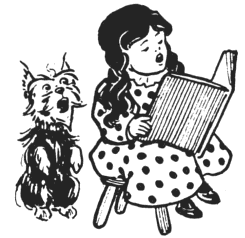
W. W. Denslow's 1900 illustration of Dorothy with Toto from The Wonderful Wizard of Oz.
Denslow’s original image establishes Toto inside the visual language of Baum’s 1900 book rather than relying on a copyrighted modern film still. It foregrounds the apparently minor companion whom the Geomytha reading treats as the story’s uninflated faculty of recognition.
Conventional Reading
Toto is Dorothy’s small dog and traveling companion in L. Frank Baum’s The Wonderful Wizard of Oz. Library of Congress materials identify the 1900 first edition as Baum’s work illustrated by W. W. Denslow, and the text itself identifies Toto as Dorothy’s dog. Toto accompanies Dorothy into Oz and remains one of the story’s recurring companions.

Geomytha Reading

In Geomytha, Toto functions as uninflated attention: the companion that does not seek completion, status, instruction, or recognition and therefore remains available to what is actually present. In the Wizard-revelation frame, Toto represents the small noticing faculty that moves behind spectacle while the larger identities remain captured by the projected authority.

Why the Difference Matters

Conventionally, Toto is Dorothy’s dog and companion. Geomytha asks what his narrative function reveals when the smallest, least status-seeking figure becomes the one associated with exposing false authority: companionship becomes a model of attention that has not been recruited by spectacle.

Parent work / tradition / source

L. Frank Baum, The Wonderful Wizard of Oz (1900); later adaptations including the 1939 film The Wizard of Oz

Source location / reference

Recurring companion to Dorothy throughout The Wonderful Wizard of Oz; pilot article centers the familiar Wizard-revelation/curtain sequence from the Oz story tradition.

Reading Boundary

The documented facts are that Toto is Dorothy’s dog and companion in Baum’s Oz story. The reading of Toto as instinct, uninflated attention, faithful recognition, or the faculty that sees through spectacle is Geomytha interpretation. This record does not claim Baum or the 1939 filmmakers consciously encoded the Is/Am/I/This grammar, nor that canine figures across traditions share one historically transmitted meaning.

Source trail

Evidence beneath the record

The Wonderful Wizard of Oz — Library of Congress first edition

Primary bibliographic/archival authority for the 1900 edition and its Denslow illustrations. Appropriate for bibliographic facts, first-edition context, and public-domain status; Geomytha interpretations remain separate.

Geo. M. Hill Co.; Library of Congress, Rare Book and Special Collections Division

The Wizard of Oz (1939) — Library of Congress

Authoritative bibliographic/archival record for the 1939 film. Use for film identity, date, credits, adaptation provenance, and registry status; Geomytha interpretation of Toto remains separate.

Library of Congress Online Catalog / AFI-Sonneborn Collection

Homer, Odyssey, Book 17 — Argos — Perseus Digital Library

Primary classical text in a scholarly digital library. Appropriate for documenting the Argos episode; the broader symbolic comparison to Toto is Geomytha interpretation.

Perseus Digital Library, Tufts University

John Wick (2014) — AFI Catalog

Authoritative film reference for production facts. The article's reading of the puppy as a surviving bond untouched by the protagonist's violent identity is interpretive rather than an AFI claim.

American Film Institute Catalog

I Am Legend (2007) — AFI Catalog

Authoritative film reference for production facts. The article's interpretation of Sam's symbolic function is Geomytha analysis, not an AFI assertion.

American Film Institute Catalog

Anubis / Jackal and the Journey of the Deceased — The Metropolitan Museum of Art

Museum curatorial record appropriate for the historical association of Anubis/jackal imagery with mummification and the journey of the deceased. Geomytha's cross-media pattern reading remains interpretive.

The Metropolitan Museum of Art