Weighing of the Heart — Papyrus of Ani, Frame 3
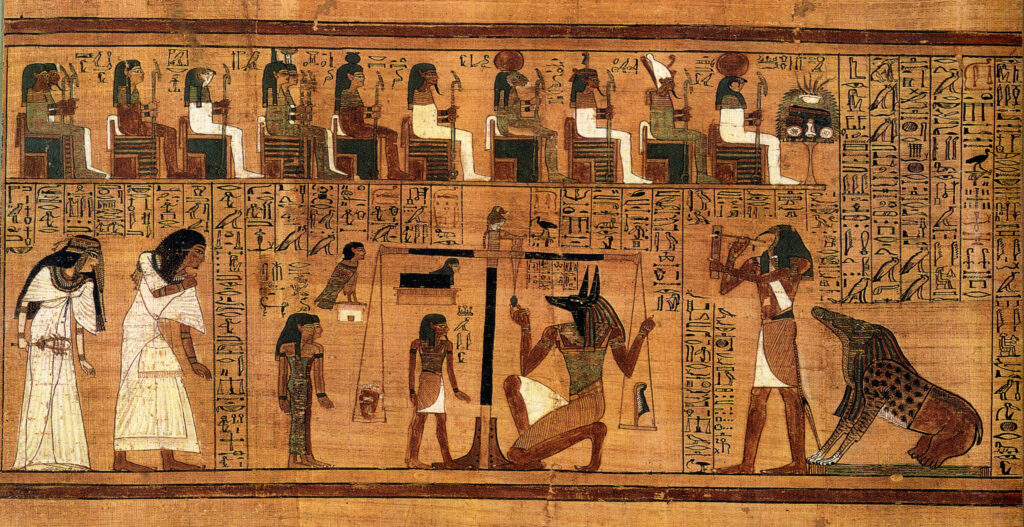
Geomytha uses this scene as a concrete image for testing whether a formed self-story or learned conditioning has become a defended claim. In that reading, the point is not that 'nature' is automatically pure or that learned material is false; the symbolic question is whether what has hardened into 'me' can be weighed without possession and returned to relation when it no longer serves.
Conventionally, this is a funerary judgment scene in which the deceased’s heart is weighed in relation to Ma’at. Geomytha reuses the same image as a disciplined symbolic test: not 'is this learned or innate?' but 'has this pattern become a defended claimant that mistakes familiarity for source?' The historical scene and the Geomytha mechanism are kept explicitly separate.
Book of the Dead / Papyrus of Ani
Papyrus of Ani, frame 3 (Ani’s Judgment), British Museum EA10470,3; judgment scene associated with Book of the Dead Chapter 125.
The documented historical material concerns ancient Egyptian funerary judgment, Ma’at as truth/order, the weighing of the deceased’s heart, and the roles of figures such as Anubis and Thoth. The reading of the scene as a test of conditioning, identity, 'second nature,' or This → Am is a Geomytha interpretation. This record does not claim that ancient Egyptian authors intended the Geomytha Is/Am/I/This grammar or a modern nature-versus-nurture theory.
