White Rabbit — Alice’s Adventures in Wonderland
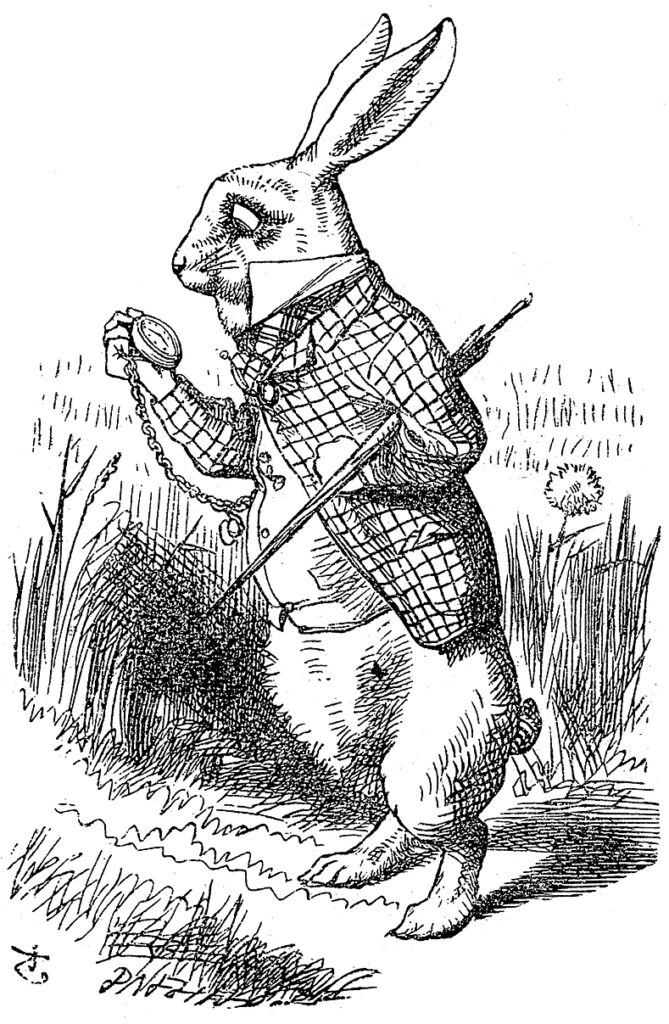
GEOMYTHA uses the Rabbit's hurried appearance as a comparison for attention captured before reflection. A striking signal organizes the next action before its consequences have been considered. In the grammar, I can begin pursuing This before Am has tested the relation between the signal and the situation.
This is a reading of the transition into pursuit, not a claim that the Rabbit commands Alice or that she follows from fear. Carroll explicitly makes curiosity her motive. The esoteric layer applies when fascination or urgency takes over the direction of attention; a rabbit, a watch, ordinary curiosity or the word late does not automatically carry that meaning.
In Carroll's source text, a curious child follows an unusual rabbit. GEOMYTHA compares the unexamined transition into pursuit with attention capture. The comparison depends on what attention does, not the literal meaning of hurry or an assertion that all curiosity is a trap.
Lewis Carroll, Alice’s Adventures in Wonderland (1865)
Carroll, Alice's Adventures in Wonderland (1865), Chapters I and XI; Project Gutenberg ebook 11.
The interpretation is GEOMYTHA's, not a definition supplied by Carroll. Curiosity is Alice's stated motive; do not rewrite it as obedience, anxiety or proof of a fixed identity. A useful warning or deadline can deserve prompt action.
Counterexamples: Alice checks the bottle for poison later in Chapter I, showing that she can pause and assess a signal; in Chapter XI the Rabbit insists on hearing more before a verdict. These actions limit any claim that the Rabbit always embodies unreflective urgency.
Primary narrative witness used here: Lewis Carroll, Alice's Adventures in Wonderland (1865), Chapters I and XI. The linked Gutenberg text is a modern digital transcription of the published work, not an original manuscript or first-edition facsimile. Tenniel's historical illustrations are separately credited. This review does not claim to establish the earliest surviving manuscript witness or comprehensive scholarly coverage.