Yellow Brick Road — Oz
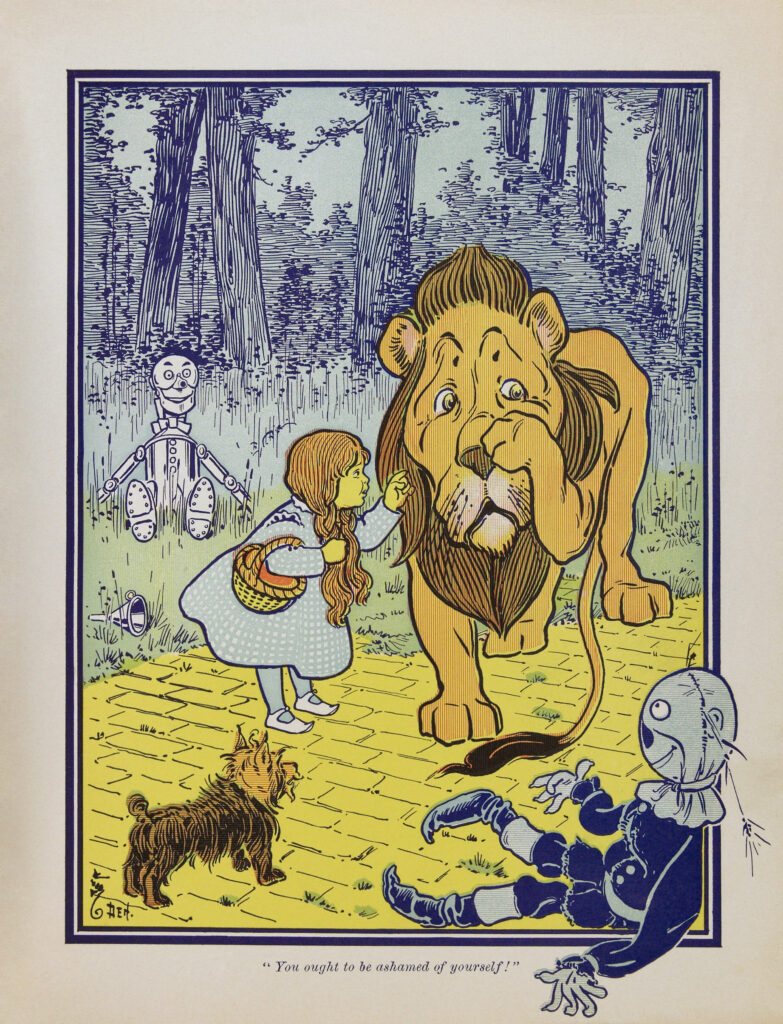
In Geomytha, the Yellow Brick Road is the outward search created by imagined incompleteness. Once I believes fulfillment lies elsewhere, movement toward a destination feels necessary. The road promises completion but terminates at projected authority, revealing the trap: a search born from lack can carry the traveler directly to the figure who claims the power to certify wholeness. The path becomes useful only when it exhausts that assumption.
Conventionally, the Yellow Brick Road is the route Dorothy follows toward the Emerald City. Geomytha reads the road as a directed search for completion that still terminates at projected authority, making the path itself a test of whether movement has mistaken destination for source.
L. Frank Baum, The Wonderful Wizard of Oz (1900); later adaptations including MGM’s The Wizard of Oz (1939)
Library of Congress first-edition Oz record; W. W. Denslow’s 1900 Yellow Brick Road illustration; Library of Congress record for the 1939 MGM film.
This is a scene-based GEOMYTHA comparison, not an authorial intention or psychological diagnosis. Keep Baum's 1900 book and MGM's 1939 adaptation distinct. A character can change function across scenes, and practical needs do not automatically become false identity.
The road really helps Dorothy reach others and learn; movement is not the whole error. The lens concerns the belief that a destination can certify complete being. A route used for an ordinary practical purpose is a counterexample.
Baum's The Wonderful Wizard of Oz appeared in 1900; the linked Library of Congress first-edition record is the earliest published book witness used here. MGM's 1939 film is a separate adaptation. Silver shoes belong to the book, ruby slippers to the film; the film's dream framing cannot silently determine the novel's meaning. Character actions and scene references must identify which version is being compared.