What remains when the person you love no longer plays the part you imagined.
There is a kind of goodbye that does not mean the love was false.
We often have trouble making room for that possibility. We hear that two people have separated and imagine that one of them must have stopped caring. We see someone leave a role and assume the gratitude they once expressed has been cancelled. We measure the truth of a relationship by whether its original shape survives.
But a relationship can change without everything that happened inside it becoming a lie.
This is not a command to leave. It is not a claim that staying means attachment or that every departure is enlightened. It is a question about the difference between caring for a person and requiring that person to remain the character we assigned them.
Two very different stories can help us see it: an ancient Greek account of Orpheus and Eurydice, and a farewell song written by Dolly Parton.
The hand that reaches back
Orpheus loses Eurydice and descends to the world of the dead. His music moves the powers below, and he is granted a chance to bring her back. There is a condition: he must lead her toward daylight without looking back too soon.
He turns. She is lost again.
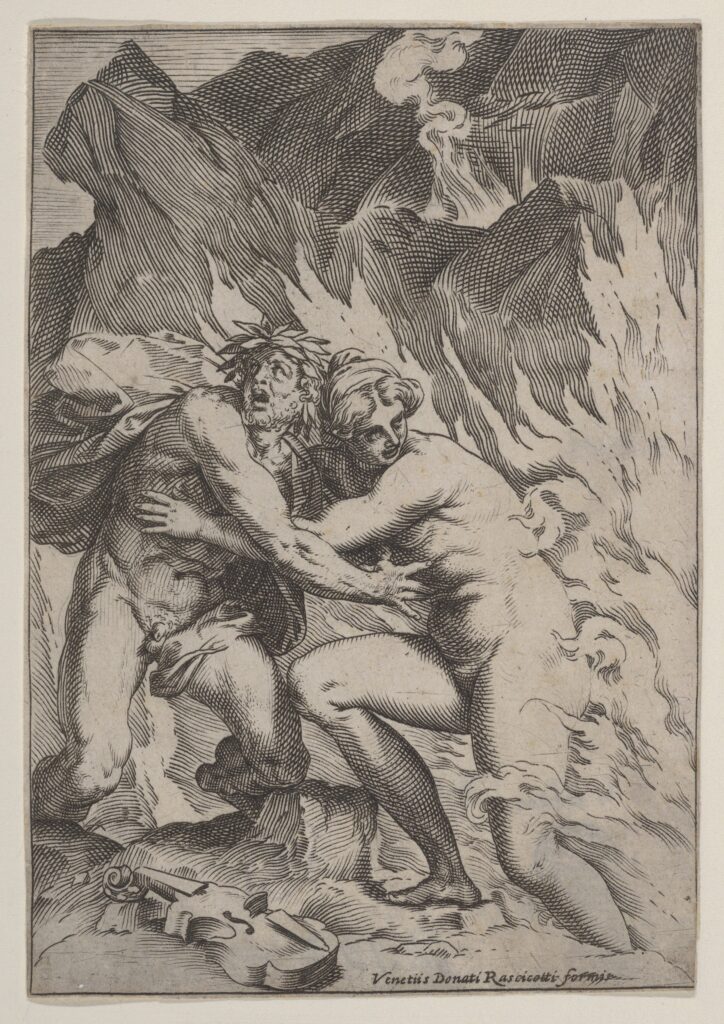
The scene has been told and retold for centuries. Ovid describes the failed return in Book X of the Metamorphoses; Virgil gives another account in Book IV of the Georgics. Later artists made the moment visible. In an engraving by Agostino Carracci, held by the Metropolitan Museum of Art, the figures reach toward one another but do not quite touch.
The image is painful because the desire is recognizable. Orpheus wants proof that the person he loves is still there. He cannot bear the uncertainty of the path.
Yet we should be careful with the story. It does not prove that he was selfish. His backward glance may be fear, grief, tenderness, or a terrible human mistake. Calling him an egoist would flatten a tragedy into a sermon.
What the story does allow us to examine is the pressure to turn love into certainty. The moment of not knowing can feel unbearable. We reach back for a sign. We want the other person to be visible, available, and exactly where we expect them.
Sometimes that need is understandable. Sometimes it becomes a claim.
The difference matters.
A farewell that kept its gratitude
In 1974, Dolly Parton left The Porter Wagoner Show after years of performing with Porter Wagoner. The professional separation was difficult. Parton wrote I Will Always Love You as a farewell.
This was not originally a romantic breakup ballad. Parton's own account explains that the song was a way to say thank you while leaving a partnership that no longer held her future. She could value what Wagoner had given her without agreeing to remain in the same role forever.
That history does not make Parton's decision a perfect model for every relationship. It was a particular professional separation, with its own conflicts and obligations. But it gives us something unusual: a documented example of affection and departure existing at the same time.
A person can be grateful and still need to change their life.
A person can wish another person well and still decline to continue the old arrangement.
The relationship was real. The role was not permanent.
That is the difference this essay is trying to preserve.
When the role begins to own the person
GEOMYTHA uses four small words to describe the movement from experience into identity: IS, AM, I, THIS.
IS is the fact of living relation before we explain it. Two people meet. They affect one another. No one owns that fact.
AM is the relationship as it happens. We remember, listen, learn, depend on one another, and respond. Love becomes visible through acts of care, not through a permanent title.
I is the capacity to say what we need and make choices. It is useful. But it can become the claimant: the part that says the other person must remain because my identity depends on their remaining.
THIS is the picture the claimant defends. This is my partner. This is my mentor. This is my child who must always need me. This is the life that proves I mattered.
A picture can help us recognize a relationship. The trouble begins when we mistake the picture for the living people.
Then change feels like annihilation. A new job becomes betrayal. A child growing up feels like abandonment. A friend finding another circle feels like a judgment on our worth. We are not only losing an arrangement; we are losing the version of ourselves that arrangement supported.
That is the claimant's fear.
It does not mean the grief is imaginary. Loss is real. So are promises, practical obligations, shared homes, and the effects our choices have on other people. The mistake is to conclude that because something was real, it must never change.
Release is not disappearance
There are two easy ways to misunderstand surrender.
The first is to think surrender means getting everything you want by becoming sufficiently spiritual. In that version, letting go is a trick for making the other person return. It is control dressed as wisdom.
The second is to think surrender means never asking anything of anyone. In that version, we avoid hard conversations, refuse to name harm, and call our silence peace.
Neither is release.
Release means recognizing that the other person is not an instrument for keeping our identity alive. We can ask, negotiate, repair, and keep commitments. We can also hear an answer we did not want without declaring that our existence has been denied.
This is different from the question explored in Surrender Is Not Compliance. There, the problem is whether a yes or no serves a responsible boundary. Here, the problem is whether we can allow the person and the role to be different things.
A parent can remain loving as a child becomes independent. A friend can honor years of closeness when the friendship changes. A couple can sometimes rebuild their relationship by releasing the old script rather than demanding that one person resume the part they used to play.
And sometimes a person must leave. Leaving can be necessary. It can also be careless. The act alone does not reveal its meaning.
The same is true of staying. Staying can be devotion or fear. It can be repair or control. We have to look at what is actually happening.
The question beneath the goodbye
Try separating three things the next time a relationship changes.
First, what do I feel? Name the grief, affection, anger, relief, or fear without making it a command for someone else.
Second, what do I owe? There may be a promise to keep, a child to care for, a debt to settle, or an apology to make. Release does not cancel responsibility.
Third, what am I demanding? Am I asking another person to behave a certain way so that I can continue to believe a story about myself?
That third question is often the hardest. It asks us to notice the difference between wanting connection and needing control.
Orpheus's backward glance remains tragic. We do not have to condemn him to learn from it. Parton's farewell remains complicated. We do not have to turn it into a universal rule to hear its lesson.
The old stories do not tell us that love means never looking back or always walking away. They show how difficult it is to let a living relationship be more than the image we have made of it.
The love may remain. The role may change.
The person is not the role.
And letting go of the role does not require us to deny the love.
Sources and further reading
See Dolly Parton’s official history at https://www.dollyparton.com/news/dolly-leaves-porter-wagoner-show and The Met object record at https://www.metmuseum.org/art/collection/search/341366. Ancient accounts are Ovid, Metamorphoses X, and Virgil, Georgics IV; no common historical encoding is asserted.