Movement can change the reach of an identity without changing its claim.
A horse with wings makes a compelling image of freedom. Something bound to the ground has acquired another possibility. Before asking what the creature means, however, we should ask what happens in the particular story.
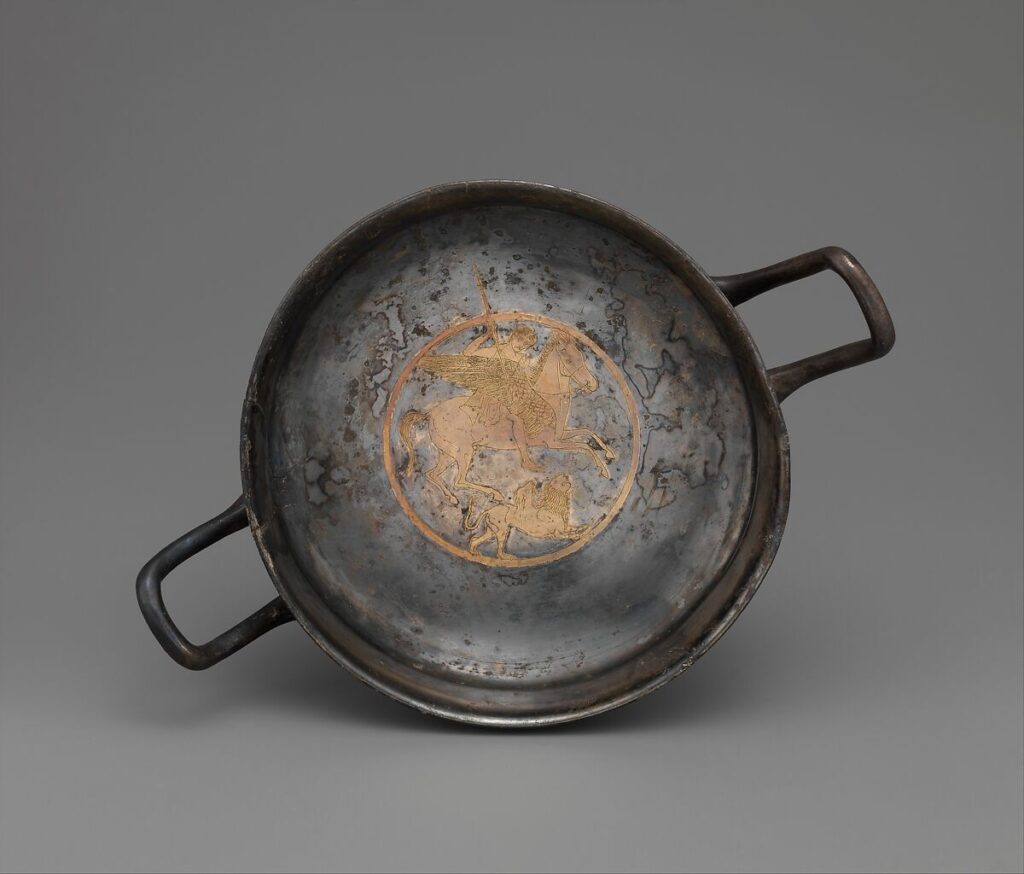
In a Greek gilt-silver cup at the Metropolitan Museum of Art, Bellerophon rides Pegasos while fighting the Chimaera. The museum identifies the figures and describes a combat, not an abstract escape from every limit.
That difference is the beginning of a disciplined GEOMYTHA reading. Flight is a capacity. What the capacity serves remains a question.
Freedom to do what?
You can leave a familiar place and carry its argument with you. You can gain money, recognition, or mobility and remain governed by the demand to prove yourself to the same imagined audience.
Those gains may be real. They may make life safer or more workable. The mistake would be to declare them meaningless because they do not answer every question about identity.
The narrower question is whether a new power changes the relationship or merely expands the range of the old claim.
Someone who needs to be admired can seek a larger audience. Someone who needs an enemy can find one farther away. A person who has learned to cooperate can also use greater reach to help more people. Mobility determines none of these outcomes by itself.
The wings do not settle what the rider is doing.
Does Pegasus equal Horus?
The original idea proposed Pegasus as Horus made mobile. In GEOMYTHA, Horus is This: the identity formed after the claimant takes possession of an appearance. That gives us a hypothesis to test, not a label to attach permanently to a Greek creature.
If a particular scene shows an identity using power to extend its own authority, the comparison may illuminate it. If the scene instead shows assistance, transport, or a capacity directed toward a concrete danger, insisting that Pegasus must represent hardened identity can obscure the event.
The cup’s pictured battle does not establish that Pegasus is the claimant, the identity, the source, or any single member of GEOMYTHA’s grammar. Rider, horse, adversary, and situation have to be examined in relation.
That is why this essay keeps the proposed equation provisional. A symbolic system becomes less useful when every image is assigned before the story begins.
The name is not a bridge by itself
The voice note also reached toward Steely Dan’s Peg. The band’s official Aja listing confirms that Peg belongs to that album. It does not establish that the song’s title abbreviates Pegasus or that its creators intended a Greek-mythic reference.
The resemblance can be the starting point for a question. It cannot carry the conclusion.
If later creator evidence or the actual lyric supports a specific comparison, it can be developed separately. This essay does not need an undocumented musical connection in order to ask what movement does to a self-image.
The difficult counterexample
A person escaping a dangerous situation may need distance, a vehicle, money, or a new name. Calling that escape merely another identity performance would be a failure of the reading.
Practical freedom matters. A larger field of action can be the condition that makes reflection possible. The question about attachment should never erase the difference between having options and being trapped.
GEOMYTHA’s distinction is more precise. Is is not produced by the achievement that displays it; Am is not the same as an image demanding admiration. I becomes claimant when expanded ability must prove a permanent identity. This is the story that says the new reach finally makes us complete.
You can keep the capacity while examining that last claim.
A useful return
Think of one new freedom you are seeking. Name its concrete value: safety, time, access, creative possibility, or room to care for someone. Then name the verdict you hope it will deliver about you.
The first may deserve steady effort. The second may keep moving farther away each time you approach it.
You do not have to clip the wings to question the rider’s demand.
Gain the freedom you need. Leave room to ask what it serves.
Sources and limits
The Met’s Gilt silver kylix, 2015.260.2, late fifth century BCE, documents the depicted Bellerophon/Pegasos/Chimaera scene. Steely Dan’s official Aja listing confirms the track title only. No artwork file, song audio, lyrics, hidden creator intention, or Pegasus/Horus equivalence is cleared or asserted by this text-only essay.