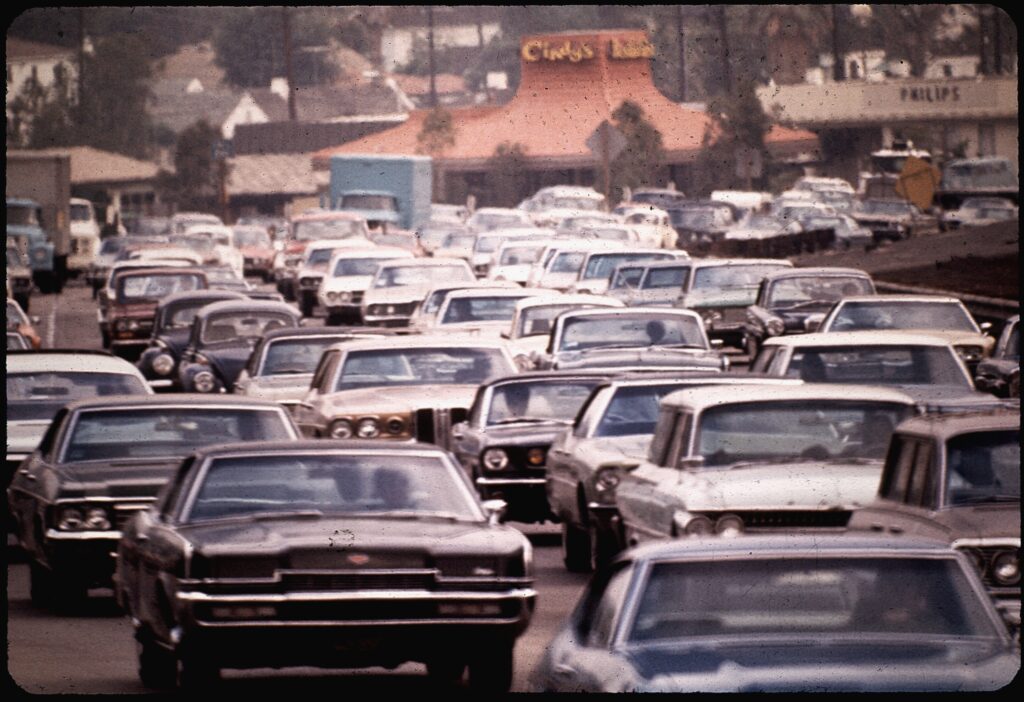
In a 1972 photograph of the Hollywood Freeway, cars are packed almost bumper to bumper.
There are sedans, headlights, chrome, and a crowd of people trying to get somewhere. Every driver has a reason to be on the road. Yet the road that promised speed has become a place to wait.
That is the strange thing about the fast lane. It can become an identity long after it stops getting you anywhere.
We know a smaller version of this feeling. A shift runs late. The phone lights up with another task. We answer before we ask whether it matters. For a moment, being needed feels good. Then quiet arrives—and we start looking for something else to do.
What happens when moving quickly stops being a useful choice and becomes the way we prove who we are?
The song that makes speed sound irresistible
In 1976, the Eagles released Life in the Fast Lane on Hotel California. The record is full of sharp, polished sound. Joe Walsh's guitar riff gives this song a powerful forward push before a listener has time to think much about where the story is going.
That riff was not originally a secret code or an elaborate theory about human consciousness. Walsh later explained that it began as a guitar exercise. Glenn Frey heard the idea and recognized a song.
Frey already had a title. In liner notes published with The Very Best of the Eagles, he described riding with a drug dealer who drove too fast. Frey asked him to slow down. The driver's reply supplied the phrase life in the fast lane.
The song grew into a story about people surrounded by pleasure, status, and stimulation who have lost their sense of what any of it is for. Frey described it as a picture of the wealthy and miserable. These are the musicians' documented accounts of the song's background, not a GEOMYTHA theory about hidden intent. Read Frey's account.
The music moves brilliantly. The characters do not necessarily move forward. That difference is where our reading begins.
When a useful pace becomes a role
Speed is useful. Sometimes you have to act immediately. The restaurant is suddenly full. A child needs help. An ambulance is coming. Someone depends on a promise you made.
But after a while, an intense pace can give us something other than results: a recognizable version of ourselves.
We become the one who always handles it. The one who never stops. The one who works harder, responds faster, takes on more, and needs less sleep. People may admire that person. We may admire that person too.
Then the danger changes. We are not only trying to finish the work. We are trying to keep the role alive.
A quiet afternoon feels like evidence that we are falling behind. A missed message feels like a failure. Another person's success feels like a challenge. Rest becomes difficult, not because the task is unfinished, but because our picture of ourselves has nothing to do.
The sequence is familiar: intensity, reward, repetition, identity, and then the fear of stopping.
The fast lane is no longer a tool. It has become a demand.
What GEOMYTHA sees beneath the highway
GEOMYTHA begins by watching the action before assigning it a symbolic name.
There is a real need. We act. We learn that speed can help. We repeat what works. Then we make a claim: I am the person who is always in motion.
That is the turning point. An ability has been mistaken for the whole person.
In GEOMYTHA's grammar, the trouble begins when a useful action becomes a defended I and finally a rigid this—a role we must continuously prove. The problem is not the ability to act, plan, or work hard. The problem is being unable to put that ability down when it is no longer needed.
The Eagles did not claim to write about this grammar. Their song offers a recognizable human story that we can read through it.
And we do not need to condemn ambition to recognize the trap.
The older warning: a chariot nobody can slow
A brief comparison comes from the Greek story of Phaethon. In Book 2 of Ovid's Metamorphoses, the young man wants to drive the chariot of the Sun as proof of his relationship to its driver. He receives the reins but cannot control the horses, and the journey turns disastrous.
This is not evidence that the Eagles borrowed the myth. The stories are very different, and a full reading of Phaethon needs its own attention.
For this question, one similarity is enough: the need to prove a role can overpower the purpose of the role. Phaethon wants the chariot to prove who he is. The people in the fast-lane song keep pursuing a life that no longer seems to satisfy them.
Neither story tells us that movement itself is wrong. Both give us a reason to ask who is holding the reins.
The hard test: when the fast lane really is necessary
Imagine two workers having the same demanding week. Both work quickly. Both stay late. Both are tired.
One is responding to an actual emergency or a temporary deadline. When the need passes, they can stop, recover, and still know who they are.
The other keeps finding a new emergency. When one task ends, they need another. Praise feels like proof of worth, and stopping feels like disappearing.
From the outside, these workers might look identical. We cannot diagnose someone's inner life from a full calendar, a long shift, or a strong work ethic. Economic pressure can also make rest unavailable. Not everybody who works too much has freely chosen that pace.
The useful distinction is not fast versus slow. It is chosen action versus compulsory self-maintenance. Does the pace answer to a real need? Can it change when the need changes? What happens to the person when the applause, pressure, or deadline goes away?
Rest can also become a badge of identity. Someone may make a show of being above work while depending on others to carry the load. GEOMYTHA is not asking us to worship slowness. It is asking us to stop worshipping a role.
Release what the speed was proving
The Waning Gibbous Moon gives GEOMYTHA the directive Release / Give Thanks. Scorpio gives the directive Penetrate: look beneath the visible behavior to the demand holding it in place.
Here they make a practical pair.
Penetrate the claim: What am I trying to prove by staying in motion?
Release the proof: What can end when the actual work is done?
Give thanks for the useful part. The hard shifts paid bills. A burst of attention solved a problem. The ability to act under pressure may have served you and others well. You do not need to despise that gift in order to stop spending it every hour.
When your next task ends, try a small test. Do not immediately replace it with another performance. Give yourself a few ordinary minutes without turning them into an achievement. Notice what insists that you are falling behind.
Then ask whether the next movement serves your life—or only the image of the person who never stops moving.
Give thanks for the speed when it helped. Release it when its work is finished.