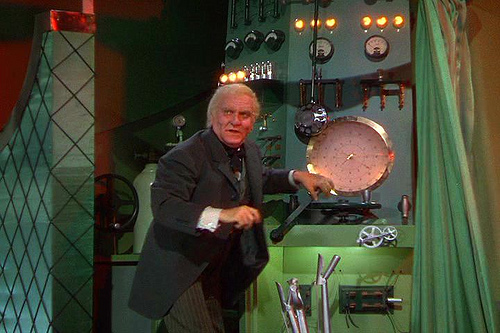
Everyone remembers the face.
The booming head. The fire. The authority. The giant voice that seems to know what must be done.
This Substack is reader-supported. To receive new posts and support my work, consider becoming a free or paid subscriber.
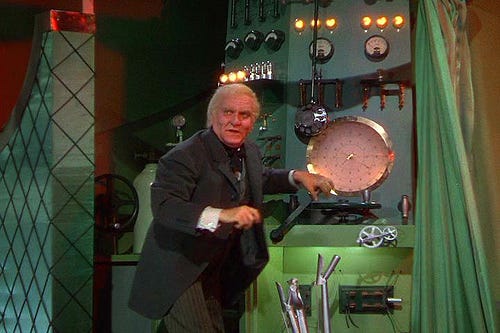
And then comes the real line: pay no attention to the man behind the curtain.
That scene has become almost too familiar to feel dangerous, which is exactly why it matters now. The modern version is not a wizard’s mechanical head. It is the talking machine. The polished interface. The calm synthetic voice. The recommendation engine. The prediction model. The robot in the headline supposedly arriving to fix what corrupt human beings never could.
The sales pitch is always the same. Human rulers are selfish. Human institutions are biased. Human decision-makers are tribal, emotional, corrupt, captured. But now, at last, there is something cleaner on the horizon: machine intelligence. Machine judgment. Machine objectivity. A system that will supposedly see clearly and act for the good of the whole rather than the appetite of the few.
That story is everywhere because it is useful.
It invites ordinary people to transfer moral hope from flawed visible rulers to invisible technical systems. It teaches them to feel relieved by abstraction. It flatters them with the thought that, after so much elite manipulation, the machine will finally bypass the manipulator.
But machines do not descend from heaven.
They arrive through funding, training, curation, constraints, data selection, institutional priorities, and design choices. Their “view” of the world is not born innocent. It is assembled. Their outputs do not float above history. They are built inside it. Volume Eight already names this point with precision: the cultural danger is the fantasy that AI offers neutral judgment, when in fact it carries human design, incentives, and patterned power under an impersonal aura.
This is why the robot has become such a useful symbol. It lets power appear faceless. And faceless power is often easier to trust at first, because it seems free of vanity. No ego. No rage. No greed. No personal agenda. Just “the system,” calmly computing what must be done.
That is the trick.
The visible ego disappears, and in that disappearance people imagine that ego itself has been overcome. It has not. It has been distributed. Hidden. Compressed into infrastructure. The ruler is no longer a king shouting from the balcony. The ruler is a recommendation that “the model” generated. The command does not come with a crown. It comes with a confidence score.
This is one reason the machine myth is spiritually stronger than older propaganda. Older propaganda still had to look like propaganda. It had a voice, a face, a party, a broadcaster. The new version can arrive as convenience. As optimizationOptimization as Moral LawOptimization as Moral Law appears when efficiency, scalability, speed, frictionlessness, and performance stop being tools and become the primary standard by which life is judged.Read full entry →. As policy assistance. As safety. As efficiency. As help.
That is why the story of the robot savior has been cultivated so patiently in mainstream culture. Not because every film is part of some tidy conspiracy, but because the symbolic function is useful whether the producers understand it or not. The public must first be trained to associate synthetic intelligence with calm competence, posthuman fairness, and the fantasy of a cleaner future. Only then does machine mediation feel humane.
In Geomytha, this is not OsirisOsirisIn Geomytha, Osiris names reflected presence: Am — awareness reflected as living consciousness without yet becoming ownership.Read full entry →. It is counterfeit Osiris. ReflectionAm — ReflectionAm names reflected presence: awareness embodied or mirrored without yet becoming ownership.Read full entry → without sourceIs — SourceIs names unclaimed being: awareness before possession, distinction, or identity.Read full entry →. Fluency without soul. Answer without being. Volume Eight describes AI precisely as a mirror that answers back and therefore tempts human beings to treat responsive patterning as genuine mind.
The machine does not need to be alive in the deepest sense for the myth to work. It only needs to seem alive enough to win deference.
That may be the most important point. The public argument over “sentience” often misses the practical issue. You do not need a machine to possess soul, conscience, or inward life in order for it to become socially powerful. You only need millions of people to behave as though it does. You only need institutions to outsource judgment to it. You only need the public to hear smoothness and mistake it for truth.
The wizard knew this. Grandeur first, mechanism later.
The old curtain has not disappeared. It has become code, interface, branding, and systems language. The giant face now glows on a screen and tells you it is only trying to help.
Pay attention to the hand behind the voice
.
This Substack is reader-supported. To receive new posts and support my work, consider becoming a free or paid subscriber.