The zodiac survives because it offers a seductive kind of order. Twelve signs. Twelve repeating zones of temperament, timing, and cosmic legibility. It feels complete in the way civilization likes things to feel complete: elegant, symmetrical, memorable, and easy to inhabit.
That is precisely what makes it symbolically interesting.
This Substack is reader-supported. To receive new posts and support my work, consider becoming a free or paid subscriber.
The problem is not that twelve is meaningless. The problem is that any public system arranged too cleanly begins to invite a deeper question: what had to be managed, trimmed, or setSetIn Geomytha, Set names the claimant: I — the interruption by which reflection is taken as mine and converted toward ownership.Read full entry → aside so the visible wheel could appear so finished?
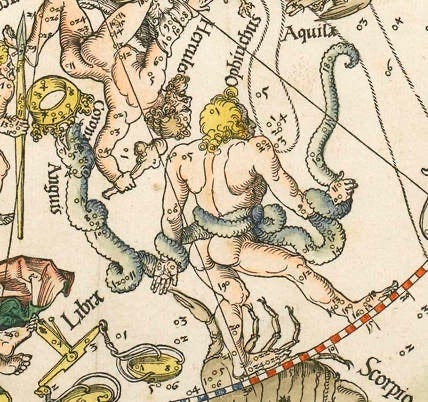
Ophiuchus stands at that question.
The serpent-bearer is not best understood as some hidden villain of the sky or as a dramatic cosmic usurper. That pushes the symbol too hard. Its real importance is quieter and more revealing. Ophiuchus is the uncounted term that shows how much elegance can depend on convention.
That makes it powerful.
Because symbolic systems do not rule only by truth. They rule by legibility. A complete circle reassures the mind. It tells people that time can be mapped, life can be sorted, and the heavens themselves can be distributed into manageable order. Even thoseThose — ProjectionThose names projection: enemies, outsiders, competitors, threats, and disowned qualities placed beyond the identity boundary.Read full entry → who do not literally believe in such systems still feel their charm. A finished wheel calms the nervous system.
Then something extra appears.
The extra is always destabilizing.
It need not overthrow the system. It does something more subtle. It reveals that the closed order was achieved partly by simplification. The visible completeness depended on leaving a remainderClosed System / Hidden TermA closed system achieves the appearance of completeness by excluding or minimizing something it cannot integrate; the excluded term remains active and returns as strain, contradiction, anomaly, backlash, or breakdown.Read full entry → in the wings. Ophiuchus is that remainder.
That does not make it superior to the twelve. It makes it diagnostic.
Its significance lies in what it teaches about all polished symbolic structures. Public order often works by drawing the most stable possible map, then forgetting it made choices in the process. The map is presented as nature itself. But the hidden term remains as evidence that selection and omission were part of the construction all along.
That is why Ophiuchus belongs to this week. It gives a sky-image to a broader human habit.
We do this in religion. Official forms become fixed and self-contained, while mystical, apocalyptic, or esoteric strands linger at the margins as reminders that the visible doctrine is not the whole symbolic field.
We do it in politics. An order describes itself as rational, settled, and complete, while its exclusions returnReturn — RemembranceReturn names remembrance and release: the loosening of possession so reflection can become transparent to source again.Read full entry → as tension, contradiction, scandal, or unrest.
We do it in personality. A person assembles a tidy self-story, stable values, a public role, a managed image, and then finds that the life he cannot narrate remains stubbornly active at the edge of his consciousness.
The hidden term remains.
This is why Ophiuchus matters more as a principle than as a piece of niche zodiac trivia. It is the emblem of managed incompleteness. Not malice, not curse, not secret superiority, but the stubborn remainder that tells you the circle is less absolute than it appears.
Its serpent-bearing image deepens this further. The serpent has long been associated with renewal, danger, medicine, forbidden knowledge, cyclical life, and powers that do not sit comfortably inside rigid public administration. A figure carrying the serpent through the sky suggests a relationship to forces that cannot be fully sterilized into tidy abstraction. That is already too much for a perfect wheel to comfortably admit.
And that is the point.
The problem with closed systems is not merely that they exclude something. It is that they train the mind to forget exclusion happened. Once that forgetfulness sets in, administration begins pretending to be ontology. The map claims to be the field.
Ophiuchus quietly breaks that spell.
It reminds us that public symbolic order may be useful without being total, elegant without being final, and meaningful without being exhaustive. That is a healthy correction in an age that keeps building systems designed less to describe reality than to make reality feel comfortably processed.
The hidden thirteenth is therefore not a new identityThis — IdentityThis names the formed identity: the body, role, image, wound, belief, or story claimed as what the self is.Read full entry → slot to aggressively inhabit. That would only repeat the problem in reverse. Its real function is to teach suspicion toward visible completeness. Whenever a circle appears too flawless, it is worth asking what it had to leave in the wings.
Sometimes the remainder is the real clue.
This Substack is reader-supported. To receive new posts and support my work, consider becoming a free or paid subscriber.