Encyclopedia Record

Closed System / Hidden Term
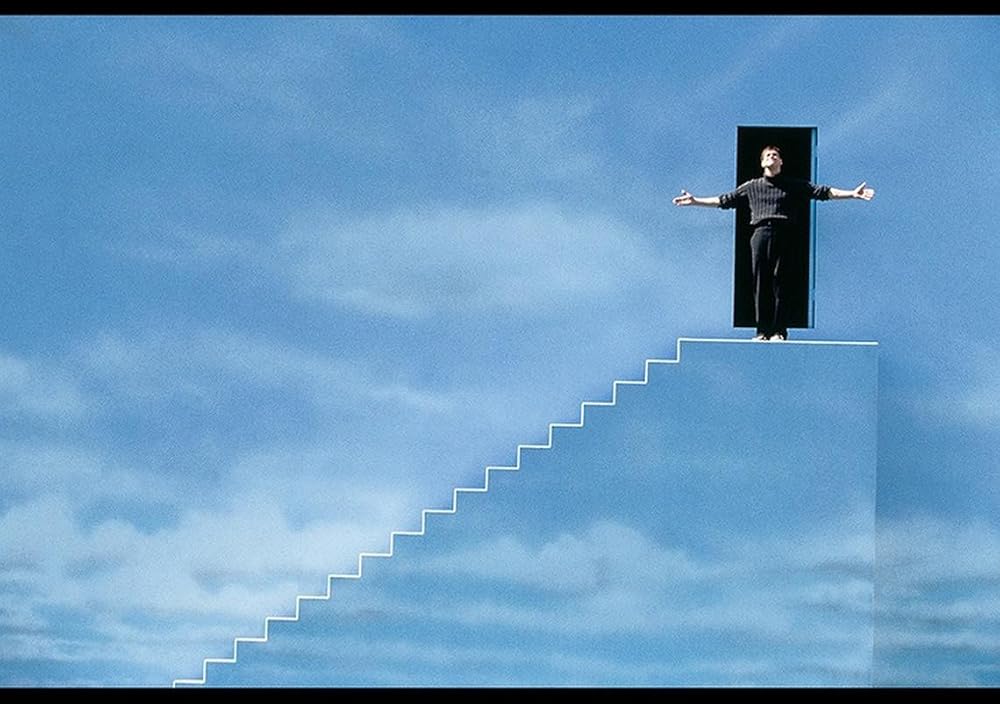
Truman Burbank at the staircase and exit door at the edge of his constructed world in The Truman Show; editorial film still used for commentary.
Mechanism statement
A closed system achieves the appearance of completeness by excluding or minimizing something it cannot integrate; the excluded term remains active and returns as strain, contradiction, anomaly, backlash, or breakdown.

Geomytha Reading

Geomytha reads the omitted remainder as a pressure point that reveals what a structure had to leave out in order to appear total.

Geomytha function

It provides a diagnostic for systems whose coherence depends on omission.

Structural movement

All This attempts closure; the hidden term exposes the limit of that closure and reopens the field toward what the system cannot contain.

Claim boundaries

The hidden term is not automatically noble or true; exclusion can concern material that is destructive, false, or simply incompatible.

Misuse warning

Do not romanticize whatever is excluded. Use the remainder diagnostically: ask what the exclusion reveals about the structure.

Applied field

Where this mechanism appears

Only explicit links already recorded by the publication engine are shown here. Conceptual resemblance alone does not create an application link.

Essays · 25

Alice and the Demonstrative World
Wonderland is not random. It only pretends to be. The body changes size. Animals talk. Time breaks. Logic loops. Queens shout. Cards become soldiers.…


The Universe Inside the Universe
One of the strangest jokes in Rick and Morty’s battery universe episode is also one of its deepest. Rick creates a civilization to power…


Why Calendars Need Remainders
A calendar is not just a way to count days. It is a claim about reality. A calendar tells a people when to work,…


Where is the Vehicle Going?
Everyone remembers the battery. Very few people remember the car. Rick and Morty’s famous battery universe episode leaves viewers with a disturbing question. What…


The Crack Is Mercy
Most people want the crack repaired. Not honored. Not studied. Not listened to. Repaired. We want the broken place sealed as quickly as possible.…


Four, Eight, Twelve, Thirteen
Geomytha has to be careful with numbers. Not because numbers are weak. Because they are powerful. A number can clarify a pattern. It can…


364 Days and the Lunar Machine
The dream is understandable. A year of 364 days possesses a remarkable beauty. Fifty-two weeks. Exactly seven days each. No fractions. No leap years.…


The Alphabet of Return
The alphabet is not the core of Geomytha. That must be said first. Geomytha does not need the alphabet to be true. The source…

Showing the 8 most recent explicitly linked essays.

Index instances · 14

364-Day Calendar — Schematic Sabbatical Year
A 364-day calendar appears in Second Temple Jewish calendrical texts and Qumran materials. Its 52 exact weeks create a highly regular schematic year.


Egyptian Epagomenal Days — Five Days Outside the 360-Day Year
The ancient Egyptian civil calendar organized twelve 30-day months and added five epagomenal days to complete a 365-day year; later traditions associated these days with divine births.


Eight Days a Week — The Beatles
“Eight Days a Week” is a Beatles song whose impossible title expresses an amount beyond the ordinary seven-day week.


Enchanted Sleep / Lotus Forgetting — Rest Motif
The Sleeping Beauty tradition features an enchanted sleep that suspends a princess and, in many versions, the surrounding household or court. In Odyssey Book IX, Odysseus' men who eat the lotus lose the desire…


Hotel California — Eagles
Hotel California is the title track of the Eagles’ 1976 album. The Recording Academy records the song as Record of the Year and a GRAMMY Hall of Fame inductee. Don Henley has described the…


Jim Henson’s A Tale of Sand
A Tale of Sand originated as an unproduced feature-length screenplay developed by Jim Henson and Jerry Juhl and was later adapted as a graphic novel. Its central figure is sent running across a surreal…


Julian Calendar
The Julian calendar was introduced under Julius Caesar and took effect in 45 BCE, regularizing the Roman civil year around a 365-day year with periodic leap-day correction.


Leap Day / February 29
The Gregorian calendar periodically inserts February 29 to keep the civil calendar aligned with the seasonal year because the tropical year is not an integer number of days.

Showing 8 explicitly linked Index instances.

Concept network

Follow the mechanism

Source trail

Evidence beneath the record

The Hidden Term — original Substack publication (2026-04-16)

Primary provenance source for the historical Geomytha publication, publication date, audience, subtitle, and version identity. It is not an independent authority for external historical claims.

Geomytha on Substack