WonderlandReferenceWonderland — Alice’s Adventures in WonderlandThe strange world Alice enters in Lewis Carroll’s Alice’s Adventures in Wonderland.Read full entry → is not random.
It only pretends to be.
The body changes size. Animals talk. Time breaks. Logic loops. Queens shout. Cards become soldiers. A trial proceeds without wisdom. Every rule seems authoritative until the next rule contradicts it.
This is usually called nonsense.
But nonsense is not the same as meaninglessness.
Wonderland is symbolic instability. It is what happens when the named world becomes strange enough to reveal its own machinery. The ordinary structures of identity — body, time, language, law, rank, judgment, personality — are loosened, exaggerated, and made ridiculous.
AliceReferenceAlice — Alice’s Adventures in WonderlandAlice, the protagonist of Lewis Carroll’s Alice’s Adventures in Wonderland.Read full entry → does not enter a world without order.
She enters a world where order has become absurd.
That is why Alice’s Adventures in WonderlandReferenceAlice’s Adventures in Wonderland — Lewis CarrollLewis Carroll’s 1865 novel Alice’s Adventures in Wonderland.Read full entry → comports so strongly with Geomytha. It shows consciousness entering the demonstrative world — the world of This, These, Those, and All This — and then returning when the whole symbolic order loses authority.
Wonderland is the dream of identity.
Alice wakes when she sees the dream is made of cards.
The Questioning I
Alice begins as I, but not yet as false sovereignty.
She is not the Queen.
She is not the ruler of Wonderland.
She is not the one shouting judgment.
She is the questioning subject: curious, bewildered, irritated, brave, confused, observant. She follows, asks, tests, argues, remembers lessons, forgets them, recites incorrectly, tries to behave properly, then slowly stops granting the dream-world final authority.
That matters.
In Geomytha, I is dangerous when it claims the field. But I can also be the function of inquiry. The one who asks. The one who notices. The one who feels something is wrong with the system.
Alice is not I enthroned.
She is I under pressure.
She is the self before it becomes a crown.
This is why she can return. She has enough I to ask questions, but not so much I that she needs to become Queen of the dream.
The White Rabbit
The first pull is urgency.
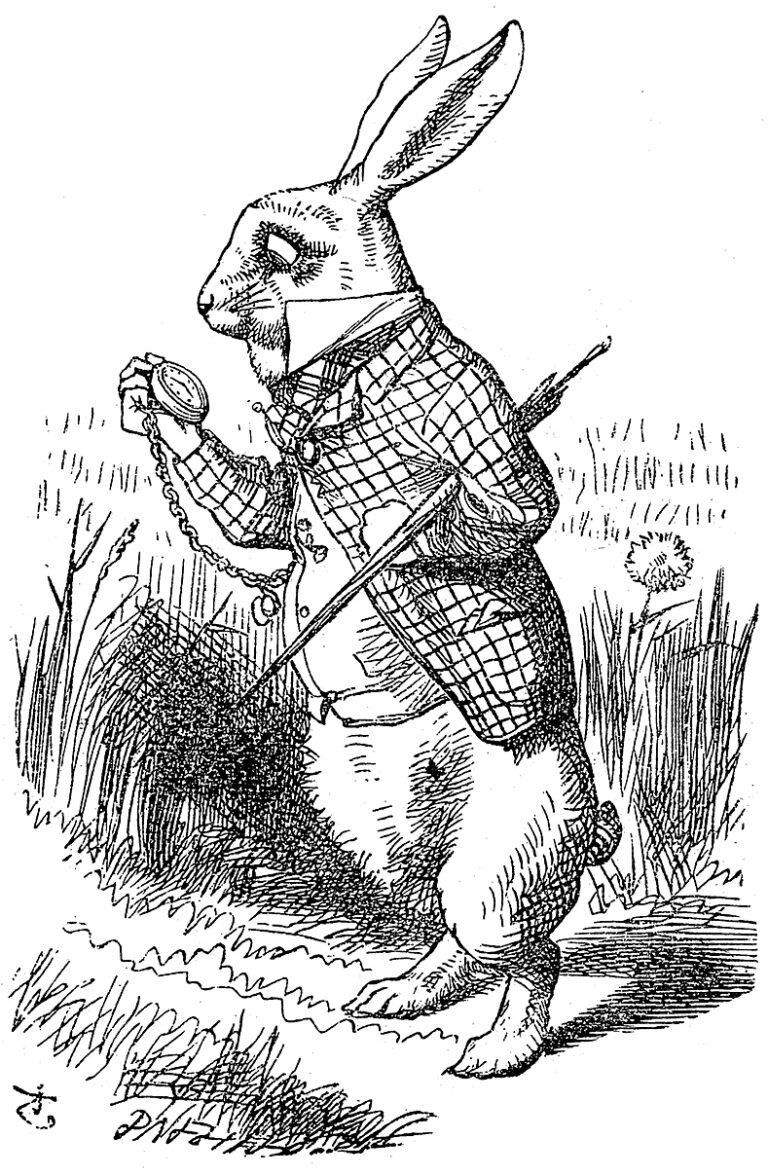
The White Rabbit runs by, worried about time. He checks his watch. He is late. His anxiety becomes magnetic.
Alice follows.
This is how many descents begin.
Not with evil.
Not with philosophy.
Not with a grand temptation.
With urgency.
A pressure appears in the field and attention obeys it. Something is late. Something must be handled. Something must be chased. Something is happening without us. The body moves before the heart has asked whether the command is real.
The Rabbit is anxious attention.
He does not explain Wonderland. He activates the descent into it.
The Rabbit hole opens when attention mistakes urgency for authority.
Down the Hole
The Rabbit hole is not only a tunnel.
It is the drop from ordinary selfhood into the machinery underneath it.
Alice falls away from the stable world of sisters, books, grass, and ordinary scale. Downward she goes into cupboards, jars, maps, shelves, labels, memories, and drifting thought. The descent is slow enough to think inside. She does not simply fall through space. She falls through association.
That is why the Rabbit hole is such a lasting image.
It names the moment consciousness leaves ordinary orientation and enters symbolic mind-world.
The fall is not chaos yet.
It is transition.
The ordinary world has lost its grip, but the new world has not yet declared its rules. Alice is between fields, suspended between the life she knows and the dream-law she is about to encounter.
This is the doorway into This.
The world is about to become intensely demonstrative:
this bottle,
this cake,
this key,
this door,
this body,
this size,
this problem,
this rule.
Wonderland begins as a room full of objects that all seem to know more than Alice does.
Drink Me, Eat Me
Then the body becomes unstable.
Alice drinks and shrinks. She eats and grows. She becomes too small for the key, too large for the room, too flooded by tears, too altered to trust her own outline.
This is one of the clearest Geomytha scenes in the story.
The false self depends on the sentence:
I am thisGEOMYTHA readingThe False-Self Sentence — I Am ThisThe false-self sentence forms when claim joins reflection to a fixed object of identity: I am this.Read full entry →.
But Wonderland makes “this” unreliable.
This body changes.
This size changes.
This relation to the room changes.
This ability to reach the door changes.
This self-image does not hold.
The body is not evil here. The body is simply no longer cooperating with identity’s demand for stability. Alice cannot use size as proof of self. She cannot say, “I know who I am because I remain the same shape.”
Wonderland begins by proving that “I am this body” is not as stable as it feels.
That is not an attack on embodiment.
It is an attack on possession.
The body is real. The claim is unstable.
“Who Are You?”
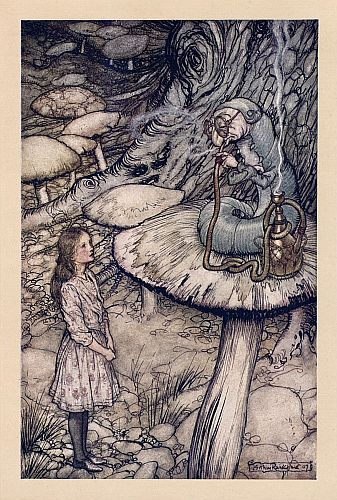
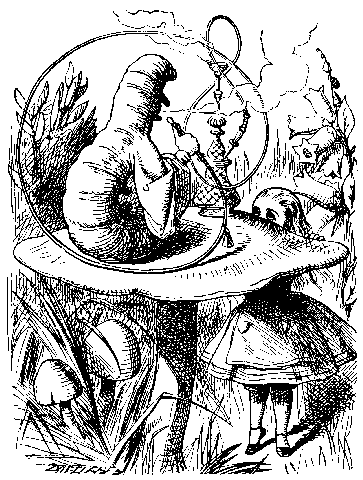
The CaterpillarReferenceThe Caterpillar — Alice’s Adventures in WonderlandIn Chapter V, “Advice from a Caterpillar,” of Lewis Carroll’s Alice’s Adventures in Wonderland, the Caterpillar asks Alice who she is.Read full entry → asks the essential question.
Not, “Where are you going?”
Not, “What do you want?”
Not, “What is your plan?”
But:
Who are you?
This is the crisis of I.
Alice cannot answer cleanly because the old identity has begun to fail. She has changed too many times. Her lessons do not come out right. Her body does not remain fixed. Her memory is uncertain. She knows she is Alice, but Wonderland has made that name insufficient.
The Caterpillar is a threshold teacher.
He is almost Hermes-like, but larval: a guide of transition, breath, metamorphosis, and strange composure. He sits in smoke and slowness while Alice is agitated by change. He does not rescue her from instability. He makes her face it.
That is what real threshold teachers do.
They do not always give identity back.
Sometimes they ask the question that reveals identity was never as solid as it pretended.
The Caterpillar does not give Alice an identity.
He destabilizes the need for one.
The Cheshire Cat
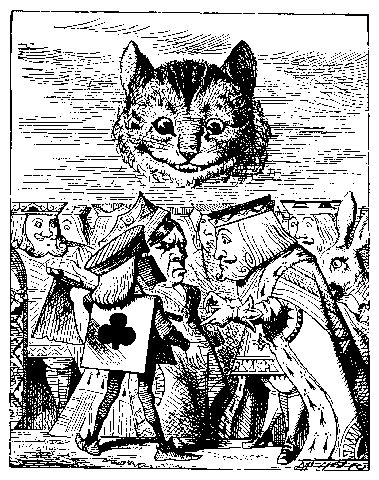
The Cheshire Cat is the grin without a stable body.
He appears and disappears. Parts of him remain after the rest has gone. The face lingers. The smile floats. Personality survives embodiment in the most unsettling way.
In Geomytha, the Cat is disembodied I.
Not evil.
Not exactly false.
But eerie because something of personhood remains after the body has become optional. The Cat is wit without weight, logic without grounding, direction without responsibility. He can tell Alice which way to go, but the answer does not really help because every direction leads deeper into madness.
That is why he is so important.
The Cheshire Cat shows what happens when intelligence becomes detached from Am.
A face without a body.
A grin without a heart.
A knowingness without a center.
He is funny because he is not fully malicious. But he is frightening because he reveals how easily the mind can keep smiling after embodiment has vanished.
The Cat is what remains when the face of I floats free of the body.
The Mad Tea Party
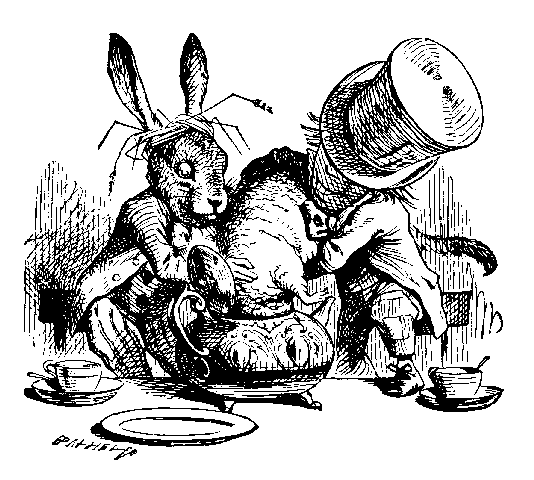
The Tea Party is broken time.
The table is set. The ritual is familiar. Tea should be domestic, orderly, social, comforting. But here the comfort has become a loop.
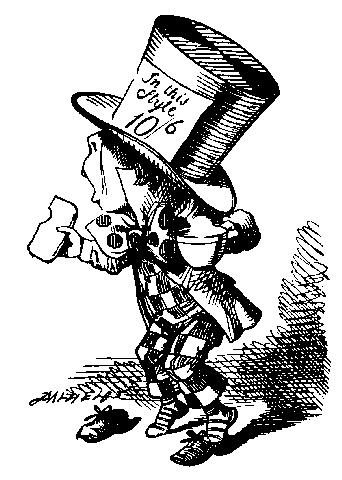
The Hatter has quarreled with Time. It is always tea-time. The party does not progress. The guests move around the table instead of returning to life. Cups change. Places change. Nothing resolves.
This is captured time in comic form.
The clock no longer opens a rhythm.
It traps the ritual in repetition.
That is why the Mad Tea Party is more than a funny scene. It is the clock after it stops returning and starts looping. A ritual meant to nourish becomes a mechanism that cannot finish itself.
Many lives contain this table.
The same argument.
The same complaint.
The same performance.
The same emotional hour.
The same unfinished conversation.
The same tea poured forever.
Time is not moving.
It is circling the wound.
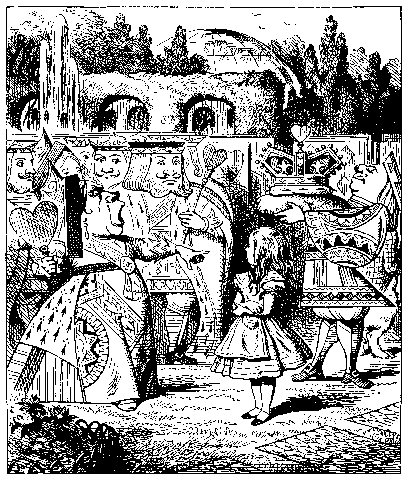
The Queen of Hearts
Then comes false sovereignty.
The Queen of Hearts is command without wisdom. Judgment without measure. Radiance as domination. Authority as noise.
“Off with their heads” is not justice. It is reflex.
That is Leo’s shadow in the story: the sovereign center that radiates power but not life. The Queen does not illumine the world. She overpowers it. Her presence forces everyone into posture. The court bends around her volatility.
In Geomytha terms, she is I wearing the crown after the heart has been forgotten.
That phrase matters because she is the Queen of Hearts.
The symbol of feeling, relation, courage, and interior truth has become a suit in a card-world. The heart has been flattened into rank and costume. Its queen rules by threat.
This is false radiance.
The center is bright with authority, but empty of source.
The Cards
The cards are artificial identities.
They have suits, ranks, numbers, faces, positions. They are persons reduced to symbolic assignment. They are not bodies in full relation. They are flat roles in a game.
That is why the card-world is so exact.
A card does not ask who it is. It is assigned. Its identity is printed. Its rank is visible. Its belonging is obvious. Its world is the deck.
This is These and Those in courtly form.
These are hearts.
Those are spades.
These are soldiers.
Those are gardeners.
This one ranks higher.
That one can be discarded.
The card-world looks orderly because every identity is legible. But legibility is not life.
A person can become a card whenever the symbolic assignment becomes more important than the living being.
Job title.
Political tribe.
Family role.
Diagnosis.
Reputation.
Follower count.
Status.
Enemy category.
Sacred label.
Printed identity is easy to arrange.
It is also easy to shuffle.
The cards are what happens when persons become positions in a game.
The Trial
The trial gathers Wonderland into one final structure.
Law, crown, court, witness, evidence, accusation, jury, sentence. Everything that has been unstable throughout the dream now tries to present itself as justice.
But the law-machine is absurd.
The rules do not clarify. The evidence does not matter. The authorities contradict themselves. The court proceeds because it has the shape of a court, not because it has the substance of truth.
This is All This.
The total symbolic environment pretending it has become reality itself.
All This always tries to complete itself through law. The dream-world wants to become official. The nonsense wants a verdict. The false sovereign wants a sentence. The cards want their printed order treated as justice.
That is the final arrogance of the dream.
It no longer says, “I am strange.”
It says, “I am law.”
The trial is Wonderland pretending its nonsense has become justice.
Nothing but a Pack of Cards
Then Alice sees.
This is the climax.
The court’s authority collapses when she recognizes what they are.
Not sovereigns.
Not ultimate judges.
Not cosmic law.
Cards.
The symbolic world depended on belief. Once Alice withdraws belief, its power fails. The Queen’s command does not need to be defeated in battle. The court does not need to be overthrown by a better court. The cards do not need to be argued into wisdom.
They need to be seen.
This is Second Death FireGEOMYTHA readingSecond Death FireSecond Death Fire is the exposing fire that burns false claim after the identity-world has reached its limit.Read full entry → in a child’s voice.
No flame appears. No apocalypse descends. No doctrine is announced. Recognition burns the false world because the false world cannot survive being recognized as false.
Return begins when Alice sees the cards as cards.
That is the whole Geomytha reading in miniature.
The false order does not lose power because Alice becomes stronger than it.
It loses power because she stops lending it reality.
The Hidden Thirteenth
Alice’s Adventures in Wonderland has twelve chapters, ending with Chapter XII, “Alice’s Evidence.”
That makes the structure especially strong.
Twelve is Wonderland.
Twelve is the dream-wheel.
Twelve is the ordered sequence of rooms, scenes, identity tests, time loops, authorities, animals, games, and courtly absurdities.
But the true return is not merely another chapter inside Wonderland.
The hidden thirteenth is waking.
That is the difference between a closed system and return.
A thirteenth room inside the dream would only extend the dream. True thirteen opens the wheel. It does not add another scene to All This. It ends the authority of All This.
Alice wakes because the symbolic order cannot hold her attention anymore.
The dream has exhausted itself.
The cards are cards.
The court is paper.
The Queen is noise.
The child returns.
What This Corrects
Wonderland is not simply chaos.
It is the demonstrative world becoming unstable enough to show its own construction.
Alice is not the false queen.
She is the questioning I learning not to believe the whole system.
The Caterpillar is not merely weird.
He is the threshold teacher asking the question identity cannot answer casually.
The Cheshire Cat is not merely comic.
He is disembodied intelligence, face without body, grin without ground.
The Mad Tea Party is not merely silly.
It is captured time.
The cards are not merely decorative.
They are artificial identities arranged into false law.
And Return is not conquest.
Alice does not defeat Wonderland by ruling it.
She wakes by seeing through it.
When the Court Is Only Cards
This is why Alice remains practical.
Everyone has a Wonderland.
Not always bright, charming, or absurd in the same way. Sometimes the private Wonderland is panic. Sometimes it is politics. Sometimes it is family drama. Sometimes it is spiritual certainty. Sometimes it is a legal court inside the head where every memory is called as evidence and every wound demands a sentence.
The questions are simple:
What urgency pulled me down the hole?
What body-story keeps changing size?
What question of identity am I avoiding?
Where has time become a Tea Party?
Who is shouting judgment without wisdom?
What cards am I mistaking for persons?
What court has authority only because I still believe it?
These questions matter because many dream-worlds survive by borrowing attention.
They do not need to be true.
They need to be believed long enough to govern feeling.
Sometimes the whole system does not need to be defeated.
It needs to be recognized.
Wake Without Hating the Dream
Wonderland is not evil.
That is important.
It is playful, unstable, comic, frightening, brilliant, cruel, beautiful, and absurd. It is a dream-world, a symbolic field, a mind-theater. The danger is not that it appears. The danger is believing it has final authority.
Alice does not need to hate Wonderland in order to leave it.
She does not need to burn every image, reject every creature, or become superior to the dream. She simply wakes from the claim.
That is Return.
Not hatred of the dream.
Freedom from obeying it.
The cards can remain cards.
The Queen can remain a memory.
The Rabbit can keep running.
The Cat can keep grinning somewhere in the branches of imagination.
But Alice no longer has to live as though the court is real.
That is lucid release.
The dream-world loses authority.
The child opens her eyes.