A radio does not become the station it receives.
It tunes.
That sounds obvious until we notice how often people do the opposite with themselves.
A mood arrives and becomes “me.” A role repeats long enough and becomes “who I am.” A taste becomes a tribe. A feed becomes a worldview. A habit becomes a personality. The receiver keeps selecting signals until the selection starts feeling like identityThis — IdentityThis names the formed identity: the body, role, image, wound, belief, or story claimed as what the self is.Read full entry →.
GEOMYTHA reads that as a problem of tuning mistaken for being.
The receiver is not the station
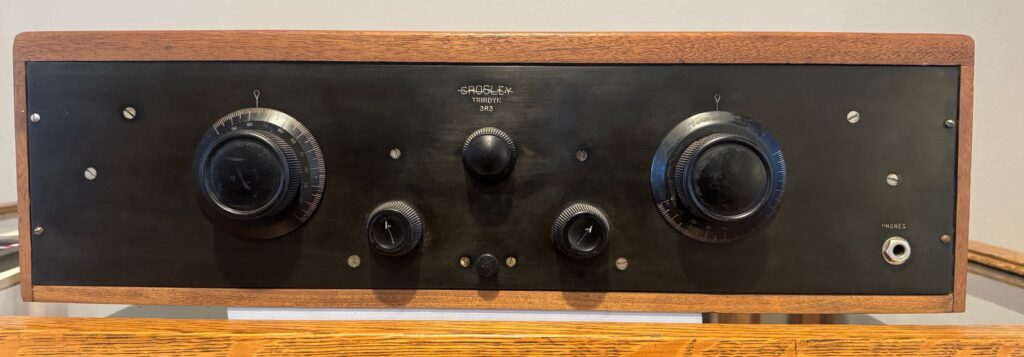
Old radio receivers make the mechanism visible because their controls are exposed. A receiver contains circuitry designed to select among available signals. Historical tuned-radio-frequency sets even included controls for selectivity so neighboring stations could be separated.
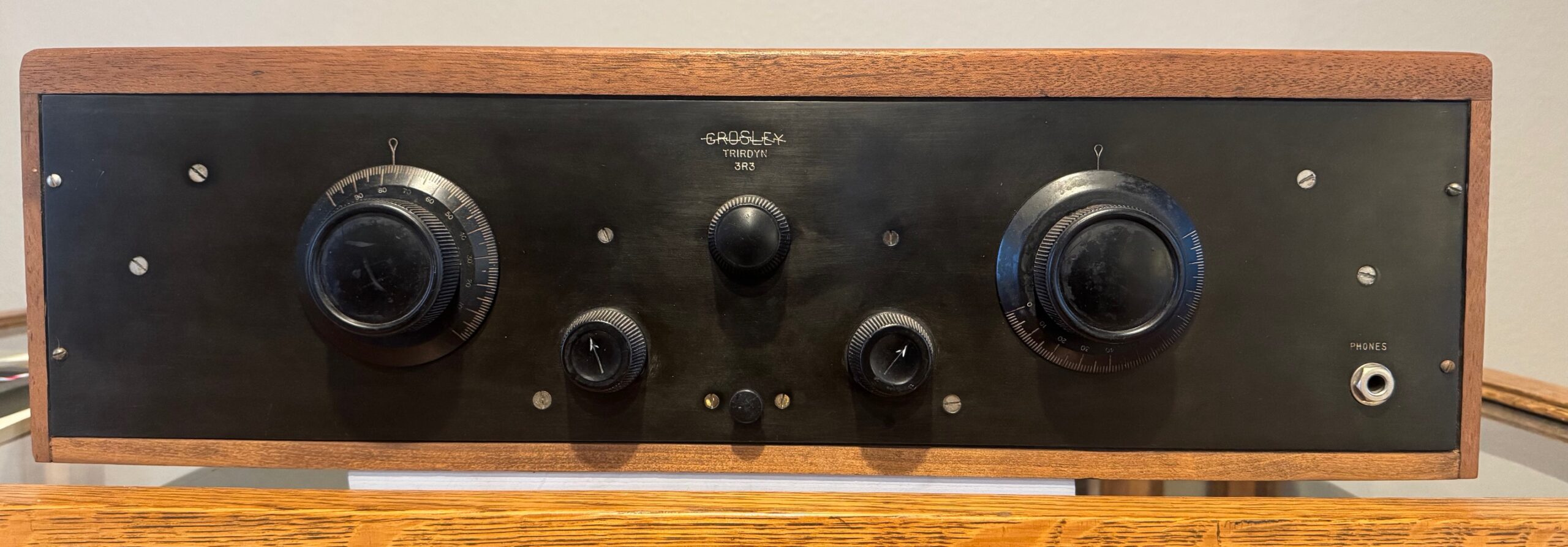
The useful action is selection.
Turn the dial and one signal becomes audible while others recede.
The mistake would be to imagine that the radio has become the station.
That is the central mechanism of this article.
Human identity often works the same way. We select, repeat, amplify, and stabilize certain patterns until the selected pattern feels like the whole field.
Field, receiver, tuner, station
The GEOMYTHA comparison can be kept simple:
Field: many possible signals are available.
Receiver: something can register what is present.
Tuner: attention selects among possibilities.
Station: a selected pattern becomes recognizable and repeatable.
The sequence is useful because none of theseThese — AccumulationThese names accumulation: possessions, titles, achievements, beliefs, communities, and other extensions gathered around identity.Read full entry → parts is bad.
A field with no selection gives you noise.
A tuner that cannot select gives you no usable signal.
A station that cannot hold a frequency cannot be recognized.
Identity works for the same reason. We need enough continuity to answer a name, keep a promise, learn a craft, raise a child, hold a job, or returnReturn — RemembranceReturn names remembrance and release: the loosening of possession so reflection can become transparent to source again.Read full entry → to a relationship tomorrow.
The distortion begins when continuity is mistaken for totality.
Radio heart, radio head
The phrases Radiohead and iHeartRadio create a useful piece of wordplay for GEOMYTHA. The comparison is symbolic, not etymological and not a claimI — ClaimI names claim: the interruption by which reflected presence is taken as mine.Read full entry → about either brand’s intended meaning.
Within the GEOMYTHA reading, the heart can stand for reception in living relation: being affected, receiving, feeling, resonating.
The head can stand for selection: naming, comparing, scanning, choosing, organizing.
Both functions are necessary.
The heart without discrimination can be overwhelmed.
The head without reception can become a machine selecting among its own categories.
The problem is not receiving and not tuning.
The problem is forgetting that the station is selected.
Personality as prolonged tuning
Imagine that every morning you turn to the same station.
At first it is preference.
Then routine.
Then familiarity.
Then expectation.
Eventually another station sounds wrong simply because it is not the one you usually hear.
Personality can form this way.
You become the funny one.
The angry one.
The responsible one.
The fighter.
The spiritual one.
The skeptic.
The victim.
The expert.
Each may describe something real. But repetition changes a description into a preset.
Then the preset begins filtering what can be received.
The person does not only express the identity. The identity starts deciding what counts as evidence.
The station called “me”
This is where identity becomes self-confirming.
If I am “the one nobody respects,” I notice every slight faster than every gesture of respect.
If I am “the competent one,” mistakes become threats to the station.
If I am “the outsider,” belonging can feel suspicious.
If I am “the strong one,” receiving help can sound like static.
The station does not merely describe experience anymore.
It edits experience.
That is the GEOMYTHA move from tuning into identity: the selected signal begins acting as though it is the field itself.
Modern platforms make the metaphor literal again
Digital audio platforms are built around selection. iHeartRadio, for example, offers live stations, artist-based stations, favorites, podcasts, and personalized listening across many devices. The user moves through a field of possible signals and selects what becomes audible.
Social feeds perform a similar action visually and socially. Follow, mute, like, replay, skip, block, subscribe.
Each action tunes the field.
Again, tuning is not the problem. Selection is necessary.
The question is whether the person still knows they are selecting.
Once the chosen stream feels like “the world,” the tuner has disappeared from view.
Boredom is not automatically presence
There is an easy mistake here.
If restless tuning can become compulsive, we might romanticize boredom and say that doing nothing automatically returns us to presence.
It does not.
Boredom can be openness.
It can also be fatigue, withdrawal, frustration, under-stimulation, avoidance, or depression.
Likewise, novelty is not automatically fragmentationDismemberment / FragmentationDismemberment names the symbolic breaking of a previously integrated reflection into separate parts, roles, objects, or powers.Read full entry →. Scanning can be useful. Curiosity can open a closed systemClosed System / Hidden TermA closed system achieves the appearance of completeness by excluding or minimizing something it cannot integrate; the excluded term remains active and returns as strain, contradiction, anomaly, backlash, or breakdown.Read full entry →. Changing the station can be exactly what is needed.
The stress test is therefore not “stillness good, stimulation bad.”
It is simpler:
Can you tune without becoming the station?
Rock and roll
GEOMYTHA sometimes uses rock and roll as another symbolic pair.
Rock suggests enough stability for a signal to hold.
Roll suggests movement, scanning, transition, retuning.
Neither function is complete by itself.
Only rock becomes rigidity.
Only roll becomes endless switching.
A living system needs both the ability to stabilize and the ability to move.
The same is true of identity.
The practical return
You do not need to erase your personality.
You do not need to become nobody.
You do not need to stop preferring certain music, people, roles, beliefs, or ways of living.
The useful move is simply to remember the difference between the receiver and the station.
When a familiar reaction appears, ask:
Is this what is here?
Or is this what I am tuned to hear?
When a role feels absolute, ask:
Is this a function I am carrying?
Or have I started calling the function my whole self?
When the signal changes, notice whether you can change with it.
Tune. Listen. Use the station. Do not mistake it for the whole field.
Sources and further reading
- Smithsonian National Museum of American History, Day-Fan Type TRF Radio Receiver — historical receiver with coupled tuning controls and a selectivity knob.
- iHeartRadio, “Welcome to iHeartRadio” — official description of live radio, stations, podcasts, and on-demand listening.
- Crosley 3R3 receiver image, Wikimedia Commons — CC0 image used in this article.
GEOMYTHA interpretation is symbolic and comparative. The technical and platform sources establish how radio receivers and listening platforms work; they do not establish the GEOMYTHA framework or imply that Radiohead or iHeartRadio intended these symbolic correspondences.