On August 29, 1966, the Beatles walked onto a stage at Candlestick Park in San Francisco. It would be their last ticketed concert together. [1]
They did not stop being musicians. They did not stop being the Beatles. Nobody in the band died that night.
But one version of the Beatles came to an end.
For years, crowds had met the band as four familiar young men in a familiar public role. People came to see the same stars, hear the hits, and participate in the excitement of Beatlemania. Even as the songs grew more adventurous, a touring performance came with limits: what could be heard, what could be played live, and what people expected to see.
Ringo Starr later recalled that audiences were no longer really listening at the shows and that the band was not playing as well as it wanted to. He said he had joined because they were great musicians, not because he wanted to spend his life on a pedestal. [2]
The musicians continued.
The old performance no longer had to.
This is what we mean here by the deliberately provocative title: the Beatles who “died” in 1966 were a public form, not four living people.
The role that used to fit
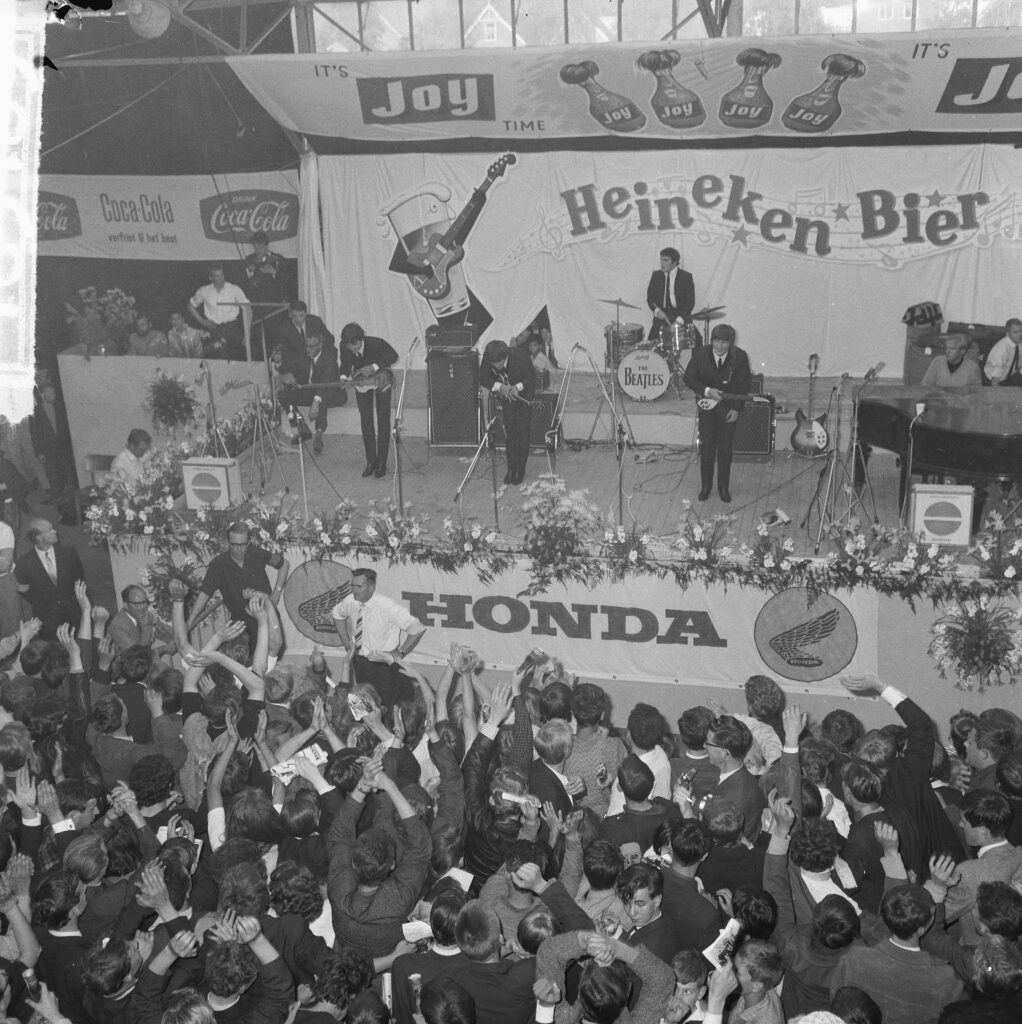
Look at the archival photograph above. The Beatles are onstage in Blokker, Netherlands, on June 7, 1964. The crowd is pressed toward the musicians. The performance is a public event, not a private conversation.
The photograph shows what a public role asks of performers: four recognizable musicians onstage, an audience waiting for them, and a room organized around a familiar kind of excitement. The scene is genuine. So is the music from that period.
There is nothing wrong with a recognizable style.
But a style can begin as a way to make something and end as a demand about what must always be made.
A performer learns which expression gets applause. A worker learns which personality gets promoted. A family learns which member is always the reliable one.
At first, the role works.
Then people stop asking what the person can do and start asking the person to repeat the role.
The helpful one must always help.
The funny one must always entertain.
The band that brought everyone joy must never disturb the picture people have of it.
A useful form begins to feel like a permanent assignment.
The experiment was already underway
We have to be precise about the history.
Leaving the stage did not suddenly invent the Beatles' musical imagination.
They began recording Revolver on April 6, 1966, months before their final ticketed concert. One of the first sessions was for Tomorrow Never Knows, which used tape loops, manipulated vocals, and approaches that could not simply be duplicated by four musicians on a stage with their usual live equipment. [3][4]
Those experiments were already happening while the band was still touring.
This matters because a neat story is tempting: they stopped being one thing and instantly became enlightened creators.
The chronology will not support that.
What changed after touring stopped was the balance of their work. The studio could become a principal place of creation rather than a place to prepare records that a touring band would need to perform.
Their official Revolver history describes more time in the studio and the experimentation it allowed. [5]
The distinction is between the beginning of a creative movement and the removal of a constraint on it.
The new music was not born from a magical funeral.
It had room to keep moving.
An imaginary band
On June 1, 1967, the Beatles released Sgt. Pepper's Lonely Hearts Club Band.
Paul McCartney later described the original idea in the band's official album history: he suggested that they step away from themselves by becoming an imaginary alter-ego band. [6]
That is an unusual answer to a problem of identity.
When the public knows you too well, you can become trapped inside the public's version of you.
The way out may be to act.
Pretend you are someone else.
Take a new name.
Try a voice that does not have to match the usual image.
At the start of Sgt. Pepper, the imaginary group introduces itself. The introduction leads to With a Little Help from My Friends, sung by Ringo Starr in the role of Billy Shears. [7]
The role is visible as a role.
Nobody needs to conclude that Billy Shears secretly took Ringo's place.
That is the important contrast with the separate false “Paul is dead” story.
The rumor imagines that a hidden substitute deceived the audience.
The album invites the audience to join a disclosed performance.
A mask can conceal.
A mask can also make room to play.
A mask is not the whole face
GEOMYTHA draws a difference between using an identity and being owned by it.
We can describe the movement in four terms:
Is → Am → I → This.
Is names what is present before the story about it becomes a possession.
Am names presence reflected in activity, relationship, sound, and image.
I is the claimant: “I am this person. I am this role. I must remain this.”
This is the hardened identity, the fixed picture that now tells every experience what it is allowed to mean.
A job title is not automatically a problem.
A name is not a problem.
A costume is not a problem.
The trouble begins when the role stops serving life and starts requiring life to serve the role.
For the Beatles, the early public image could still be remembered and enjoyed. They did not have to renounce every earlier song or pretend that Beatlemania had never happened.
They could stop asking each new recording to confirm that old image.
In the GEOMYTHA comparison, a role becomes healthier when it is used deliberately and can also be put down.
That is not the same as destroying the self.
It is allowing one form to end without making that ending a death sentence for everything that continues.
What remained alive
Now turn from the stage in the 1964 photograph to what the group was making for listeners in 1967.
We no longer need to see four men standing before an audience to recognize the Beatles. On Sgt. Pepper, the band puts a fictional group between itself and the listener. The familiar musicians are still there. They have not been replaced. What changes is the form in which their work can appear.
New studio methods let them assemble sounds that could not simply be reproduced by four musicians repeating the old stage act. That change had already begun during Revolver; stopping tours gave it more room, not its first spark.
Does that mean they became completely free of public identity? No. They still worked inside a record industry, with commercial pressures, relationships, creative differences, and limits of their own.
The new imaginary group could itself become a brand audiences wanted repeated. A new mask can become another prison.
That is why the contrast matters. One real photograph shows the old live role doing its work; the later recordings document a different creative possibility. Neither a photograph nor a record tells us everything about the lives of the people who made the music.
The hard test: did the new freedom really come from leaving the stage?
There is a strong objection to this interpretation.
The Beatles' change can be explained without a symbolic death at all.
Recording technology had changed. The group had already developed more ambitious musical interests. Concert sound was limited, and the conditions of touring were difficult. The group was maturing, working with producer George Martin and studio engineers, and operating inside a rapidly changing musical culture. [2][3][5]
Those are real historical mechanisms.
They should not be replaced with a claim that the musicians underwent an initiation, killed an ego, or secretly acted out GEOMYTHA.
Nor should we exaggerate the alter-ego idea.
The Sgt. Pepper framing is especially clear in its opening, Billy Shears introduction, and reprise. It does not mean every song on the album is sung from a single consistent fictional viewpoint.
It is also possible to put on a new persona and become more attached to it than to the old one.
A celebrity can change clothes and still need constant admiration.
A worker can leave one job and build a new identity around being the person who escaped.
A person can stop playing the dutiful child and become permanently invested in being the rebel.
Changing the costume does not itself settle anything.
The question is whether the new form can still be used, questioned, and set aside.
If it cannot, the old demand has only moved.
Return is not going backward
This brings us to GEOMYTHA's word Return.
Return does not mean restoring the early-1960s Beatles.
That would be regression: asking life to go back into a form that has already been lived.
Return means recognizing what the form was serving.
The music mattered more than a fixed photograph of the musicians.
The activity mattered more than the public demand to remain unchanged.
The performers could use an imaginary band as a new vessel for expression, without that vessel having to become a permanent description of their being.
This is a GEOMYTHA analogy, not a claim about private spiritual experiences the Beatles never documented.
The historical facts concern a career transition and changing methods of making music.
The symbolic question concerns our relationship to the roles we play.
Let a role do its work
You may not be a world-famous musician.
But you probably carry a role somebody expects you to maintain.
Maybe you are the responsible one at work.
Maybe you are the strong one at home.
Maybe you are the person who always knows the answer.
Try this distinction.
You do not have to stop helping, working, or making decisions.
You do not even have to stop using the familiar name.
Ask whether you can perform the role without needing it to settle who you are.
Can you be reliable and still ask for help?
Can you be confident and still learn?
Can you make something new without having to announce a new permanent identity?
The Beatles did not have to vanish to make a different record.
A touring form ended. The musicians kept working.
Sometimes the thing that needs to die is only the demand to keep performing yesterday.
Remember what the role was for.
Then let it become a role again.
Sources and image credits
1. The Beatles, “The last ticketed Beatles concert at Candlestick Park.” Official archive confirms August 29, 1966, as their final ticketed concert. It does not mean they never performed publicly again: their rooftop performance followed in 1969.
2. The Beatles, Anthology, section “The End of Touring.” Ringo Starr and Paul McCartney recollections about performing, audiences, and the final concert.
3. The Beatles, Revolver special-edition production history. Recording began April 6, 1966, with experimental studio work already underway before the final tour.
4. The Beatles, official Tomorrow Never Knows song entry. Original studio methods and creative process.
5. The Beatles, official Revolver album history. Studio time and the band's final live-touring calendar.
6. The Beatles, official Sgt. Pepper's Lonely Hearts Club Band album history. Release date June 1, 1967; McCartney's own alter-ego-band explanation.
7. The Beatles, official With a Little Help from My Friends entry. Ringo's vocal performance and the fictional Billy Shears role.
8. Featured historical photograph: Jack de Nijs / Anefo, Dutch National Archives, The Beatles performing at Blokker, June 7, 1964, negative 916-5169. Original archival scene, uncropped, CC0 1.0 Universal. Shown at responsive size in the featured-image position.
Editorial boundary: “Death” in the title is metaphorical. The Beatles were alive in 1966. The GEOMYTHA model is a comparison about identity and creative expression, not a documented intention of the musicians or a historical mechanism behind their albums.